

Executive Overview
As humanity stands on the precipice of a new era in interplanetary exploration, the mechanical heartbeats of our future deep-space vehicles are being rigorously tested in the swamplands of Mississippi. In a decisive step forward for the agency’s ambitious human spaceflight roadmap, NASA has successfully completed yet another high-power developmental engine test for the Space Launch System (SLS). This critical milestone directly supports the ongoing development of the Artemis campaign—an international endeavor designed not merely to return humanity to the lunar surface, but to establish a sustainable, long-term infrastructure that will ultimately serve as the launching pad for the first crewed missions to Mars.
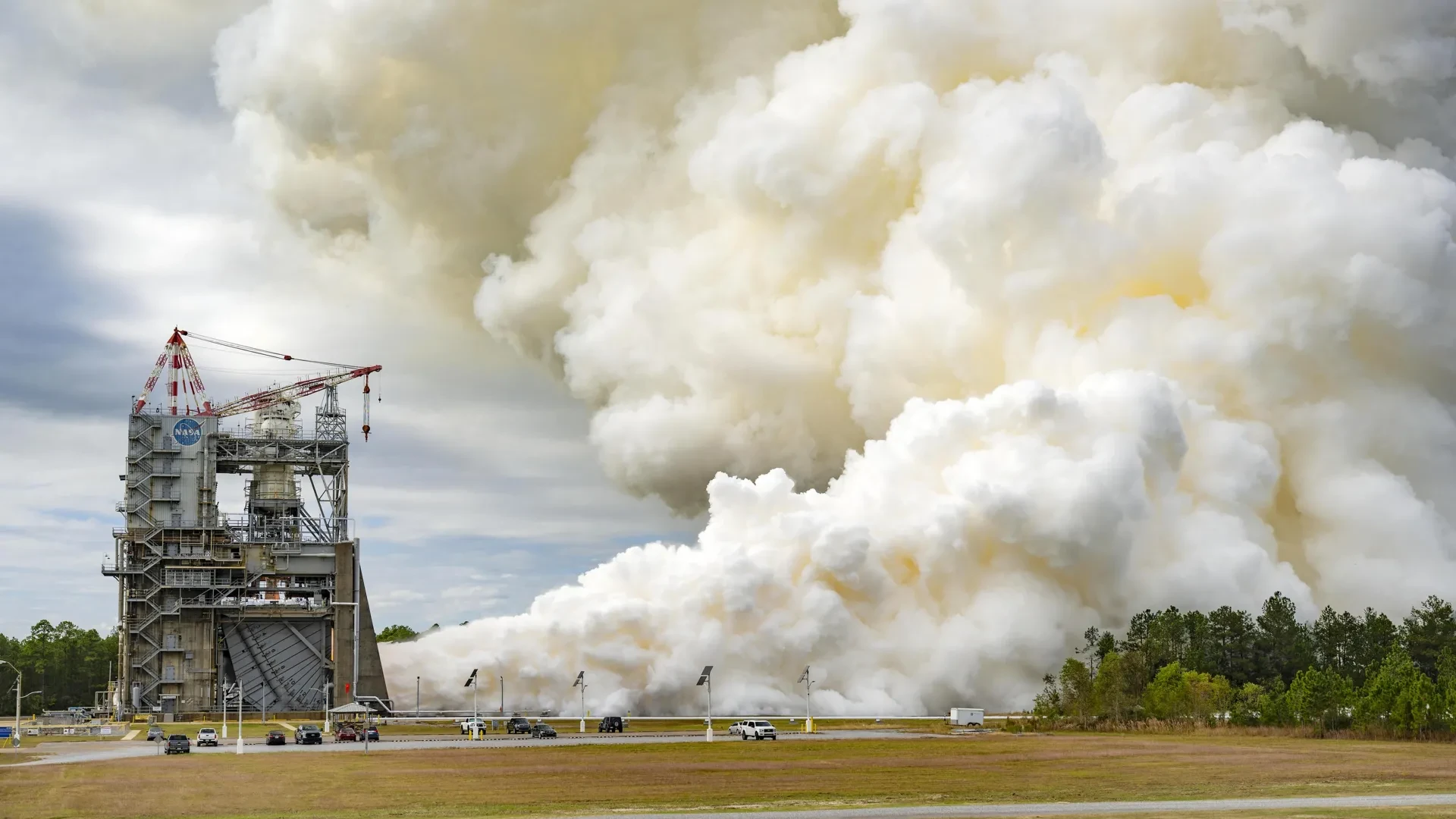
Conducted on November 18 at the legendary Fred Haise Test Stand at NASA’s Stennis Space Center near Bay St. Louis, Mississippi, the latest static-fire test targeted RS-25 developmental engine No. 10001. While this specific piece of hardware is slated for ground evaluation rather than flight, the data harvested during its operation is of inestimable value. Engineers and propulsion specialists scrutinized every telemetry stream as the engine roared to life, running for its full scheduled duration of three minutes and 20 seconds (200 seconds).
The successful completion of this test validates analytical models and provides NASA, alongside its primary engine contractor L3Harris Technologies and aerospace partner Nova Space Solutions, with granular performance data. This information is vital for refining the power, operational efficiency, and structural reliability of subsequent RS-25 engine batches destined for upcoming Artemis flights, specifically targeting the complex architecture of Artemis IV and beyond.
By systematically pushing these legendary engines—originally derived from the historic Space Shuttle Main Engine (SSME) program—to their absolute limits in a controlled terrestrial environment, NASA continues to mitigate the immense risks inherent in heavy-lift rocketry. This comprehensive investigative report explores the technological mechanics of the recent test, the timeline and strategic goals of the Artemis IV mission, the elite industrial partnerships powering the SLS program, and the overarching vision that connects the lunar South Pole to the reddish dust of Mars.
Detailed Chronology of the November 18 Test
The intricate choreography required to test a multi-million-pound-class rocket engine begins weeks before ignition. The Fred Haise Test Stand—named after the Apollo 13 lunar module pilot—is a towering, industrial concrete monolith uniquely suited to withstand the deafening acoustics, cryogenic temperatures, and searing thermal energies produced by the RS-25 engine.
Pre-Test Preparations and Countdown Sequence
In the days leading up to November 18, teams of instrumentation technicians, propulsion engineers, and safety officers meticulously prepared engine No. 10001. Every square inch of the engine’s plumbing, turbopumps, and avionics suite underwent non-destructive evaluation, leak checks, and electrical continuity tests.
On the morning of the test, the Stennis control room hummed with focused intensity. Cryogenic propellants—super-chilled liquid hydrogen ($textLH_2$) at roughly minus 423 degrees Fahrenheit and liquid oxygen ($textLOX$) at minus 297 degrees Fahrenheit—began flooding the massive propellant storage vessels and feeding lines connected to the test stand. Thermal conditioning of the engine’s high-pressure turbopumps is a critical phase; the components must be chilled down uniformly to prevent catastrophic thermal shock when the cryogenic fluids are introduced at high velocities during startup.
By mid-morning, the automated ground launch sequencer assumed control of the terminal countdown. In the final seconds, purge systems cleared residual gases, and the electronic ignition sequence was armed.
The Ignition and 200-Second Burn
At precisely the scheduled moment, engine No. 10001 roared to life. The startup sequence of an RS-25 is a masterclass in aerospace engineering precision. Within milliseconds, the dual preburners ignited, spinning up the high-pressure fuel and oxidizer turbopumps to tens of thousands of revolutions per minute. The main combustion chamber pressure rapidly climbed to thousands of pounds per square inch, forcing a blinding, supersonic diamond shockwave of superheated exhaust gases downward into the flame trench of the test stand.
For exactly 200 seconds (three minutes and 20 seconds), the engine sustained its developmental burn profile. During this window, the test article experienced operational environments that simulate the intense vibrational loads, thermal gradients, and fluid dynamics encountered during an actual flight profile.
- Thrust and Performance Vector: Although run at a developmental power level suited for the specific objectives of test article No. 10001, the RS-25 architecture is fundamentally designed to throttle dynamically between 85% and 111% of its rated power level, adapting to the changing aerodynamic pressures experienced by the SLS rocket as it punches through the atmosphere.
- Data Acquisition: Throughout the 200-second duration, hundreds of specialized sensors embedded across the engine body recorded gigabytes of high-frequency data. Strain gauges monitored metal fatigue, acoustic sensors listened for combustion anomalies, and pressure transducers tracked fluid dynamics within the turbopumps.
As the countdown clock hit zero, the automated shutdown sequence gracefully cut the propellant valves, and the roaring thunder subsided into a lingering haze of water vapor and ambient steam. The test was an unqualified success, yielding clean telemetry and confirming the structural integrity of the engine’s upgraded components.
Supporting Context & Metrics: The Anatomy of the RS-25 and SLS
To fully appreciate the significance of the Stennis test, one must examine the staggering scale of the Space Launch System and the engineering pedigree of the RS-25 engines that propel it off the pad at NASA’s Kennedy Space Center in Florida.
The Powerhouse of the SLS Core Stage
The Space Launch System is the world’s most powerful operational rocket, engineered specifically to carry heavy payloads, the Orion spacecraft, and human crews beyond Low Earth Orbit (LEO) and toward the Moon. The rocket’s massive core stage relies on a quartet of RS-25 engines mounted at its base.
Working in tandem with twin solid rocket boosters, these four engines generate an astonishing 2 million pounds of combined thrust at liftoff. This immense power is necessary to overcome Earth’s gravity well and accelerate the massive stack to orbital velocities.
Evolution from Shuttle Heritage to Deep Space Workhorse
The RS-25 is not a newly designed clean-sheet engine; rather, it is a direct evolution of the Space Shuttle Main Engine (SSME), widely regarded as one of the most reliable and sophisticated liquid-propellant rocket engines ever flown. However, adapting the SSME for the SLS required significant modifications:
- Increased Thrust Demand: While shuttle engines typically operated at 100% to 104% of their rated power level, the SLS core stage requires the RS-25 engines to operate at 109% power throughout the first stage ascent to maximize payload capacity.
- Advanced Controller Technology: Modern flight controllers—the "brains" of the engine—were developed to provide enhanced communication, fault detection, and automated throttling capabilities.
- Cost and Manufacturing Reductions: Through partnerships with prime contractors like L3Harris Technologies (via Aerojet Rocketdyne), manufacturing techniques have been updated. Modern additive manufacturing (3D printing), advanced casting methods, and streamlined welding processes have drastically reduced the per-engine cost and production timeline while increasing reliability.
The Testing Imperative at Stennis Space Center
No RS-25 engine is ever cleared for flight without first proving itself on the test stands at Stennis Space Center. The facility houses some of the largest test stands in the world, capable of handling the colossal loads and vibration frequencies generated by mega-class rocket engines.
The rationale behind these rigorous ground tests is straightforward: spaceflight offers zero margin for error. By subjecting development and flight-ready engines to conditions that mimic or exceed actual flight profiles, engineers can uncover subtle design flaws, validate manufacturing upgrades, and ensure that every component performs flawlessly when lives are on the line.
Official Statements and Industry Collaboration
The success of the November 18 test is a testament to the collaborative framework uniting NASA civil servants, major defense and aerospace contractors, and specialized engineering firms. This public-private partnership is the cornerstone of the modern aerospace industrial base.
Leadership Perspectives
Speaking on the strategic value of the ongoing testing campaign, NASA propulsion officials emphasized that ground testing is the unsung hero of crewed spaceflight missions.
"Every time we ignite an RS-25 engine on the test stand at Stennis, we are writing another line of insurance for the Artemis astronauts who will ride atop the Space Launch System," noted a senior propulsion program manager during a post-test technical briefing. "Developmental engines like No. 10001 give our engineers the operational freedom to test new manufacturing techniques, push performance boundaries, and collect vital data without risking flight hardware. The insights gained from this 200-second burn directly feed into the reliability and safety margins required for Artemis IV and the long-term exploration architecture."
L3Harris Technologies, which oversees the production and testing of the RS-25 engines, highlighted the seamless synergy between corporate engineering teams and NASA field centers. Representatives underscored that transitioning from legacy manufacturing methods to modern, efficient production lines requires relentless verification through ground testing.
"The data collected from the Fred Haise Test Stand validates our predictive engineering models," stated an L3Harris lead propulsion engineer. "We are continually refining how these engines handle extreme cryogenic temperatures, hyper-fast turbopump rotations, and immense combustion pressures. This test brings us one step closer to finalizing the engine configurations for future Artemis flights."
The Collaborative Ecosystem
The success at Stennis is shared among a triad of key entities:
- NASA (National Aeronautics and Space Administration): Provides overarching mission architecture, safety oversight, technical governance, and operational management of the Stennis Space Center test facilities.
- L3Harris Technologies: Serves as the primary contractor responsible for the design, manufacture, assembly, and lifecycle support of the RS-25 engine fleet.
- Nova Space Solutions: Collaborates closely with propulsion specialists to provide specialized instrumentation, data acquisition support, and engineering analysis services that ensure telemetry integrity during high-stress static fire events.
This multidisciplinary coalition ensures that every structural weld, every turbine blade, and every software algorithm meets the uncompromising standards of human-rated spaceflight.
Future Outlook: From Artemis IV to the Red Planet
The telemetry and physical insights gathered from engine No. 10001 do not exist in a vacuum; they are immediate building blocks for the unfolding Artemis roadmap, which stretches well into the 2030s and beyond.
Setting Sights on Artemis IV (2028)
While NASA prepares for near-term flights in the Artemis sequence, the agency has its strategic gaze firmly fixed on Artemis IV, a mission officially scheduled for 2028.
- Mission Profile: Artemis IV will launch from NASA’s historic Kennedy Space Center in Florida. Utilizing the immense power of the Space Launch System, the mission will loft a crew of astronauts aboard the Orion spacecraft toward the lunar vicinity.
- The Lunar South Pole Objective: Unlike the equatorial landing sites of the Apollo era, Artemis missions are targeting the Moon’s South Pole. This region is of immense scientific and practical interest because its permanently shadowed craters harbor vast reserves of water ice. This ice can potentially be harvested and converted into drinking water, breathable oxygen, and—crucially—liquid hydrogen and liquid oxygen rocket propellant, effectively turning the Moon into a fueling station for deep space voyages.
- Sustained Human Presence: Artemis IV is designed to advance the establishment of sustained surface infrastructure, including habitation modules, power grids, and mobility systems, paving the way for a permanent human foothold on another celestial body.
The Ultimate Horizon: Human Exploration of Mars
The Moon is not the final destination of the Artemis program; it is the ultimate proving ground. The logistical, psychological, and technological challenges of living and working on the lunar surface—at a distance of roughly 240,000 miles from Earth—will provide NASA and its international partners with the operational experience required for the ultimate voyage: the first crewed mission to Mars.
A journey to the Red Planet will span multiple years, demanding closed-loop life support systems, radiation shielding, autonomous repair capabilities, and heavy-lift propulsion systems capable of transporting massive hab-units, descent vehicles, and return stages. The lessons learned from developing, testing, and flying the RS-25 engines form the foundational DNA of this capability. Every second that engine No. 10001 burned on the test stand in Mississippi represents a brick laid in the bridge to another world.
As the smoke clears over the Stennis Space Center and engineers begin combing through the terabytes of performance data, one truth remains abundantly clear: the pathway to Mars is forged through meticulous preparation, unyielding technical rigor, and the indomitable human drive to explore the unknown. Through each successful static fire, NASA moves closer to turning the science fiction of interplanetary civilization into the empirical reality of tomorrow.
