

EXECUTIVE OVERVIEW
Deep within the luminous, chaotic heart of our galaxy lies Sagittarius A (Sgr A), the Milky Way’s resident supermassive black hole. For decades, this gravitational behemoth—tipping the cosmic scales at approximately four million times the mass of our Sun—has captivated astronomers. Yet, despite its immense mass, Sgr A* cuts a remarkably restrained figure compared to the blazing, hyper-luminous active galactic nuclei found at the centers of more distant galaxies. It exists in a state of chronic, low-level starvation, feasting only intermittently on the sparse matter drifting through its immediate vicinity.
For over twenty years, researchers have tracked a series of enigmatic, compact gas clouds threading their way through the extreme gravitational environment surrounding the black hole. These mysterious "clumps" of ionized hydrogen and helium, observed sliding along elongated orbits, have long served as cosmic breadcrumbs. Astronomers suspected they held the key to understanding how matter manages to plunge inward toward the event horizon, but their precise point of origin and mechanics of formation remained stubbornly elusive.
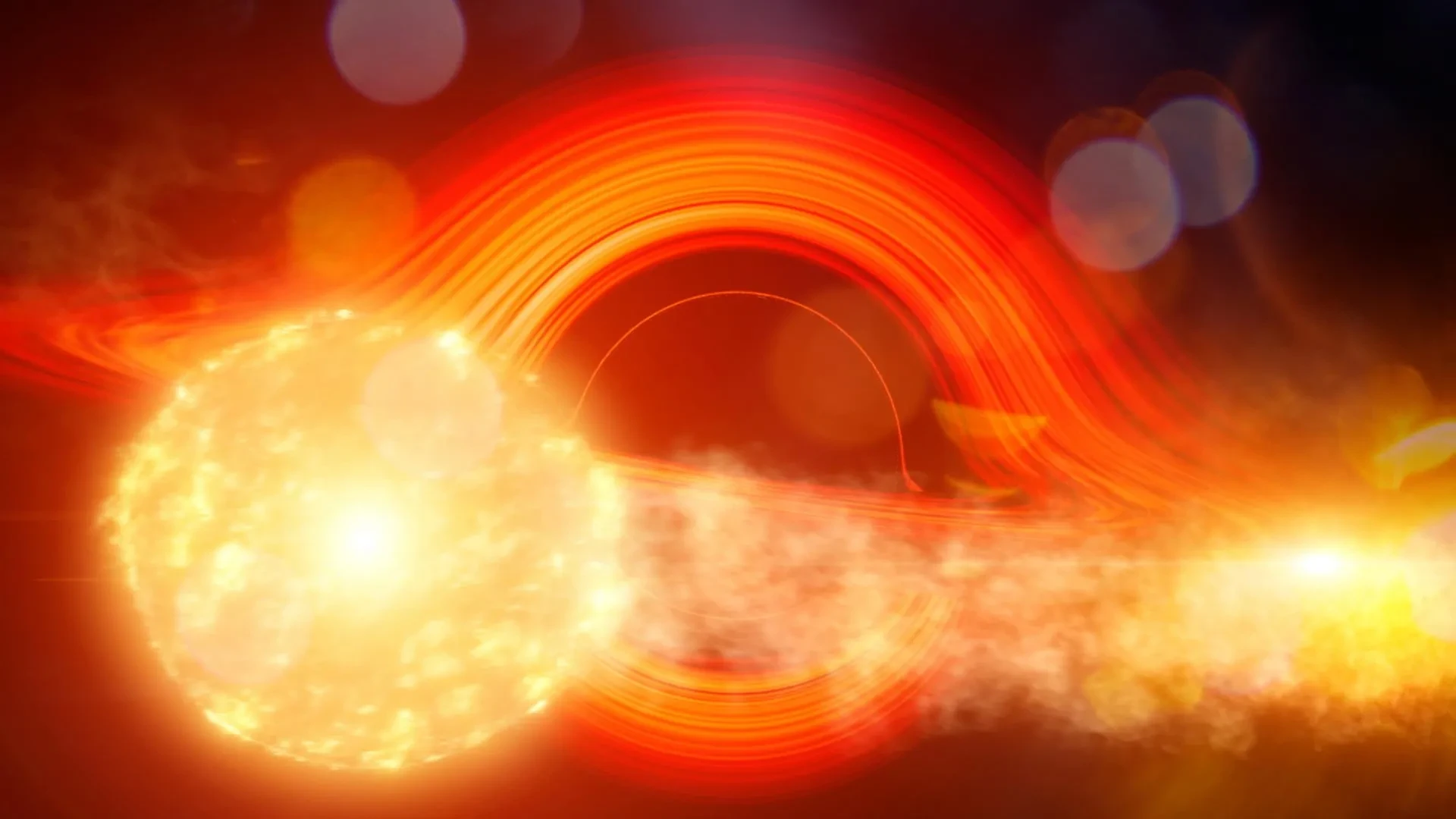
Now, an international team of researchers spearheaded by the Max Planck Institute for Extraneous Physics (MPE) has potentially solved this enduring astrophysical puzzle. By combining state-of-the-art infrared observations with advanced hydrodynamical computer simulations, the research team has successfully traced these mysterious clouds—collectively known as the G1-2-3 streamer—back to their natal source: IRS 16SW, a massive, volatile contact binary system composed of two colossal stars locked in an extraordinarily tight orbital embrace.
This breakthrough discovery bridges multiple domains of astrophysics. It demonstrates that the turbulent winds generated by massive young stars do not merely sculpt the interstellar medium; they actively funnel fresh fuel toward the very edge of galactic oblivion, offering a compelling window into the dietary habits of supermassive black holes.
DETAILED CHRONOLOGY: UNRAVELING THE G-CLOUD MYSTERY
The saga of the Galactic Center’s gaseous anomalies began unfolding in earnest in 2012, setting off a twelve-year investigative pursuit across multiple observatories and generations of instrumentation.
2012: The Discovery of G2
The pivotal turning point occurred when astronomers identified a compact, highly unusual cloud of ionized gas dubbed G2. Weighing in at several times the mass of the Earth, G2 blazed with characteristic hydrogen and helium emissions, signaling a blend of hot gas and microscopic dust particles. As researchers tracked its trajectory, they realized G2 was hurtling along a highly eccentric, elongated orbit that would bring it dangerously close to Sagittarius A*. Trailing behind this primary mass was a faint, stretched-out extension designated as G2t.
The G1 Retro-Discovery
Shortly after G2 captured the astronomical community’s attention, researchers looping back through archival infrared data recognized another, similar object—G1—traveling along a remarkably parallel path. The striking similarities in their orbital characteristics hinted strongly that G1, G2, and the trailing G2t were not isolated, random interstellar vagabonds. Instead, they appeared to be dense concentrations of gas riding within a larger, continuous streamer of material.
Astrophysicists understood that even subtle density fluctuations within a continuous gas stream could make it appear disjointed. Because gas brightness scales with the square of its density, slightly more compact pockets shine disproportionately bright, creating the illusion of distinct, isolated "clouds" floating in an otherwise uniform wake.
The Emergence of G3 and the G1-2-3 Streamer
As observation programs continued, astronomers detected more gas gathering from G2’s sprawling wake, coalescing into yet another compact cloud following a strikingly similar orbital path. Although the natural naming convention pointed toward "G3," that designation had already been claimed by an unrelated object in the galactic center. Nonetheless, the newly realized structural continuity cemented a unifying concept: these related clouds trace a connected, sweeping flow of material through the central parsec of the Milky Way, now officially cataloged as the G1-2-3 streamer.
SINFONI, ERIS, and the Hunt for the Source
With a coherent structural pathway established, the MPE-led team deployed advanced observational firepower to map the kinematics of the system. Utilizing two powerhouse infrared spectrographs—SINFONI and the newer ERIS—both mounted on the European Southern Observatory’s Very Large Telescope (VLT), the team harnessed cutting-edge adaptive optics. These systems correct for the blurring effects of Earth’s atmosphere in real time, delivering exceptionally sharp, diffraction-limited images of the chaotic Galactic Center.
By targeting a specific infrared hydrogen emission line known as the Brackett-γ line, the astronomers measured the precise three-dimensional positions and line-of-sight velocities of the clouds. Reconstructing their historical trajectories backward through space and time yielded a startling geometric realization: G1, G2, and G2t share orbits with nearly identical shapes and spatial orientations. Mathematically, the probability of three unrelated, randomly injected clouds sharing such tightly coordinated orbital paths is infinitesimally small. They had to share a common birthplace.
SUPPORTING CONTEXT & METRICS: THE ENERGETICS OF A GALACTIC CORE
To understand the profound significance of tracing these clouds to their source, one must appreciate the extreme physics governing the innermost regions of the Milky Way.
[Massive Binary System: IRS 16SW]
             │
             ▼ (Stellar Winds & Collisions)
[Compressed Gas Stream: G1-2-3 Streamer]
             │
             ▼ (Gravitational Acceleration)
[Supermassive Black Hole: Sgr A* (4 Million Solar Masses)]
             │
             ▼ (Accretion & Low-Level Sustained Activity)
The Accretion Problem
Sagittarius A sits approximately 26,000 light-years away in the constellation Sagittarius. While it is a supermassive black hole, it is famously quiescent, radiating energy at a rate many orders of magnitude below its theoretical maximum capacity (the Eddington luminosity). This quiescence implies that Sgr A suffers from an ongoing fuel shortage.
Calculations by theoretical astrophysicists indicate that for the black hole to sustain its current, modest level of activity and emission, it requires a steady accretion rate of roughly one Earth mass of gas every ten years. Historically, explaining how ambient galactic gas loses enough angular momentum to fall into the black hole has posed a major hurdle. Diffuse gas tends to sweep past the gravitational well rather than plunge directly into it.
This is precisely where the G1-2-3 streamer changes the narrative. Compact, dense clouds possess significantly higher inertia and interact differently with the ambient radiation and magnetic fields of the Galactic Center. If dense concentrations of gas can be systematically generated and funneled inward, they provide a reliable, episodic conveyor belt of sustenance straight to the black hole’s doorstep.
The Physics of IRS 16SW
Working backward from the kinematic data, the MPE team narrowed down the origin point to IRS 16SW. This system is not a solitary star, but a massive contact binary—two hyper-luminous, evolved massive stars orbiting so closely together that their outer envelopes touch and bleed into one another.
IRS 16SW resides safely within the famous clockwise stellar disk, a population of young, massive stars swirling around Sgr A*. The extreme environment of a massive binary system is characterized by ferocious stellar winds—supersonic streams of charged particles blasting away from the stars at thousands of kilometers per second.
When the opposing winds of the two stars in IRS 16SW slam into one another, they create a violent, high-pressure shock zone right in the region between them. Within this compressed hydrodynamic crucible, gas is violently squeezed, cooled, and gathered into dense clumps. As the two stars orbit each other and move through their wider path around the galactic core, these dense accumulations can occasionally break free from the binary’s gravitational grip, flung outward into the surrounding space like mud spinning off a high-speed tire.
Once liberated, these dense pockets of gas are captured by the immense gravitational field of the Galactic Center, naturally falling into elongated orbits that mirror the observed properties of the G1-2-3 streamer.
OFFICIAL STATEMENTS & PERSPECTIVES
The convergence of high-resolution spectroscopy, orbital mechanics, and hydrodynamical modeling has drawn praise from across the international astrophysical community.
Lead researchers involved in the MPE-led initiative emphasize that this discovery redefines our understanding of stellar feedback loops near extreme gravitational wells. "For years, the G2 cloud was treated as a bizarre anomaly—a cosmic riddle defying easy classification," noted one of the lead project astrophysicists during the findings briefing. "By demonstrating that these clouds are systematic byproducts of a known stellar system, we shift our paradigm. We are no longer looking at random debris; we are watching a manufacturing plant for black hole fuel."
Theoretical modelers who constructed the gas-flow simulations noted that replicating the precise morphologies of G1, G2, and the trailing streamer required accounting for complex thermodynamics, radiative cooling, and orbital shear.
"The computer models didn’t just casually match our observations—they predicted the exact physical mechanisms," explained a co-author specializing in hydrodynamical simulations of galactic nuclei. "When you run the physics of colliding stellar winds in a tight binary situated in a tidal gravitational field, the formation of these streamers isn’t just possible; it is an inevitable consequence of the environment."
Senior astronomers not directly affiliated with the study have similarly hailed the work as a masterclass in multi-instrument observational astronomy, noting that without adaptive optics systems like SINFONI and ERIS, piercing through the thick dust obscuring our view of the Galactic Center would have remained impossible.
FUTURE OUTLOOK: THE NEXT FRONTIER IN GALACTIC CENTER RESEARCH
While identifying IRS 16SW as the primary engine behind the G1-2-3 streamer marks a monumental leap forward, it also opens up entirely new avenues of inquiry for galactic astronomers.
Mapping Future Infall Events
With the orbital pathways and generation mechanism now mapped, researchers can model the future lifecycle of the G1-2-3 streamer. As these dense clumps continue their journey along their elongated orbits toward Sagittarius A*, astronomers will have a predictive framework to study how gas interacts with the hot, diffuse accretion disk surrounding the black hole in real time.
Future monitoring campaigns will look for high-energy flares or shifts in Sgr A*’s X-ray and infrared emissions that might coincide with the arrival of these dense gas parcels at the event horizon. Catching a supermassive black hole in the act of digesting a stellar-wind-derived cloud would provide unprecedented empirical data on accretion physics.
Searching for Other Stellar Factories
IRS 16SW is unlikely to be a unique anomaly. The clockwise stellar disk surrounding Sagittarius A* contains dozens of other massive, luminous stars and potential binary systems. Armed with the computational and observational signatures identified in this study, the MPE team and other research consortia plan to survey the broader Galactic Center for other hidden "gas factories." It is entirely possible that multiple binary systems are contributing to a complex, multi-stranded network of gas streams weaving through the central parsec.
Ground-Based and Space-Based Synergy
As next-generation facilities come online—including the Extremely Large Telescope (ELT) currently under construction in Chile—astronomers anticipate gaining even higher-resolution views of the Galactic Center. Combining the unprecedented light-gathering power of future ground-based telescopes equipped with advanced adaptive optics alongside space-based observatories like the James Webb Space Telescope (JWST) and future X-ray missions will allow scientists to peer deeper into the dust and resolve finer structures within the gas streams than ever before.
Ultimately, this discovery knits together disparate threads of astrophysics—connecting the violent life cycles of massive stars, the complex hydrodynamics of stellar winds, and the grand, gravitational appetite of supermassive black holes. It paints a dynamic, interconnected picture of our galaxy’s core, proving that even in the most extreme and violent corners of the Milky Way, the life of stars and the fate of black holes are inextricably bound together.
