

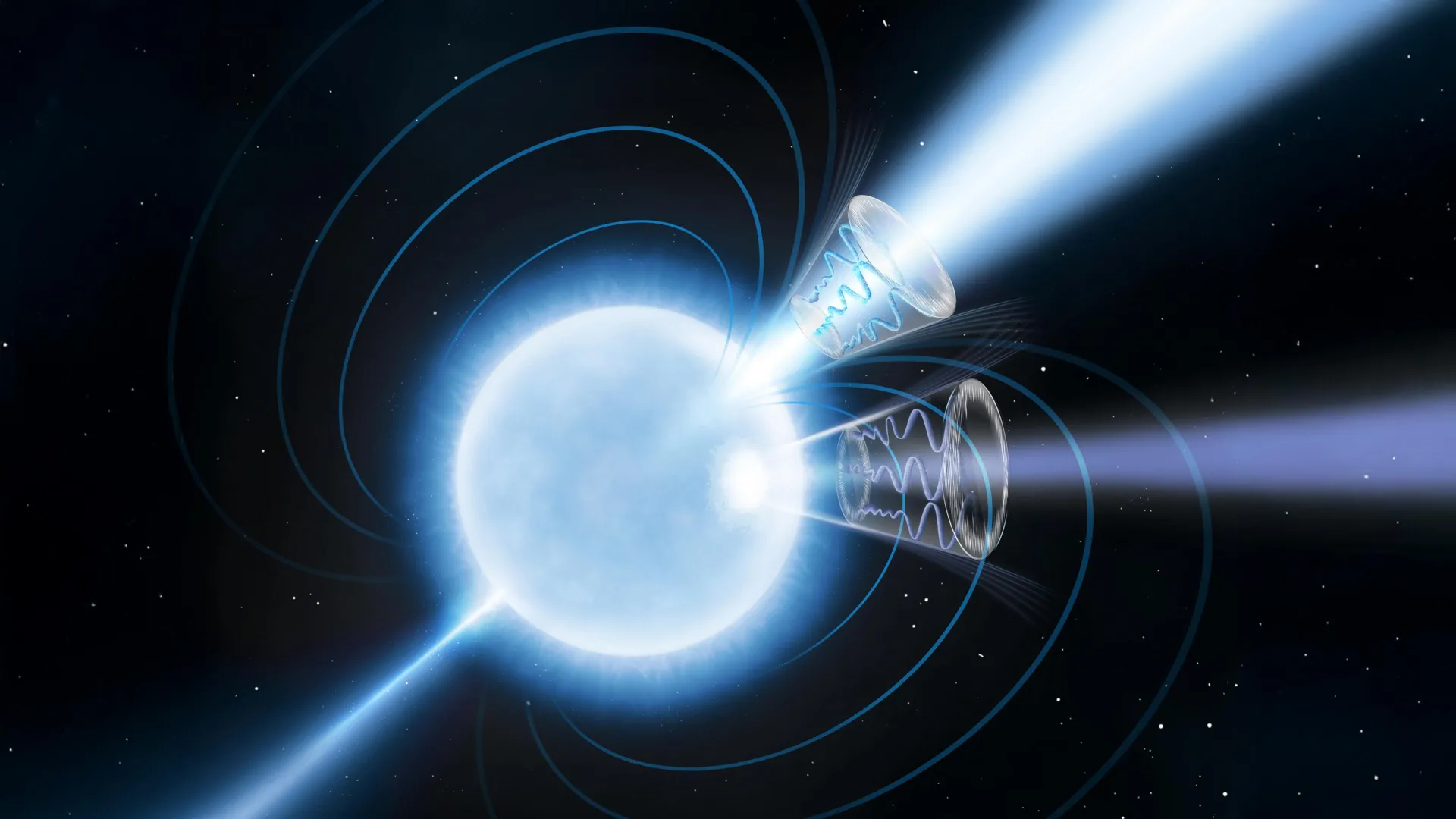
In what may represent a monumental turning point for modern physics, an international collaboration of astronomers has reported the strongest evidence to date supporting one of quantum mechanics’ most counterintuitive predictions: that apparently empty space is not empty at all, and that the vacuum itself can actively influence the propagation of light.
The phenomenon, known scientifically as "vacuum birefringence," was first theorized nearly nine decades ago by German physicist Werner Heisenberg and his colleague Hans Heinrich Euler. Their foundational calculations suggested that the quantum vacuum is a roiling, dynamic sea of "virtual particles"—entities that flicker into and out of existence in fractions of a second. Normally, these fleeting fluctuations remain undetectable. However, the researchers propose that under the influence of extraordinarily intense magnetic fields, these virtual particles become aligned, altering the polarization and trajectory of passing light waves.
For nearly 90 years, proving this bizarre quantum quirk has remained an elusive holy grail for physicists. Human-engineered laboratories on Earth are simply incapable of generating magnetic fields powerful enough to force the effect into view. But nature, it turns out, possesses laboratories of its own.
By training a suite of advanced space- and ground-based telescopes—including NASA’s Imaging X-ray Polarimetry Explorer (IXPE) and CSIRO’s Parkes radio telescope—on a rare, highly magnetized neutron star known as a magnetar, researchers led by Dr. Marcus Lower of Swinburne University of Technology have captured data that strongly hints at the first direct detection of vacuum birefringence. The findings, recently published in the prestigious journal Nature, open an unprecedented window into the behavior of quantum mechanics under conditions of extreme cosmic stress. If definitively confirmed, this discovery will validate nearly a century-old theory and provide scientists with a novel observational tool to probe the deepest mysteries of the quantum universe.
Detailed Chronology: Unlocking a Decades-Old Quantum Mystery
The path to detecting vacuum birefringence spans generations, bridging early 20th-century theoretical physics with 21st-century astrophysical observation.
1. The Theoretical Foundation (1930s)
In 1936, Werner Heisenberg and Hans Heinrich Euler published a paper outlining the nonlinear electrodynamics of the quantum vacuum based on Paul Dirac’s early formulations of quantum electrodynamics (QED). Their equations predicted that in the presence of a sufficiently powerful magnetic field, the vacuum would behave like a birefringent crystal—meaning it would split light waves into different polarization states depending on their orientation relative to the magnetic field. At the time, the prediction was purely academic. The required magnetic field strength was orders of magnitude beyond anything humanity could fathom producing.
2. The Astrophysical Hunt
As observational astronomy advanced through the latter half of the 20th century, astrophysicists identified magnetars—a rare subclass of neutron stars born from the collapsed cores of massive stars. Possessing the most intense magnetic fields in the known universe, magnetars emerged as the only conceivable natural laboratories capable of testing Heisenberg and Euler’s century-old hypothesis. Yet, capturing clear, unambiguous signatures of vacuum birefringence required technological leaps in X-ray and radio polarimetry.
3. The Multi-Telescope Campaign
The breakthrough came when an international team turned its attention toward the magnetar designated 1E 1547.0-5408 (or 1E1547 for short). The observational campaign was truly global and multi-spectral:
- NASA’s IXPE: The Imaging X-ray Polarimetry Explorer provided high-sensitivity polarization measurements of the X-rays emitted by the magnetar.
- The International Space Station (NICER): The Neutron star Interior Composition Explorer provided critical complementary X-ray data.
- CSIRO’s Parkes Radio Telescope ("Murriyang"): Operated by Australia’s national science agency, this instrument tracked the radio waves pulsing from the star.
4. Data Processing and Supercomputing
Following the raw data collection, Dr. Lower utilized the Parkes radio telescope to capture precise measurements of how the magnetar’s radio waves changed direction—their polarization state—as the star rotated on its axis. This massive dataset was subsequently fed into Swinburne University’s high-performance Ngarrgu Tindebeek supercomputer. The computational analysis revealed striking geometric alignments and polarization behaviors that closely matched theoretical predictions for vacuum birefringence, culminating in the landmark paper published in Nature.
Supporting Context & Metrics: The Extreme Physics of Magnetars
To understand why magnetars are uniquely suited to test quantum mechanics, one must examine the staggering physical parameters governing these objects.
The Scale of Magnetar Magnetic Fields
Earth’s magnetic field is a modest affair, registering at roughly 0.5 Gauss. The strongest steady magnetic fields ever generated in a human laboratory reach up to approximately 1,200 Tesla (or 12 million Gauss). By contrast, magnetars possess magnetic fields ranging from $10^14$ to $10^15$ Gauss (10 billion to 100 billion Tesla).
As Dr. Lower noted, detecting vacuum birefringence requires a magnetic field over 100 million times stronger than any ever engineered on Earth. Magnetars comfortably exceed this threshold, making them the only known objects in the universe capable of bending light via vacuum polarization.
The Anatomy of 1E 1547.0-5408
The success of the recent study was not merely due to the magnetar’s immense magnetic field, but also to its fortuitous orientation relative to Earth. Through meticulous tracking of radio and X-ray polarization, the research team determined two vital geometric traits of 1E1547:
- Aligned Axes: The magnetar’s magnetic axis and its rotational axis are nearly perfectly aligned.
- Pole-On Perspective: Earth happens to view the magnetar from a nearly pole-on vantage point.
This rare viewing geometry created an unobstructed, clean line of sight through the densest regions of the magnetic field. As X-rays and radio waves passed outward through this environment, Heisenberg’s virtual electron-positron pairs were forced into strict alignment with the magnetic field lines. This uniform structuring cleanly imprinted the birefringent signature onto the escaping light, allowing sensitive instruments like IXPE to register extraordinarily high levels of polarization.
Official Statements and Expert Insights
The implications of the research have resonated deeply within the global astrophysics community, drawing praise for the collaborative, multi-instrument approach used to tackle a notoriously difficult problem.
Dr. Marcus Lower, reflecting on the arduous nature of the quest, emphasized the partnership between theoretical physics and modern observational hardware:
"Detecting vacuum birefringence requires a magnetic field that is over 100 million times stronger than any we’ve ever made on Earth. Thankfully, nature has provided us with magnetars, which are the perfect cosmic laboratories to go looking for this effect."
Explaining the underlying physical mechanism observed by the team, Dr. Lower elaborated on how the intense environment organizes the subatomic landscape:
"Because of the magnetic field’s strength, Heisenberg’s virtual particles become aligned with the direction the field is pointing. By carefully tracking the direction the radio waves and X-rays oscillate as the magnetar rotates, the team found that the alignment of 1E1547’s magnetic and rotational poles were ideal for detecting vacuum birefringence."
Co-investigators and peer reviewers have highlighted that while the data represents the most compelling evidence yet for vacuum birefringence, the scientific process demands rigorous verification. The team stresses that separating the quantum signature from other complex plasma and thermal processes occurring in the magnetar’s magnetosphere remains an ongoing challenge. Nonetheless, the alignment between theory and observation in this study has set a new benchmark for quantum astrophysics.
Future Outlook: Completing Heisenberg’s 90-Year Quest
The publication of "Vacuum birefringence and the polarized X-ray emission of a radio magnetar" in Nature marks a destination, but it also serves as a starting line for the next phase of quantum research.
Refining the Data and Simulations
To move from "strongest evidence" to absolute confirmation, the research team is already planning subsequent observation campaigns. Future allocations of telescope time on advanced X-ray and radio observatories will aim to gather deeper, higher-resolution polarization datasets across multiple magnetars, rather than relying solely on 1E1547.
Simultaneously, computer scientists and astrophysicists are upgrading the algorithms running on supercomputers like Swinburne’s Ngarrgu Tindebeek. By developing more sophisticated magnetohydrodynamic and quantum-electrodynamic simulations, researchers hope to precisely model the confounding noise of stellar plasma. This will enable them to isolate the subtle fingerprint of vacuum birefringence with absolute mathematical certainty.
Broader Implications for Fundamental Physics
Beyond validating an 88-year-old prediction, confirming vacuum birefringence opens doors to testing other extreme tenets of modern physics. If scientists can reliably use magnetars as natural particle accelerators and quantum laboratories, they can probe domains where quantum mechanics and general relativity intersect.
As Dr. Lower concluded:
"With these future data on hand and our updated simulations, we may finally be able to complete the quest started by Heisenberg nearly 90 years ago."
In the grand tradition of scientific discovery, the answers to our most abstract subatomic questions may ultimately be written in the most violent, extreme corners of the cosmos.