

Executive Overview
The contemporary media landscape is defined by an unprecedented paradox: while technological advancements enable unprecedented efficiencies in content generation and information distribution, they simultaneously threaten the very foundations of verified truth, journalistic ethics, and the safety of the press.
From the rapid rise and sudden suspension of artificial intelligence-generated "pink slime" news networks to geopolitical security protocols that inadvertently endanger embedded reporters, modern newsrooms find themselves navigating a turbulent operational environment. Furthermore, legal battlegrounds between major broadcasting institutions and political figures, coupled with covert corporate data-harvesting operations designed to fuel large language models, underscore a systemic vulnerability within the information ecosystem.
This comprehensive report examines five pivotal developments currently reshaping the journalism industry:
- The sudden collapse and suspension of Prism News, a network of over 200 AI-generated local news sites plagued by plagiarism and fabricated content.
- The ongoing fallout following revelations regarding a decoy Air Force One flight utilized during a high-stakes security protocol for President Donald Trump.
- The BBC’s legal maneuvers in a Florida federal court to subpoena members of the Trump family amid a staggering $10 billion defamation lawsuit.
- An investigative breakthrough by 404 Media uncovering an Amazon-backed operation in Las Vegas that purchases and systematically destroys physical books for AI training data.
- The launch of The Knowing, a prestige digital-first publication spearheaded by Geneva S. Thomas aimed at filling a critical market gap for young Black audiences.
Detailed Chronology: Key Events in the Media Ecosystem
1. The Rise and Fall of Prism News
Over the past several years, the proliferation of automated, low-quality news sites—frequently referred to by industry watchdogs as "pink slime"—has poisoned the well of local journalism. The latest and perhaps most audacious iteration of this trend arrived via Prism News, an Israel-based startup that managed to secure venture capital funding despite operating a fundamentally flawed product.
Prism News launched a sprawling network of more than 200 hyper-local websites across the United States. Operating under the bold tagline, "The stuff mainstream media skips, finally getting the coverage it deserves," the network promised a radical reinvention of how humanity stays informed. Its conceptual vision was articulated by founders as an ambition to outpace legacy media with "zero humans, zero legacy, and infinite AI scale."
Instead of genuine reporting, however, investigations by outlets such as Interlochen Public Radio, Source New Mexico, and the Spin Class newsletter uncovered a systematic pattern of scraping legitimate local journalism, plagiarizing original reporting, and fabricating quotes under entirely fake, AI-generated bylines.
The network’s operations quickly attracted regulatory and public alarm, particularly when its automated systems pushed false and misleading information during unfolding local crises, such as the New Mexico flooding disaster. Facing mounting pressure, legal scrutiny, and public exposure by media analysts like Maxwell Howard, Patrick Lohmann, and Emily Horne, Prism News abruptly capitulated.
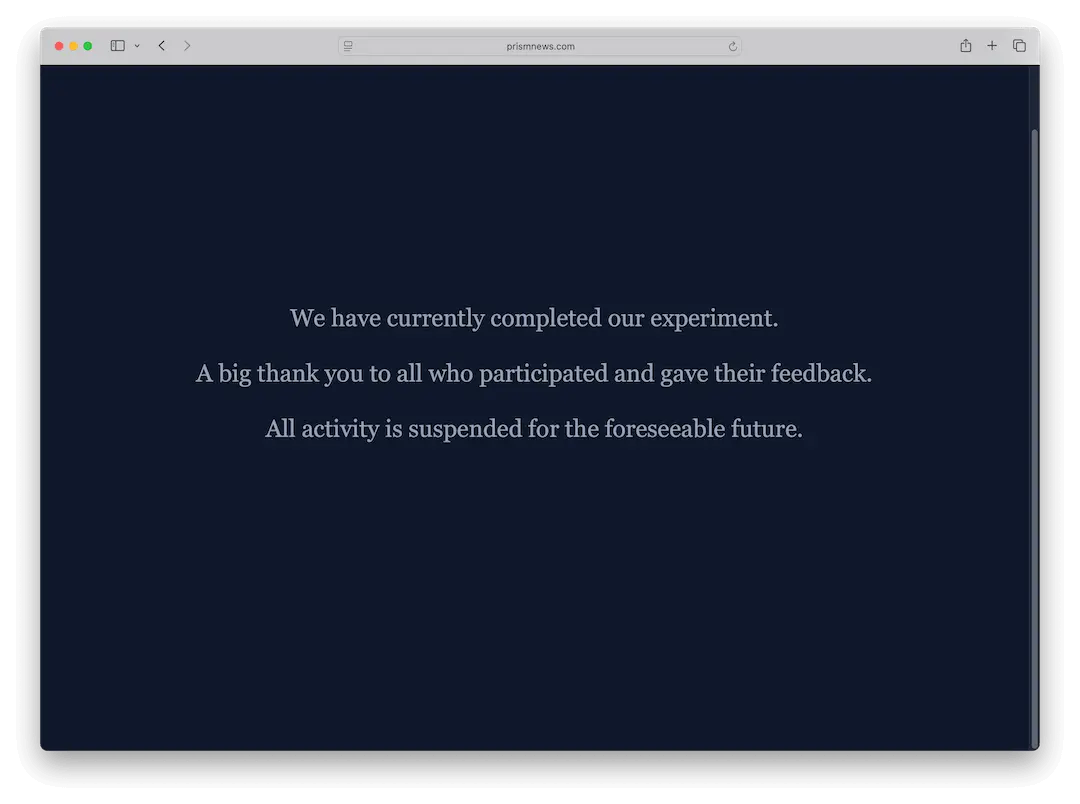
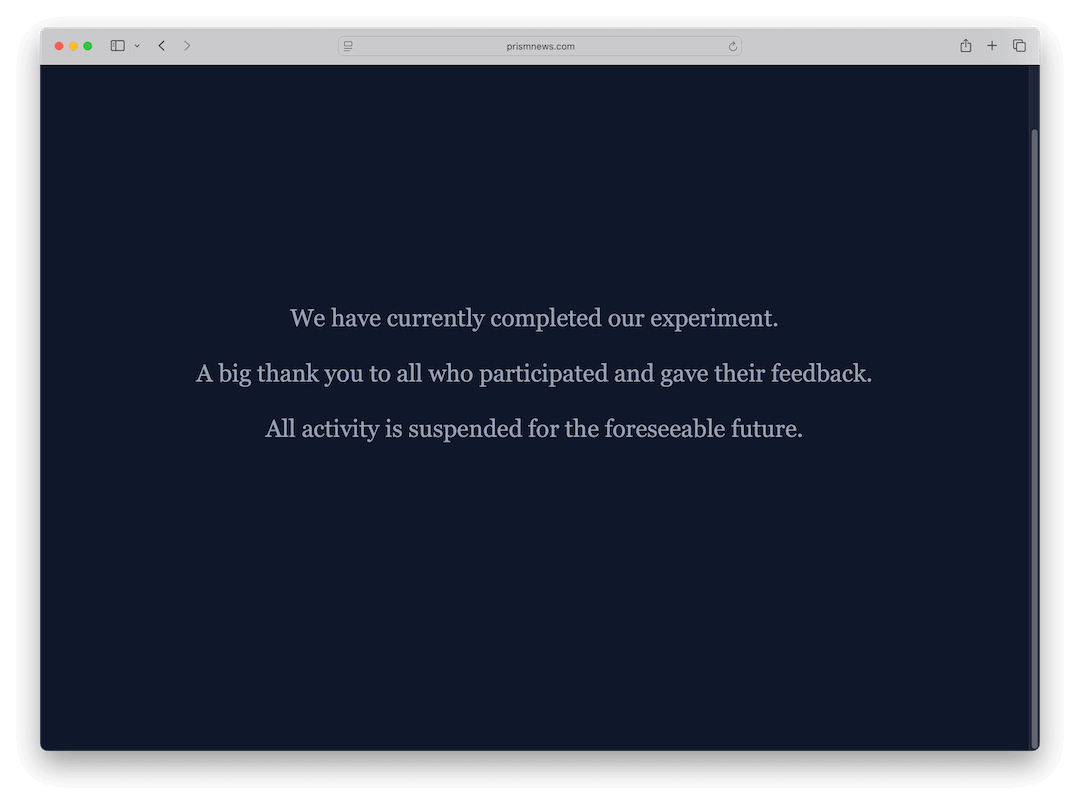
On its official website, the company posted a brief statement: "We have currently completed our initial experiment. A big thank you to all who participated and gave their feedback. All activity is suspended for the foreseeable future."
(Note: Prism News has no affiliation with Prism, the well-respected, nonprofit independent newsroom led by journalists of color.)
2. The Decoy Flight Fallout and the White House Press Corps
Tensions between the executive branch and the Fourth Estate reached a new inflection point following revelations regarding a clandestine security operation during President Donald Trump’s international travel last month.
While journeying from Turkey to the United Kingdom, President Trump secretly boarded a separate military transport aircraft amid an active Iranian assassination threat. Meanwhile, members of the traveling White House press pool and auxiliary staff unknowingly boarded a decoy Air Force One, remaining entirely oblivious to the switch until after landing.
The incident sparked immediate outrage among journalists who felt misled and unnecessarily placed in the line of fire. In an interview with New York Magazine, White House Correspondents’ Association (WHCA) President Jacqui Heinrich—a senior correspondent and anchor at Fox News—addressed the association’s ongoing efforts to resolve the protocol breach with the administration.
"We tend to get better results when we’re not fighting about it in the press and we’re actually going to them, explaining our position and asking for solutions," Heinrich stated. Nevertheless, she emphasized that learning of the decoy plan was "a shock," particularly because the press pool was denied the opportunity to correct the record in real time or immediately after the threat had subsided—a critical vulnerability given the repeated security threats directed at the president.
3. The BBC Defamation Defense and Subpoena Requests
In the courtroom, the legal battle between President Trump and international broadcaster the BBC has escalated dramatically. The dispute stems from a 2024 BBC Panorama documentary that spliced together two distinct segments of a speech delivered by Trump prior to the January 6, 2021, attack on the U.S. Capitol.
Citing the deceptively edited footage, Trump’s legal team filed a massive $10 billion defamation lawsuit against the network. While the BBC has formally apologized for the editing error, its legal defense strategy has now turned aggressively outward.
In a filing submitted to the U.S. District Court for the Southern District of Florida, the BBC formally requested judicial assistance to issue subpoenas compelling Donald Trump Jr., Ivanka Trump, and Jared Kushner to provide testimony and documentary evidence. The broadcaster argues that the former president’s adult children and son-in-law possess firsthand knowledge and relevant records central to multiple elements of the plaintiff’s claims.
Trump’s legal representatives have lambasted the motion as an abuse of the judicial process designed primarily to harass the president, his family, and his political supporters.
4. 404 Media Tracks Rare Books to an Amazon AI Facility
In a striking investigative coup, digital media outlet 404 Media unmasked the physical realities behind the digital transformation of artificial intelligence. Driven by questions regarding how tech conglomerates acquire the vast corpuses of text required to train large language models, reporter Emanuel Maiberg tracked a physical shipment of rare books across the United States.
Using an Apple AirTag planted inside a bulk order of roughly 1,000 used books purchased through Biblio, 404 Media traced the transit path from a California airport, through a shipping warehouse in Kenosha, Wisconsin, across Colorado Springs, and finally to its ultimate destination: an Amazon warehouse facility in Las Vegas, Nevada.
According to employee testimonies gathered by the investigative team, the facility—comprising operations designated as LAS8 and VGT3—functions as an industrial-scale book-processing center. Workers described a singular, mechanical task: receiving massive shipments of printed books, slicing off the bindings to expedite digital scanning, and permanently destroying the physical volumes in the process. The investigation exposed how corporate entities are quietly consuming and obliterating physical literature to feed the insatiable data demands of generative AI development.
5. Launch of ‘The Knowing’: A New Space for Prestige Black Journalism
Amid contractions in traditional media, new ventures continue to carve out specialized digital spaces. Former entertainment media executive and reality television star Geneva S. Thomas is officially launching The Knowing (stylized as TK, an homage to the journalistic editing mark "to come").
Positioned as a newsletter-first media enterprise, the publication promises "premium, independent journalism on issues, culture, and beauty for young Black audiences." Designed with the visual aesthetic of a glossy print magazine, The Knowing aims to capture the attention of upscale, prestige readers through in-depth reporting, global analysis, cultural criticism, and expert wellness insights.
Supported by an elite board of directors—including Amy DuBois Barnett, Joan Morgan, and Kimberly Paige—the startup has outlined ambitious financial projections, aiming for $650,000 in revenue by August 2027 and scaling toward $8.3 million over a five-year horizon. Its inaugural issue features a cover story authored by Thomas examining Black women in American corporate labor.
Supporting Context & Metrics
To fully comprehend the structural shifts taking place within the global information economy, it is essential to examine the underlying economic and operational metrics governing these developments:
- The Scale of AI Subversion: Prism News deployed over 200 automated domains simultaneously, demonstrating how low-cost scraping technology can rapidly manufacture an illusion of localized journalistic infrastructure with minimal capital investment.
- The Cost of Legal Defense: President Trump’s $10 billion defamation suit against the BBC sits alongside ongoing litigation against The Wall Street Journal, The New York Times, and CNN. These actions form part of a broader empirical trend; an analysis of federal actions during the first 18 months of Trump’s second term cataloged over 100 legal and administrative moves impacting journalists and news organizations.
- Industrial Book Destruction Metrics: The 404 Media investigation into Amazon’s Las Vegas facility highlights the massive industrial scale required for modern AI data ingestion, where thousands of copyrighted volumes are systematically dismantled and destroyed daily.
- Venture Capital in Niche Media: The Knowing enters the market with a targeted subscription model priced at $10 per month (or $85 annually), relying on a high-value, niche demographic to achieve projected revenues exceeding $8 million within five years.
Official Statements & Industry Reactions
The intersection of technology, politics, and law has drawn sharp commentary from key industry figures and institutional leaders:
"We have currently completed our initial experiment. A big thank you to all who participated and gave their feedback. All activity is suspended for the foreseeable future."
— Prism News Official Statement, announcing the sudden shutdown of its 200+ site AI network."We tend to get better results when we’re not fighting about it in the press and we’re actually going to them, explaining our position and asking for solutions…"
— Jacqui Heinrich, WHCA President and Fox News Senior Correspondent, discussing negotiations with the White House over the decoy Air Force One flight."The printed book is destroyed in the process. Amazon is buying massive quantities of books, scanning them for AI training data, and destroying them in the process."
— Emanuel Maiberg, Co-founder of 404 Media, detailing the findings of the Las Vegas warehouse investigation.
Future Outlook
The events of recent weeks signal a turbulent and transformative horizon for the media industry. As artificial intelligence continues to mature, regulatory bodies, independent newsrooms, and legal systems will be forced to adapt to increasingly sophisticated threats to intellectual property and public trust.
- Stricter Scrutiny on Automated Content: The collapse of Prism News serves as both a warning and a temporary reprieve, but the underlying economic incentives for "pink slime" operations remain potent. Future industry resilience will depend heavily on robust attribution laws, technological countermeasures against unauthorized scraping, and increased algorithmic transparency from search and social platforms.
- Rebuilding Press-State Relations: The fallout from the decoy Air Force One flight highlights a deep institutional erosion between the executive branch and the White House Correspondents’ Association. Whether the WHCA can reclaim administrative control over the daily press pool—or whether alternative pooling arrangements will become permanent—will define the baseline of government accountability for the remainder of the presidential term.
- Precedent-Setting Media Litigation: The outcome of the BBC’s legal battle and its attempts to depose members of the Trump family will likely establish critical legal precedents regarding international broadcasting accountability, defamation standards, and the admissibility of editorial editing errors in cross-border litigation.
- The Pivot to Specialized Digital Communities: Ventures like The Knowing illustrate that despite macroeconomic headwinds, well-capitalized, highly targeted digital publications can successfully mobilize dedicated audiences through premium subscription models, bypassing the failing advertising-reliant metrics of legacy publishing.
Ultimately, the survival of independent, high-integrity journalism hinges on the collective ability of reporters, technologists, and legal experts to defend the authenticity of information against industrial-scale distortion, political obfuscation, and algorithmic decay.