

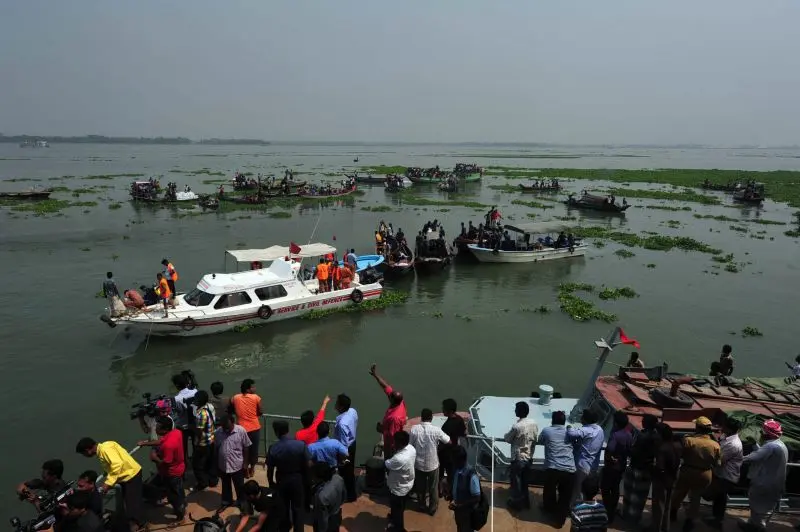
DHAKA, Bangladesh — Frantic rescue operations continued late into Tuesday evening across the murky waters of southern Bangladesh, hours after a packed passenger vessel collided with a cargo ship and capsized in the dead of night.
Authorities confirmed that at least 32 people lost their lives in the disaster, while more than 60 others remained unaccounted for. The sinking of the MV Shariatpur-1 has once again cast a harsh spotlight on the perilous state of domestic maritime transport in the South Asian nation—a country crisscrossed by a vast, intricate web of rivers where fatal waterborne accidents remain a persistent and tragic reality.
Executive Overview
The disaster unfolded in the early hours of Tuesday on the Meghna River, situated within the Munshiganj district, approximately 25 miles (40 kilometers) south of the capital, Dhaka. Carrying an estimated 250 passengers—many of whom were fast asleep in their cabins—the MV Shariatpur-1 was struck by an oncoming cargo ferry. The impact ruptured the passenger vessel’s hull, causing it to take on water rapidly and plunge more than 70 feet (over 20 meters) to the riverbed.
While initial response teams managed to pull approximately 30 survivors from the water, families of the missing fear the final death toll will rise significantly. Search and recovery divers from the Bangladesh Navy, the Fire Service and Civil Defence, local police, and the Bangladesh Inland Water Transport Authority (BIWTA) have been deployed to scour the wreckage. Officials caution that numerous bodies may still be trapped within the submerged cabins of the sunken ferry, compounding the anguish of grieving relatives gathered along the riverbanks.
Detailed Chronology: The Night the Shariatpur-1 Sank
The voyage began late Monday from the Shariatpur district, with the MV Shariatpur-1 navigating the nocturnal waters toward Dhaka. Most passengers had retired for the evening, lulled by the gentle current of the river, unaware of the impending disaster.
At approximately 2:30 a.m. local time, the routine journey turned catastrophic. In heavy pre-dawn river traffic and low visibility, the passenger vessel collided head-on with a cargo ferry. Survivors described the collision as sudden and violent, offering no time for safety protocols or emergency announcements.
Accounts from the Survivors
For Mohammad Dulal Dewan, a 55-year-old passenger traveling with his extended family, the disaster unfolded in a blur of terror and confusion.
"We were seven in a cabin in the ferry, and six of my family members are still missing," Dewan recounted in an interview with CNN, his voice shaking with grief. "Everything happened before I could understand anything."
Dewan and his family were making the journey to Dhaka to see his brother-in-law, Shamim Fakir, off on an international flight to the United States, which had been scheduled for early Wednesday morning. Instead of a celebratory farewell, Fakir and five other members of the family remained missing as rescue operations stretched into the night.
Thrown from his berth by the force of the impact, Dewan managed to claw his way to the deck. Realizing the ship was rapidly listing and heading downward, he made a split-second decision. "I jumped into the river and was rescued by people in another passing ferry," he said.
Official Statements and Rescue Operations
As daylight broke over the Meghna River, the true scale of the tragedy became apparent. Emergency response teams rushed to the site, establishing command posts along the shore as distraught family members arrived clutching photographs of their missing loved ones.
Mohammad Azizul Alam, the administrative chief of the Munshiganj district, confirmed that local authorities had compiled a registry of 61 missing individuals based on reports from families at the scene. He warned that the current death toll of 32 was provisional and expected to climb as divers gained access to the lower compartments of the vessel.
"We believe many bodies are still trapped inside the sunken ferry, and the rescue operation is still on," Shahabuddin Khan, the police chief of Munshiganj district, told reporters.
The technical complexities of the recovery operation proved formidable. Using sonar equipment, maritime authorities successfully traced the wreckage resting on the riverbed at a depth exceeding 20 meters. Specialized diving units from the Bangladesh Navy descended into the murky, high-current waters to feel their way through the tangled corridors of the sunken hull, attempting to extract victims while air pockets grew increasingly scarce.
Supporting Context & Metrics: A History of Maritime Peril
The sinking of the MV Shariatpur-1 is far from an isolated incident. Bangladesh possesses one of the world’s most extensive inland waterway networks, with hundreds of rivers, streams, and estuaries serving as vital arteries for trade and passenger travel. However, the sector has long been plagued by systemic safety failures.
The Numbers Behind the Crisis
- 4,000+ Fatalities: Independent safety organizations estimate that nearly 4,000 people have lost their lives in ferry accidents across Bangladesh since 1977.
- Annual Toll: Hundreds of lives are claimed annually in river transport disasters.
- Passenger Capacity: Boats routinely operate significantly above their legally mandated passenger capacities, particularly during major holidays and peak travel seasons.
Maritime experts point out that safety regulations are frequently flouted by operators and poorly enforced by regulatory bodies. Common violations include overloading, a lack of mandatory life-saving equipment such as life jackets and lifeboats, poor maintenance of vessel hulls, and the failure to adhere to navigational rules during periods of heavy fog, rain, or night operations.
Furthermore, the rapid expansion of unregulated cargo vessels navigating the same narrow river channels alongside passenger ferries has dramatically increased the risk of catastrophic collisions.
Future Outlook and Demands for Reform
In the wake of yet another avoidable tragedy, public outcry is mounting across Bangladesh. Civil society groups, transport unions, and bereaved families are once again demanding sweeping structural reforms to the nation’s inland water transport sector.
Critics argue that promises of government crackdowns on unregistered vessels and overloaded ferries have historically resulted in short-term enforcement campaigns followed by a return to dangerous negligence. For meaningful change to occur, transportation analysts argue that the government must implement:
- Stricter Licensing and Vessel Inspection: Mandatory, transparent safety audits for all commercial passenger and cargo vessels operating on inland waterways.
- Technological Upgrades: Equipping all commercial rivercraft with modern radar, GPS, and automated identification systems (AIS) to prevent night-time collisions in low-visibility conditions.
- Accountability and Enforcement: Imposing severe legal penalties, including permanent license revocations and criminal negligence charges, for ship owners and operators who violate safety protocols or carry excess passengers.
- Enhanced Emergency Response: Expanding regional diving and salvage capabilities to reduce response times during maritime emergencies.
As search teams continue to pull recovery yields from the dark depths of the Meghna River, the political and moral pressure on Dhaka to overhaul its maritime safety regime has never been greater. For families like Mohammad Dulal Dewan—shattered by the sudden loss of their loved ones—reforms will come too late, but they remain a vital necessity to prevent future generations from suffering the same devastating fate.
