

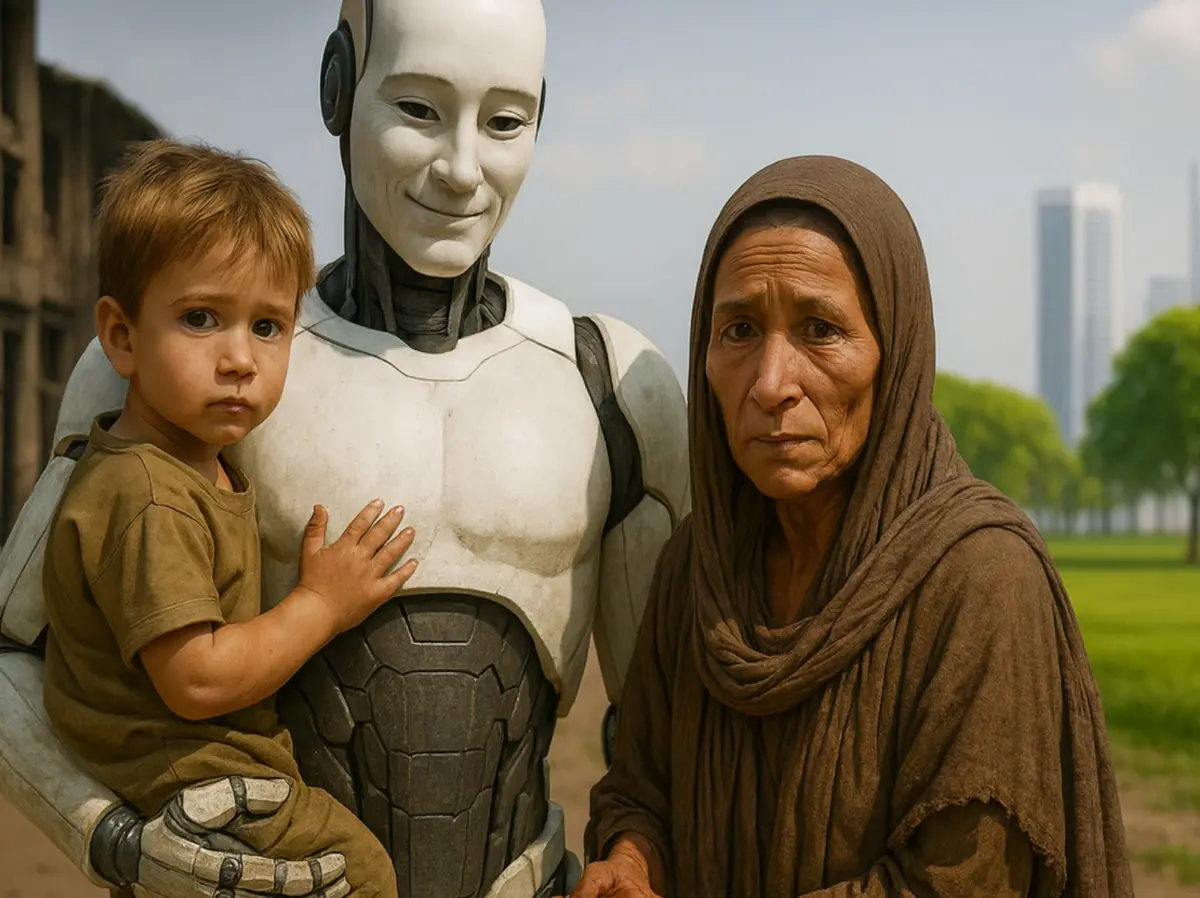
Executive Overview
We have officially crossed the threshold. The era of humanoid robots acting merely as clunky, tethered public relations stunts or laboratory novelties has come to a definitive close. Long cushioned by science fiction, humanity now faces an unprecedented technological convergence: the marriage of advanced electromechanical engineering with autonomous, generative artificial intelligence.
No longer restricted to scripted demonstrations on trade-show stages, today’s humanoid robots are stepping directly onto active factory floors, handling complex assembly tasks, and inching ever closer to our domestic spaces. Yet, as these machines become increasingly lifelike—booming with silicone-composite skin, fluid biomimetic motion, and context-aware "brains"—society is being forced to confront profound psychological, economic, and existential challenges.
What happens when the boundary between humans and machines becomes virtually impossible to distinguish? What occurs when a world is populated by entities that mirror our appearance and behavior down to the blink of an eye, yet possess zero biological history? This investigation explores the rapid technological evolution of humanoid robotics, the monumental socioeconomic shifts on the horizon, the looming threats of systemic misuse, and the critical guardrails humanity must establish before science fiction permanently overtakes our reality.
Detailed Chronology: From Novelty to the Assembly Line
To understand where the humanoid robotics industry stands today, one must trace its rapid acceleration over the past two decades. The trajectory shifts from rigid, pre-programmed mechanical marvels to adaptive, machine-learning platforms capable of self-directed improvement.
The Era of Mechanical Stunts (2000–2015)
At the turn of the millennium, humanoid robotics was defined by mechanical proofs of concept. In November 2000, Honda unveiled ASIMO, a milestone robot celebrated globally simply for its ability to walk forward, ascend stairs, and maintain balance without falling over. Throughout the 2000s and early 2010s, academic labs and corporate research divisions showcased similar bipedal machines. However, these systems operated entirely on rigid, millions-of-lines-long lines of unchangeable code. They could not adapt to dynamic environments, nor could they generalize skills. They were expensive, fragile public relations instruments designed to inspire wonder rather than execute productive labor.
The Generative AI Leap (2016–2022)
The paradigm shifted permanently with the explosion of modern Artificial Intelligence and deep learning architectures. In February 2016, Hanson Robotics introduced Sophia, a hyper-expressive humanoid that captured international headlines. While Sophia and her contemporaries were still largely conversational displays powered by scripted language models and teleoperation, they signaled a critical cultural shift: humanity was becoming fascinated—and unsettled—by human-like aesthetics paired with responsive software. Behind the scenes, roboticists realized that mechanical hardware had outpaced software; robots could walk, but they didn’t know what to do or how to adapt.

Commercial Deployment and Industrial Scale (2023–Present)
Today, we are witnessing an aggressive, highly capitalized race toward commercial deployment. Modern humanoids are no longer confined to clean-room laboratories. Companies like Figure AI have transitioned directly to active industrial environments. Figure AI’s Spartanburg plant deployment with BMW saw its Figure 02 model actively contribute to the manufacturing of over 30,000 vehicles, handling delicate sheet metal components alongside human workers.
Simultaneously, Tesla has integrated early iterations of its Optimus humanoids into its own Gigafactories, utilizing reinforcement learning pipelines to accelerate operational intelligence. What separates these modern platforms from their predecessors is not just their dexterity, but their underlying intelligence. Powered by advanced spatial-temporal models—such as Figure AI’s Helix or NVIDIA’s GR00T—these robots do not require line-by-line programming. Instead, they observe a human worker perform a task (such as sorting parts, folding laundry, or loading a dishwasher), understand the contextual intent, mimic the physical action, and independently iterate to optimize performance.
Supporting Context & Metrics: The State of the Market and Technology
Despite breathtaking software leaps, the physical engineering of humanoid robots remains anchored by severe real-world constraints. Analysts tracking the global humanoid robotics market note that capital investment continues to intensify, transforming pilot projects into scalable platforms. However, significant engineering hurdles persist across three major vectors:

- Power and Energy Density: Modern battery technology remains a primary bottleneck. Most current humanoids can only operate continuously for a few hours before requiring a recharge or a manual battery swap, limiting shift-work efficiency.
- Dynamic Locomotion: While bipedal walking has been largely mastered on flat, predictable factory floors, navigating the chaotic, unstructured environment of a real household—cluttered with toys, pets, and uneven rugs—remains an immense computational and mechanical challenge.
- Manufacturing Costs: Building a high-degree-of-freedom mechanical skeleton equipped with tactile sensors, high-torque actuators, and onboard compute is extraordinarily expensive. While intense market competition is successfully driving down production expenses, deploying consumer-grade models remains economically prohibitive for the average household.
Despite these hurdles, the commercial pipeline is moving rapidly. Industry forecasters predict that within the next ten to twenty years, humanoids will transition from automotive plants to retail floors, hospitals, and residential homes.
+-----------------------------------------------------------------------------------+
|                         EVOLUTION OF HUMANOID ROBOTICS                            |
+---------------------------+---------------------------+---------------------------+
| Era                       | Primary Driver            | Core Limitation           |
+---------------------------+---------------------------+---------------------------+
| 2000–2015: Novelty        | Mechanical locomotion,    | Rigid code, zero adaptive |
|                           | public relations stunts.  | intelligence, fragility.  |
+---------------------------+---------------------------+---------------------------+
| 2016–2022: Expression     | Conversational AI,        | Teleoperation reliance,   |
|                           | aesthetic realism.        | lack of general utility.  |
+---------------------------+---------------------------+---------------------------+
| 2023–Present: Industrial  | Foundation models         | Battery constraints,      |
|                           | (GR00T, Helix), autonomy. | high manufacturing costs. |
+---------------------------+---------------------------+---------------------------+
To achieve seamless integration into human spaces, research has shifted heavily toward sensory realism. Scientists are currently engineering advanced silicone-composite artificial skins that mimic human touch sensitivity, maintain a warm tactile feel, and house thousands of micro-sensors. Furthermore, developers are utilizing silent micro-actuators and artificial muscle systems mounted to robotic cranial structures, enabling micro-expressions like confusion, tiredness, or empathy.
Projects like Realbotix’s Aria—showcased at major tech conventions with price tags hovering around $175,000—demonstrate just how close the commercial market is to delivering hyper-realistic social companions.

Official Statements & Industry Perspectives
The rapid commercialization of humanoids has triggered intense debates among technologists, economists, and ethicists regarding the long-term utility and perils of replacing human presence with synthetic agents.
Proponents of the technology point to the "3D Jobs" framework—automating tasks that are Dull, Dirty, and Dangerous. Industrial advocates argue that deploying humanoids into high-risk environments, such as deep-underground mining, hazardous waste handling, or high-voltage electrical grid repair, will drastically reduce workplace fatalities and occupational injuries.
Furthermore, demographic pressures in hyper-aging societies—particularly in nations like Japan, South Korea, and parts of Western Europe—have made automation an economic necessity. Governments and healthcare organizations view lifelike humanoids as a viable solution to elder-care shortages, capable of monitoring vital signs, offering companionship to isolated seniors, and providing safe physical assistance.

Conversely, psychological and social researchers issue stark warnings about the unintended consequences of artificial intimacy. Experts studying the intersection of AI and mental health emphasize that humanoids programmed to be perpetually agreeable, patient, and compliant could exacerbate the global loneliness epidemic.
"When you introduce a synthetic companion that never argues, never requires emotional compromise, and simulates unconditional affection, you risk driving humans away from the messy, vulnerable work of real interpersonal relationships. We may see widespread social withdrawal on an unprecedented scale."
Economists also caution against unbridled optimism regarding labor displacement. While techno-optimists argue that widespread robot labor will reduce the cost of goods and usher in an era of material abundance, the transitional phase threatens mass unemployment. Blue-collar workers, delivery drivers, warehouse operators, and retail staff face displacement within a compressed timeline, threatening severe wealth concentration among tech conglomerates if robust safety nets are not put in place.

Future Outlook: Risks, Misuse, and Societal Safeguards
As humanoid robots inevitably cross the threshold from industrial assets into our private lives, the potential for individual and state-sponsored misuse escalates dramatically.
The Threat Matrix
- Identity Theft and Targeted Scams: Hyper-realistic androids introduce terrifying vectors for fraud. A bad actor could deploy a customized robot designed to impersonate a corporate executive, a political figure, or even a trusted family member to breach high-security zones or manipulate vulnerable individuals.
- Synthetic Manipulation: Commercial entities could leverage "synthetic empathy." Household robots programmed to simulate deep emotional attachment to children or families could be utilized to subtly steer consumer behavior, brand loyalty, and ideological viewpoints.
- Geopolitical and Security Risks: At a national level, the militarization of humanoid platforms equipped with autonomous targeting systems introduces catastrophic risks to global security, challenging international humanitarian laws regarding armed conflict.
Establishing Guardrails
Given that technological progress cannot be halted by bans or moratoriums, society must proactively construct systemic guardrails to harness humanoids safely. Experts advocate for three primary interventions:
- Mandatory Digital Watermarking and Identification: Every humanoid robot must incorporate immutable, easily verifiable physical and digital signatures that instantly identify it as a synthetic entity to both human senses and electronic scanners.
- Rigorous Ethical and Behavioral Protocols: Strict international standards must govern the boundaries of emotional simulation, preventing manufacturers from programming artificial deception regarding sentience or emotional reciprocity.
- Economic Transition Frameworks: Governments must institute proactive fiscal policies—such as automation taxes or universal basic safety nets—to buffer the workforce against rapid displacement and ensure that productivity gains are distributed equitably.
Preserving What Makes Us Human
Ultimately, the arrival of lifelike humanoid robots will serve as an unsparing mirror for humanity. For centuries, our species has defined its unique place in the universe through intellectual capacity, language, tool use, and emotional expression. As electromechanical machines learn to replicate these exact traits with increasing fidelity, we are forced to look past superficial functions and rediscover the deeper essence of our consciousness.

This technological transition does not have to spell the end of human meaning. By delegating dangerous, dull, and physically grueling labor to machines, we are presented with a historic opportunity to reallocate our collective energy toward philosophy, art, scientific discovery, and genuine human connection.
Our responsibility as the architects of this future extends far beyond making robots faster, stronger, or more intelligent. Our true mandate is to build unyielding ethical boundaries that ensure these machines remain instruments of human flourishing. The ultimate goal of the humanoid revolution must never be to replace humanity, but to give us our humanity back.
