

Grief, Outrage, and Answers Demand: Inside the Aftermath of the Kandahar Massacre
Executive Overview
KABUL, Afghanistan — In the quiet hours before dawn on a Sunday in March 2012, a horrific act of violence shattered the fragile semblance of peace in the Panjwai district of Kandahar province. A lone U.S. service member stationed at a nearby base allegedly slipped away from his post, entered local residential compounds, and carried out a pre-dawn rampage that left 16 Afghan civilians dead, including nine children and several women. The victims were targeted in their sleep, their lives extinguished in a sudden, inexplicable explosion of military-grade violence.
The massacre immediately thrust the already strained relationship between the United States, NATO, and the Afghan government into a profound crisis. While top American officials, including President Barack Obama, quickly offered expressions of sorrow and deepest condolences, these diplomatic gestures rang hollow amid the blood-stained walls of Panjwai’s villages. The devastation was absolute: one family alone lost eleven members in a single night.
As investigators picked through bullet-riddled doors, blood-splattered floors, and charred remains, profound questions emerged regarding the mental fitness of the accused soldier, the accountability of coalition forces under the Status of Forces Agreement (SOFA), and the safety of returning refugees in what had long been considered a Taliban stronghold. This report provides an in-depth examination of the tragedy, detailing the timeline of events, the profile of the accused soldier, the broader geopolitical fallout, and the path forward for an international military mission reeling from the catastrophe.
Detailed Chronology of Events
The Pre-Dawn Incursion
The events of that fateful Sunday morning unfolded in two neighboring villages in the Panjwai district of Kandahar province—an area historically recognized as the birthplace and a persistent hotbed of Taliban activity. According to eyewitness accounts from surviving family members, the attack began quietly, catching sleeping households entirely unaware.
Survivors recalled hearing sporadic gunfire and chaotic shouts before an armed intruder breached their living spaces. One mother, speaking from the doorway of her ruined home, recounted the harrowing details:
"One guy came in and pulled a boy from his sleep and he shot him in this doorway. Then they came back inside the room and put a gun in the mouth of one child and stomped on another child."
The assault targeted multiple homes, leaving carnage in its wake. When the shooting finally stopped, 16 villagers—spanning generations, from elderly residents to toddlers—lay dead. In the immediate aftermath, bodies were loaded into the backs of pickup trucks to be transported for hasty burials. Among them was a dead toddler with a bloodstained face lying between two adult men, while a pulled-back blanket in an adjacent vehicle revealed the charred legs and feet of two additional victims who had suffered severe burns.
The Immediate Aftermath and Funerals
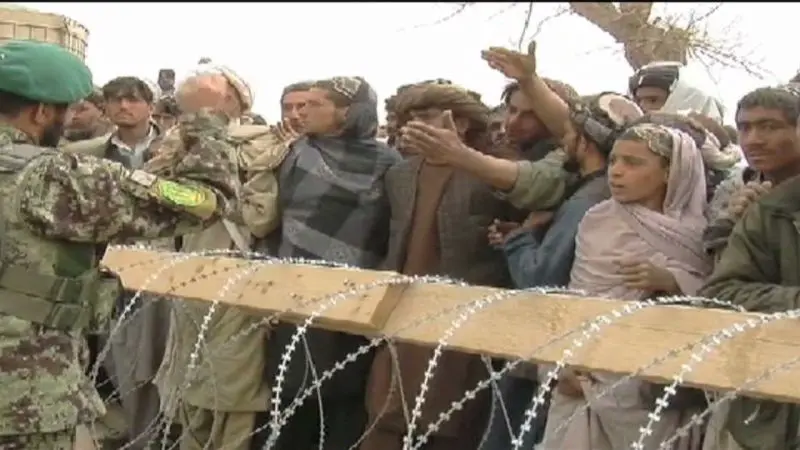
By Sunday afternoon, the focus in the villages shifted from rescue to mourning. Families spent the day digging graves and burying their dead, rejecting the traditional cycles of immediate retaliation in favor of shared grief, though the Taliban quickly issued statements vowing revenge for the massacre.
Villagers expressed deep betrayal, noting that they had only recently returned to their homes after receiving explicit assurances of safety from coalition forces at the nearby military base.
"This base told us to come back to our villages… we will not bother you. This is your land, and this is your own village," one grieving woman recalled. "But these dogs came and grabbed us."
Investigators from both Afghan authorities and the International Security Assistance Force (ISAF)—the U.S.-led NATO mission in Afghanistan—swarmed the villages. They combed the dust for shell casings, cataloged bloodstains, and interviewed shell-shocked survivors who struggled to comprehend how anyone could perpetrate such atrocities against infants. Pointing to the small bodies draped in shrouds, another villager demanded answers: "They are 2-year-olds. Are these Talibs?"
Supporting Context & Metrics: The Accused Soldier and the Local Environment
Profile of the Accused
As the investigation intensified, new and troubling details regarding the perpetrator emerged from the U.S. Department of Defense. Defense officials confirmed that the suspect was a U.S. Army staff sergeant. His military background was extensive and specialized:
- Combat Specialization: He was a qualified infantry sniper, rigorously trained to neutralize targets with lethal precision at ranges up to 800 meters.
- Deployment History: The sergeant had completed three arduous tours of duty in Iraq.
- Prior Trauma: During his service in Iraq in 2010, he suffered a traumatic brain injury (TBI) resulting from a vehicle accident.
- Current Status: Following medical treatment and subsequent evaluation, he was cleared to return to active duty and was serving his very first tour in Afghanistan at the time of the shooting.
The revelation that a veteran with a documented traumatic brain injury and elite sniper training was positioned in a vulnerable civilian interface zone sparked immediate scrutiny regarding military mental health screenings, combat fatigue protocols, and the deployment of soldiers with underlying psychological or neurological wounds.
The Panjwai District Context
Panjwai is not an ordinary district; it is deeply embedded in the narrative of the Afghan conflict. Known as the geographic cradle of the Taliban movement, it has witnessed some of the fiercest fighting of the war. Yet, prior to the massacre, local residents who had fled earlier hostilities had begun to trickle back. Many returned precisely because U.S. and NATO forces had established a local security footprint, promising that the area was pacified enough for civilian resettlement.
The tragedy severely undermined this fragile trust. Residents emphasized that they had not seen Taliban fighters in the area for five months prior to the incident, making the sudden, unprovoked assault by a coalition soldier all the more incomprehensible and devastating.
Official Statements and Diplomatic Friction
Condemnations and Official Responses
The international response was swift, marked by deep embarrassment and urgent damage control. U.S. President Barack Obama telephoned Afghan President Hamid Karzai to express his profound sorrow and personal condolences, promising a full, transparent, and swift investigation into the incident. Defense Secretary Leon Panetta and other high-ranking military leaders issued similar statements, characterizing the soldier’s actions as deeply tragic and entirely unrepresentative of the values of the U.S. armed forces.
However, these formal apologies carried little weight on the ground in Kandahar. With one family losing eleven members in a single night, local religious leaders and elders underscored the widening chasm between the occupying forces and the local population.
The Controversy Over Jurisdiction
The massacre immediately triggered a fierce jurisdictional battle between Afghan lawmakers and U.S. military authorities. Outraged Afghan parliamentarians demanded that the accused soldier be handed over to the Afghan justice system and face a public trial held on Afghan soil.
Pentagon and ISAF officials quickly rejected these demands. Pentagon Press Secretary George Little clarified the legal framework governing the case:
"The soldier was never in the custody of Afghan forces and will not face punishment under the Afghan justice system. The U.S. military has strong means to address wrongdoing. There is an agreement in place with the government of Afghanistan, so that the investigation — and when appropriate, prosecution — will be done through U.S. military channels."
This refusal to yield jurisdiction inflamed existing tensions. Village tribal leaders and ordinary citizens alike expressed deep skepticism that a U.S. military court-martial could deliver true justice for crimes committed against Afghan children, deepening the sense of alienation and injustice felt across the region.
Future Outlook: Implications for the NATO Mission
The Panjwai massacre stands as one of the most damaging single-incident moral crises of the post-2001 war in Afghanistan. It arrived at a critical juncture when coalition forces were already attempting to navigate a complex transition strategy, handing over security responsibilities to the Afghan National Security Forces (ANSF) ahead of a planned international withdrawal.
Strategic Fallout
- Erosion of Local Partnerships: The incident severely compromised the counterinsurgency doctrine of population-centric security. When villagers cannot trust the soldiers stationed to protect them, the foundational premise of partnership collapses.
- Fueling Insurgent Recruitment: While mass protests were temporarily averted due to grief and local fatigue, the Taliban capitalized on the tragedy to intensify their anti-Western propaganda and recruitment efforts, leveraging the civilian casualties to rally anti-coalition sentiment.
- Re-evaluating Military Health and Oversight: The case forced the Pentagon to re-examine how it screens soldiers for post-traumatic stress disorder (PTSD), traumatic brain injuries (TBIs), and cumulative combat fatigue, particularly among elite combatants deployed across multiple complex theaters of war.
As legal proceedings moved forward within the U.S. military justice system, the ghosts of Panjwai continued to haunt the coalition’s exit strategy. The tragedy served as a grim reminder of the human cost of prolonged asymmetric warfare—not only in the lives lost on the battlefield, but in the profound, irreparable breach of trust between an occupying military force and the vulnerable civilian population it vowed to protect.
