

Executive Overview
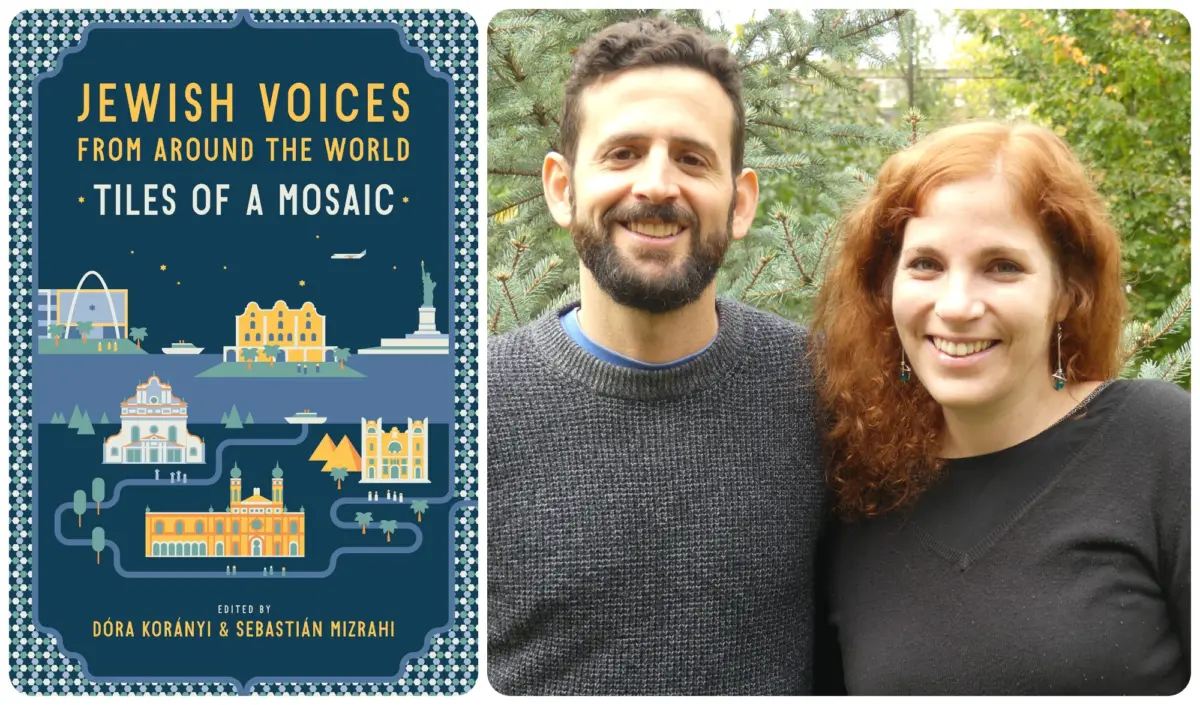
In 2020, as international travel abruptly halted and physical cultural spaces shuttered under global pandemic lockdowns, a unique digital initiative emerged to map the vast, under-documented topography of global Jewish heritage. Co-founded by Dóra Korányi, a Hungarian Jewish psychologist and former Budapest tour guide, and her husband, Sebastián Mizrahi—a Venezuelan-born cultural coordinator of Syrian- and Russian-Jewish descent raised by Argentinian parents—the platform Qesher (hebrew for "connection") set out to democratize access to diaspora narratives.
What began as a localized series of five virtual lectures quickly evolved into a international movement, bridging micro-communities across six continents. The project’s culmination is a flagship collection of 18 scholarly and personal essays titled Jewish Voices from Around the World: Tiles of a Mosaic, published in November by Vallentine Mitchell.
The publication marks a critical intervention in contemporary Jewish historiography. By elevating stories from historically peripheral communities—ranging from the Abayudaya of Uganda and the Afro-Cuban Jewish diaspora to the ancient trade-route Jews of India, Libya, and the Caribbean island of Curaçao—Qesher challenges dominant, binary narratives that often reduce Jewish identity to an Ashkenazi-Mizrahi dichotomy. The initiative underscores how digital connectivity can rescue endangered cultural memory, documenting how isolated pockets of the diaspora navigated forced migration, linguistic shifts, and complex internal controversies.
       [2020 Pandemic Lockdown]
                  │
                  ▼
   [Qesher Founded by Korányi & Mizrahi]
                  │
                  ▼
   [5-Part Virtual Lecture Series]
   (Budapest, Spain, Turkey, Bulgaria, Finland)
                  │
                  ▼
   [Global Expansion & Digital Archiving]
   (Uganda, Cuba, India, Libya, Curaçao, etc.)
                  │
                  ▼
   [Publication by Vallentine Mitchell]
   ("Jewish Voices from Around the World: Tiles of a Mosaic")
Detailed Chronology: From Pandemic Disruption to Global Anthology
The Pre-Pandemic Heritage Landscape (Pre-2020)
Prior to 2020, Korányi and Mizrahi operated independently within the cultural tourism sector. Korányi, leveraging her background in clinical psychology, offered specialized historical tours through Budapest’s historic 7th District (Erzsébetváros), exploring the complex layers of Hungarian Jewish history, assimilation, and post-Holocaust revival. Concurrently, Mizrahi organized Sephardic heritage expeditions across Spain, tracing the legacy of Bnei Anusim (descendants of Jews forced to convert during the Inquisition) and the medieval golden age of Iberian Jewry.
The Spring 2020 Pivot
When global travel restrictions invalidated traditional tourism models in early 2020, Korányi and Mizrahi recognized a growing paradox: while physical borders were closing, international audiences were increasingly seeking meaningful, remote cultural engagement.
In response, they launched a experimental series of five online lectures under the banner of Qesher. Utilizing their immediate professional network, the initial presentations featured local educators speaking on:
- The complex identity of post-war Budapest;
- Sephardic memory in modern Spain;
- The Ladino-speaking communities of Turkey;
- The historic Bulgarian Jewish diaspora; and
- The distinct, Northern European Jewish community of Finland.
+-------------------------------------------------------------------------+
|                    INITIAL QESHER LECTURE NETWORK                       |
+------------------+-----------------------+------------------------------+
| Geographic Hub   | Dominant Heritage     | Key Cultural Themes          |
+------------------+-----------------------+------------------------------+
| Budapest, HU     | Neolog / Ashkenazi    | Post-war revival & assimilation|
| Iberian Peninsula| Sephardic             | Inquisition legacy & diaspora|
| Istanbul, TR     | Judeo-Spanish/Ladino  | Ottoman integration & language|
| Sofia, BG        | Balkan Sephardic      | WWII rescue & survival        |
| Helsinki, FI     | Nordic Ashkenazi      | Integration in military/state|
+------------------+-----------------------+------------------------------+
Rapid Escalation and Audience Dynamics (2020–2022)
The pilot lectures yielded an immediate, unpredicted demographic response. The majority of early attendees joined from North America—many being second- or third-generation descendants of immigrants seeking deeper context regarding their family origins. Rather than remaining passive viewers, participants routinely requested programming on lesser-known, highly specific Jewish geographies.
Realizing that public demand exceeded their immediate network, Korányi and Mizrahi systematically identified scholars, local historians, and community elders capable of providing first-person accounts of historically isolated Jewish enclaves. Within months, Qesher grew from a transient lecture schedule into a permanent digital hub.
Curation and Publication (Late 2022–November)
Recognizing the ephemeral nature of live virtual presentations, the co-founders initiated an academic compilation project. They selected 18 contributors to transition their oral and visual presentations into rigorous essay format.
In late November, academic publisher Vallentine Mitchell released Jewish Voices from Around the World: Tiles of a Mosaic. The print anthology formally archived these localized histories, bringing peripheral diaspora perspectives into university libraries, institutional archives, and global public discourse.
Supporting Context & Metrics: Unpacking the Global Diaspora
The research synthesized by Qesher and formalized in Tiles of a Mosaic highlights several recurring themes across global Jewish history: the mechanics of forced exile, the adaptation of liturgical traditions to local geographies, and the socio-legal schisms that emerge within isolated populations.
+--------------------------------------------------------------------------+
|                 GLOBAL DIASPORA DYNAMICS & CASE STUDIES                  |
+--------------------+---------------------+-------------------------------+
| Region / Community | Key Cultural Dynamic| Documented Historical Event   |
+--------------------+---------------------+-------------------------------+
| Curaçao            | Liturgical /        | Schism over "haggafen" vs.    |
| (Dutch Caribbean)  | Linguistic Rigidity | "hageffen" leading to illegal  |
|                    |                     | underground house-prayers     |
+--------------------+---------------------+-------------------------------+
| Hungary            | Evolving Halakhic   | Broad cultural acceptance of  |
| (Central Europe)   | & Modern Identity   | patrilineal descent contrary  |
|                    |                     | to traditional matrilineality |
+--------------------+---------------------+-------------------------------+
| Uganda             | Independent Modern  | Formation of the Abayudaya    |
| (Sub-Saharan Africa)| Adoption            | community through direct      |
|                    |                     | biblical textual study        |
+--------------------+---------------------+-------------------------------+
| India              | Trade Network       | Co-existence of Bene Israel,  |
| (South Asia)       | Integration         | Cochin, and Baghdadi Jews     |
+--------------------+---------------------+-------------------------------+
The Anatomy of Internal Schism: The Curaçao Case
Among the anthology’s most vivid case studies of cultural preservation is the historical split within the Dutch Caribbean island of Curaçao—home to Mikvé Israel-Emanuel, the oldest continuously operating synagogue in the Americas. As Mizrahi notes, the Dutch colonial Sephardic community experienced a profound internal conflict caused by liturgical pronunciation.
The dispute centered on the final word of the Kiddush (the traditional blessing recited over wine). One faction insisted on the traditional Hebrew pronunciation "hageffen", while an emerging faction mandated "haggafen".
[Traditional Faction] ──► Pronunciation: "Hageffen" ──► Maintained Official Synagogue
                                                             │
                                                             ▼ [Denial of Royal Charter]
                                                             │
[Reformed Faction]    ──► Pronunciation: "Haggafen" ──► Formed Unsanctioned Underground House-Prayers
This linguistic divergence reflected deeper socio-economic and theological fractures between the established merchant elite and newer arrivals. The controversy escalated to the point where a dissenting faction submitted a formal petition to the King of Holland, requesting royal authorization to establish an independent, second congregation on the island. Upon the Crown’s rejection, the dissenting group broke away illegally, conducting clandestine services in private residences—a stark example of how religious and linguistic precision served as a battleground for identity and authority in isolated colonial outposts.
Fluidity vs. Orthodoxy: The Hungarian Contrast
In contrast to the strict orthodoxy observed in colonial Curaçao, Korányi highlights the dynamic, pragmatic adaptations that evolved in Central Europe, particularly in post-Holocaust Hungary.
Following the destruction of nearly two-thirds of Hungarian Jewry during World War II, and under the subsequent secularizing pressure of the Communist regime, traditional standards of Jewish identity underwent significant transformation. While traditional halakha (Jewish law) strictly dictates matrilineal descent—requiring a individual’s mother to be Jewish for the person to be recognized as such—modern Hungarian Jewish institutions developed a pragmatic tolerance.
In contemporary Budapest, individuals with patrilineal Jewish heritage are widely integrated into communal, educational, and cultural life. This flexibility illustrates how local history and trauma recalibrate communal boundaries, prioritizing inclusivity over strict adherence to ancient legal codes.
Official Statements and Editorial Philosophy
The founders’ approach combines rigorous historical research with personal narrative, allowing contributors to frame their histories through familial memory.
Dóra Korányi on the Genesis and Methodology of Qesher
"I’m a psychologist by training, but I used to guide tours in the Jewish quarter of Budapest as a hobby. When the pandemic hit, I stopped doing that, and Sebastián had to stop organizing his Sephardic heritage tours in Spain. We thought, we have all this knowledge; let’s do something online. First, we created just a series of five online lectures about the unique history, culture, and people of Jewish communities from people that we knew. I did my talk about Budapest, and then we brought in voices from Spain, Turkey, Bulgaria, and Finland.
Most of our audience ended up being from North America—people who knew their Jewish roots originated in different countries, but who knew very little of what is going on in those countries today, or the deeper history. Because there was so much interest, we looked for more speakers who could articulate the lived experience of other communities. It snowballed quickly. Within months, those lectures led to the creation of Qesher and, ultimately, the book.
We looked specifically for contributors who have deep roots in a place, who could integrate their family stories alongside historical research. Our goal is that when someone reads this collection, they experience the real diversity of Jewish communities, languages, and histories."
Sebastián Mizrahi on Common Patterns Across the Diaspora
"We wanted this book to emphasize Jewish communities whose stories are less often told, so that readers from those backgrounds could find something they personally connect to, while simultaneously discovering traditions entirely new to them.
Across all these diverse geographies—from the Sephardic communities of Spanish and Portuguese descent to Ashkenazi networks in Eastern Europe—there are structural patterns that keep repeating. We see recurring cycles of exile, forced migration, and unexpected asylum. Places received migrants from vastly different backgrounds who eventually connected, frequently resulting in intermarriages between Sephardic and Ashkenazi families that altered the cultural landscape of those cities.
Small details often reveal the deepest truths about a culture. The Curaçao essay, for example, illustrates how liturgical exactness occupied a central role in communal life—a contrast to other regions where survival necessitated flexibility. In Curaçao, when the King of Holland denied the dissenting faction’s petition for a new synagogue, they simply formed an unauthorized, underground community and prayed in their homes. These accounts demonstrate that the Jewish diaspora is not a monolith, but an interconnected mosaic."
Future Outlook & Industry Implications
The publication of Jewish Voices from Around the World: Tiles of a Mosaic represents a broader shift in how identity, cultural preservation, and diaspora studies intersect with modern publishing and digital media.
+--------------------------------------------------------------------------+
|                     FUTURE STRATEGIC ROADMAP FOR QESHER                   |
+-------------------+------------------------------------------------------+
| Pillar            | Strategic Objective                                  |
+-------------------+------------------------------------------------------+
| Digital Archive   | Expand open-access digital repositories featuring    |
|                   | oral histories from endangered communities.          |
+-------------------+------------------------------------------------------+
| Institutional     | Partner with university Judaic studies departments   |
| Integration       | to integrate the text into academic curricula.       |
+-------------------+------------------------------------------------------+
| Hybrid Cultural   | Relaunch specialized, ethical heritage tourism       |
| Tourism           | combining physical travel with pre-trip lectures.    |
+-------------------+------------------------------------------------------+
| Translation &     | Translate the anthology into Spanish, Hebrew, and    |
| Global Reach      | French to reach non-English diaspora networks.       |
+-------------------+------------------------------------------------------+
Expanding the Digital Archive
Qesher plans to maintain its virtual platform as an interactive, open-access archive. As elder generations within smaller diaspora communities—such as the indigenous Jews of Cochin or the shrinking communities of North Africa—pass away, the platform’s audio-visual recordings serve as primary source materials for future academic research.
Educational Integration
With Vallentine Mitchell handling academic and institutional distribution, the essays in Tiles of a Mosaic are being integrated into university-level Jewish Studies, anthropology, and migration studies curricula. By providing accessible, peer-reviewed primary perspectives from non-Western Jewish hubs, the text fills a long-standing gap in standard academic textbooks.
The Evolution of Cultural Tourism
As global travel has resumed, Korányi and Mizrahi are blending physical heritage tours with digital preparation. Travelers are increasingly seeking immersive educational experiences over standard sight-seeing. Qesher’s model demonstrates that virtual lectures can build informed, respectful travel cohorts who engage with host communities through an understanding of their distinct histories.
By transforming a pandemic-era pivot into an enduring educational platform, Qesher has established a durable blueprint for cultural preservation. The initiative proves that even the most dispersed communities can bridge geographic, linguistic, and historical divides to preserve their shared legacy.
