The contemporary technology landscape is dominated by a singular, persistent corporate delusion: the assumption that every human being is desperately waiting for artificial intelligence to permeate every facet of their personal and professional existence. Across Silicon Valley boardrooms, enterprise software conventions, and product strategy meetings, leaders operate under the evangelistic belief that "more AI" is an absolute, self-evident value proposition. If a product is not "AI-first," it is deemed obsolete. If a workflow does not incorporate a generative chatbot, it is considered inefficient.
Yet, this utopian vision collides harshly with a mundane, frustrated reality. Most people do not want more artificial intelligence—at least, not in the intrusive, disruptive, and poorly implemented ways enterprise leaders envision it.
Data from recent enterprise adoption studies reveals a glaring chasm between massive corporate investments in generative AI and actual user retention. Far from driving unbridled excitement, uninvited AI integrations frequently result in low adoption rates, high delivery costs, and severe reputational damage for the companies pushing them. Rather than liberating humanity from drudgery, the relentless push for "vibe-coded" automation is intensifying workloads, compounding organizational inefficiencies, and threatening the creative essence of human labor.
This investigative piece explores why the current "AI-first" paradigm is failing end-users, how technology is mistakenly being positioned as a value proposition rather than an operational tool, and what the market actually demands: an "AI-second" approach that respects human agency, preserves critical thinking, and quietly eliminates the dullest aspects of daily life.
Detailed Chronology: The Evolution of the AI Fatigue Loop
To understand how the technology sector arrived at this profound disconnect, one must trace the rapid, breathless timeline of the generative AI boom and its subsequent operational hangover.
Phase 1: The Gold Rush of "Bolt-On" Innovation (2022–2023)
Following the public debut of advanced large language models, corporations panicked. Fearing the "Kodak moment" of obsolescence, executive leadership across virtually every industry mandated immediate AI integration. Product teams were pressured to ship features overnight. The resulting products were classic "bolt-ons"—separate, disconnected chat interfaces shoehorned into existing software suites.
During this initial phase, velocity was king. Companies measured success not by user utility or long-term retention, but by press releases and stock price bumps. However, these rushed implementations ignored fundamental principles of user experience (UX) design, thrusting unpredictable, hallucination-prone models directly into mission-critical employee and consumer workflows.
Phase 2: The Productivity Illusion and Workflow Fragmentation (2024–2025)
As organizations forced these tools into daily operations, the promised productivity gains failed to materialize in the ways executives expected. Instead of reducing labor, AI tools multiplied the number of systems workers had to navigate.
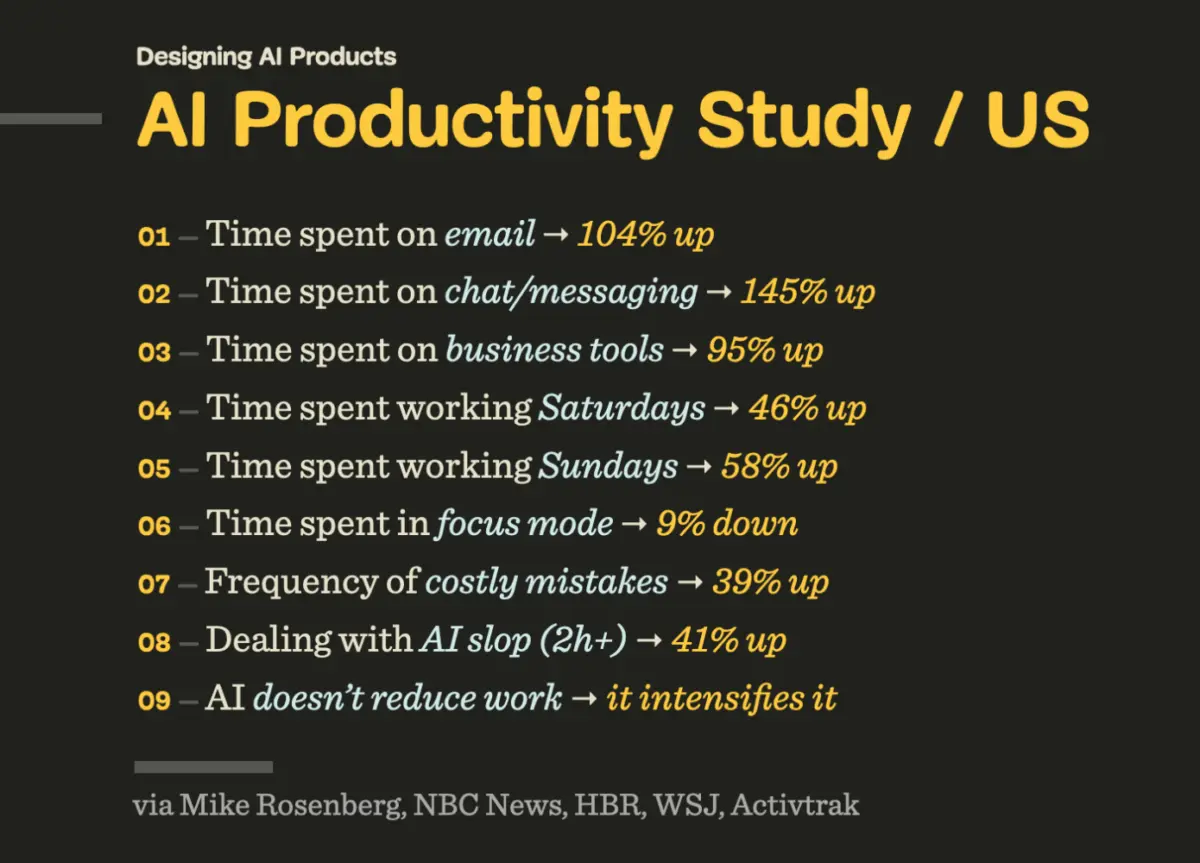
Employees found themselves jumping endlessly between fragmented applications, now tasked with an entirely new burden: managing, prompting, and—most importantly—fact-checking the output of generative algorithms. The hidden labor of error-checking began to eclipse the time saved by automated drafting. Furthermore, studies tracking enterprise digital habits revealed a startling trend: time spent managing emails, chat messaging, and business tools surged dramatically, while deep-focus time plummeted. Workdays expanded into evenings and weekends as professionals struggled to clean up after autonomous software agents.
Phase 3: The Reckoning of User Resistance (2026 and Beyond)
Today, the market is experiencing a profound psychological backlash. Users are no longer willing to accept "Powered by AI" as a valid substitute for genuine utility. Consumers are rejecting forced AI integrations—from unnecessary conversational interfaces in home appliances to automated narrative features in children’s books and uninvited agents poking through personal financial accounts.
The prevailing public sentiment has shifted from wide-eyed optimism to deep-seated skepticism, change fatigue, and anxiety over job security. As organizations recognize that AI cannot patch over years of poor data hygiene, broken corporate cultures, and internal political silos, a sobering realization has taken hold: the market is ready for a fundamental redesign of how artificial intelligence serves human needs.
Supporting Context & Metrics: The Human and Economic Toll
The disconnect between corporate aspiration and human desire is laid bare when examining empirical workplace data and economic research.
The Productivity Paradox
Comprehensive analyses tracking corporate productivity following aggressive AI rollouts have upended the narrative that automation inherently lightens workloads. Rather than reducing labor, AI frequently intensifies it. Key metrics from recent workforce productivity studies highlight alarming operational costs:
Surge in Digital Communication: Time spent managing enterprise email has increased by over 100%, while corporate chat and messaging volumes have jumped by upwards of 140%.
Erosion of Deep Work: Employee focus mode metrics have declined globally, directly correlated with the constant fragmentation introduced by secondary AI tools.
The Weekend Creep: Professional work spilling over into Saturdays and Sundays has risen significantly, driven by the need to manage system backlogs and review automated outputs.
The Cost of "AI Slop": Dealerships, customer service desks, and corporate offices report an estimated 40% increase in time wasted managing, correcting, or filtering low-quality, AI-generated errors and hallucinations.
+--------------------------------------------------------------------------+
|                  THE AI PRODUCTIVITY PARADOX (US STUDY)                  |
+--------------------------------------------------------------------------+
|  Email Time Management  ............................... +104%          |
|  Chat & Messaging Volume .............................. +145%          |
|  Business Tool Hopping  ...............................  +95%          |
|  Weekend Work (Sat/Sun) ...............................  +52% (Avg)    |
|  Costly Operational Mistakes ..........................  +39%          |
|  Dealing with "AI Slop" & Hallucinations ..............  +41%          |
|  Focus Mode & Deep Work ...............................  -9%           |
+--------------------------------------------------------------------------+
|  Conclusion: AI doesn't reduce work—it intensifies and fragments it.     |
+--------------------------------------------------------------------------+
AI Is Not a Value Proposition
In product design and business model strategy, a fundamental error is being made: treating artificial intelligence as an end-user value proposition. As renowned design frameworks and business canvas analyses demonstrate, AI belongs strictly in the realm of Key Activities and Key Resources, not in the Value Proposition box.
Customers do not buy a product because it has AI inside; they buy it because it solves a specific problem reliably, quickly, and predictably. When AI features are unreliable, they cease to be assets and instantly become liabilities. Unlike deterministic software—which executes the exact same code every time—probabilistic AI models introduce variance, forcing users to constantly audit outputs for errors.
Vulnerability vs. Adaptability in the Labor Market
Research from organizations such as the Brookings Institution and GovAI, highlighted in major economic analyses by The Washington Post, maps the complex vulnerability of various professions to AI automation. Software developers, creative writers, and public relations specialists find themselves highly exposed to generative automation.
Yet, the danger lies not in the automation of routine tasks, but in the corporate impulse to strip the human element entirely out of creative, high-judgment domains. The professions least vulnerable—and most satisfying—are those where human intuition, physical presence, and empathetic judgment remain paramount.
Official Statements and Industry Perspectives
The backlash against forced AI integration has united designers, economists, and corporate strategists in calling for a radical reassessment of product development philosophies.
Industry thought leaders have forcefully articulated the boundaries of where artificial intelligence belongs in human society. Notably, enterprise leader and strategist Bo Young Lee captured the sentiment of millions in a widely circulated industry statement:
"I don’t want to read books written by AI. I don’t want to gaze upon paintings by AI. I don’t want AI to teach my children. I don’t want to have an AI therapist. I don’t want AI making my medical decisions. I want AI to do all the physical and mental labor that taxes me so I can read books written by humans and go to art galleries to engage with art made by humans. I want AI that makes my life easier rather than forces me to change myself."
This perspective cuts to the core of the issue: technology should bend to human habits, cognitive models, and emotional needs—not the other way around.
UX design experts and product educators echo this caution, emphasizing that users do not evaluate software by comparing it to the imperfections of other human beings; they compare software features directly against other software features. If a traditional, non-AI feature works with 100% predictability and an AI-driven feature fails 5% of the time, the user will reject the AI feature every single time. Reliability will always trump novelty.
Future Outlook: The Rise of the "AI-Second" Paradigm
As the initial hype cycle matures into pragmatic disillusionment, the technology sector stands at a critical crossroads. The future of successful digital product design will not be defined by "AI-first" dogmatism, but by a more mature, humble philosophy: AI-Second design.
1. Moving from Replacement to Augmentation
The primary objective of enterprise AI must shift away from the radical fantasy of replacing entire human workflows. Instead, technology should focus squarely on augmentation. AI excels at absorbing mundane, repetitive, and mentally exhausting administrative drudgery—data entry sorting, baseline log categorization, and tedious formatting. By absorbing these low-joy tasks, technology can return precious time and mental bandwidth to workers, allowing them to focus on high-level strategy, empathy, and creative execution.
2. Ambient, Calm, and Invisible Integration
The best tools are those that vanish into the background. Rather than forcing users to open dedicated chat windows, type endless conversational prompts, or micro-manage autonomous agent swarms, future systems should integrate seamlessly into existing mental models. Whether a feature utilizes machine learning, algorithmic automation, or advanced neural networks is irrelevant to the end-user; what matters is that it operates predictably, quietly, and reliably without demanding constant cognitive overhead.
3. Re-centering Human Connection
Ultimately, the technology industry must remember that humans are social creatures who thrive on authentic connection, shared narratives, and emotional resonance. The ultimate promise of automation should never be a future where humans spend more time talking to algorithms and managing machine-generated content.
The true horizon of artificial intelligence is to handle the invisible friction of daily existence so cleanly and efficiently that humanity is left with more time to do what it has always loved doing: spending meaningful, uninterrupted time with other human beings.