

Executive Overview
On Capitol Hill, political theater frequently borders on the absurd, but rarely does a high-stakes congressional hearing dissolve into a mix of constitutional hardball and women’s college basketball trivia. That, however, is precisely what transpired during a tense Tuesday hearing featuring former special counsel Jack Smith.
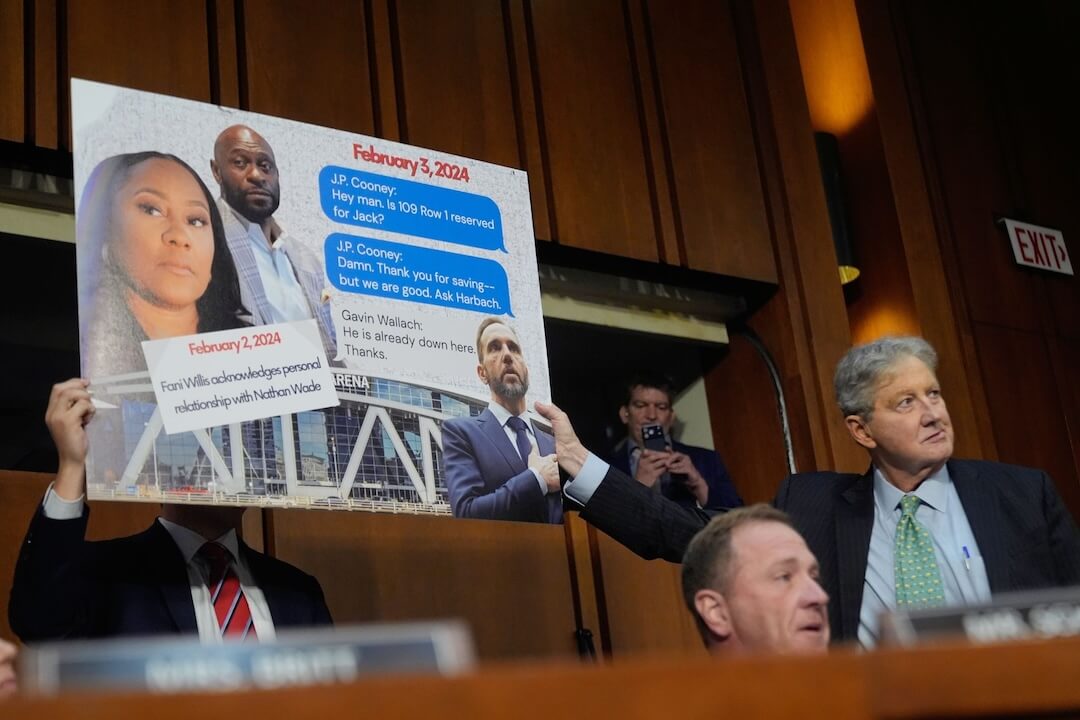
While the proceedings were designed to offer congressional Republicans a platform to scrutinize Smith regarding his landmark investigations into Donald Trump, the session instead delivered a viral, self-inflicted political disaster. Missouri Republican Senator Eric Schmitt attempted to execute a dramatic "gotcha" moment, accusing Smith of perjury over an alleged trip to an Atlanta Hawks NBA game.
Instead of trapping the former prosecutor, Schmitt fell flat on his back. Smith effortlessly dismantled the accusation by revealing he was actually in Maryland watching Iowa Hawkeyes superstar Caitlin Clark. The blunder sparked an immediate avalanche of bipartisan ridicule, media condemnation, and widespread incredulity across Washington.
Beyond the Capitol Hill spectacle, the broader media landscape remains under siege. Tensions between the White House and the press corps have reached a boiling point as major news organizations fight to extend temporary protections against executive press bans. Meanwhile, legacy institutions like The Washington Post are attempting to pivot toward institutional resilience, publishing their inaugural impact report following a tumultuous period of sweeping layoffs. This report explores the convergence of these developments, examining the intersection of political overreach, First Amendment battles, and the evolving state of modern journalism.
Detailed Chronology of a Congressional Blunder
The trouble began on Tuesday morning as the Senate Judiciary Committee convened. Jack Smith, who led the high-profile federal investigations into Donald Trump, stepped up to testify. For Republican lawmakers, the hearing was viewed as an opportunity to aggressively question Smith’s prosecutorial decisions and alleged political motivations.
However, the proceedings took an intensely bizarre turn when Senator Eric Schmitt claimed the spotlight—not for a sharp legislative inquiry, but for what media observers immediately dubbed an "epic face-plant."
According to reporting by The New York Times, Schmitt adopted a conspiratorial tone during his questioning. He suggested that Smith had traveled to Atlanta to meet with a local prosecutor who had also brought charges against Donald Trump. When Smith categorically denied the trip, Schmitt escalated the stakes. Armed with what he believed was an airtight paper trail, the Missouri senator accused Smith of perjury, aggressively labeling him a "dirtbag."
"I’ll give you a second to process it so you don’t, you know, perjure yourself," Schmitt stated, doubling down on the accusation. "I think you’ve already perjured yourself."
Smith, visibly baffled by the line of questioning, calmly clarified his whereabouts during the timeframe in question. In February 2024, Smith stated, he had indeed attended a basketball game—not in Atlanta, and certainly not an NBA match. Instead, he had traveled to the University of Maryland to watch then-Iowa Hawkeyes sensation Caitlin Clark dominate the hardwood.
The realization of the error dawned slowly in the hearing room before Democratic Senator Amy Klobuchar of Minnesota intervened. Piecing together the glaring logical gap, Klobuchar deduced that Schmitt’s staff—or the senator himself—had catastrophically confused the nickname of the University of Iowa (the Hawkeyes) with the National Basketball Association’s Atlanta franchise (the Hawks).
Rather than gracefully walking back the explosive claim, Schmitt dug in his heels. Klobuchar publicly urged the Missouri Republican to apologize to Smith, particularly given the disparaging "dirtbag" remark hurled across the dais. Schmitt refused.
"I’m going to begin my questions now," Klobuchar remarked, visibly exasperated. "But I think that people should have their facts straight before they accuse someone of being a dirtbag and not get the teams wrong."
Supporting Context & Metrics: The Media Reaction
The fallout from Schmitt’s error was instantaneous and merciless, echoing across digital platforms and cable news broadcasts alike. Veteran journalists and political commentators dissected the blunder as a textbook example of confirmation bias blinding a lawmaker to basic reality.
- Alex Griffing (Mediaite): Characterized the incident as an "epic face-plant," noting it triggered an immediate cascade of criticism from media pundits.
- Chuck Todd (Veteran Journalist): Posted on social media that the moment was "just an embarrassing moment for GOP Sen. Schmitt. What a disaster. Confirmation bias virus runs deep with Schmitt."
- Jonathan Karl (ABC News): Expressed shock at the parliamentary anomaly, tweeting, "This was bizarre. I have never seen ‘evidence’ introduced so quickly and then hidden. Senator Eric Schmitt accuses Jack Smith of perjury for denying he went to an Atlanta Hawks game… As it turns out, he went to an Iowa Hawkeyes game (in Maryland)."
- Scott MacFarlane (MeidasTouch / Formerly CBS News): Noted the rarity of the misstep after two decades on Capitol Hill, stating, "An absolutely brutal mistake by Sen. Eric Schmitt and his staff. 24 years of covering Congressional hearings… I’ve never seen anything like this."
- Charles P. Pierce (Esquire): Delivered a scathing critique in Esquire, writing that the senator "lacks only a red rubber nose and some floppy shoes," before calling for a higher standard among the electorate: "Vote for conservatives if you must. But please, stop electing idiots to high office. It’s a millstone on the rest of us."
- Scott Jennings (Conservative CNN Contributor): Conceded on-air that it was a "rough moment," though adding that he personally likes Schmitt as a Missouri politician, validating that the episode was an undeniable miscalculation.
Ultimately, Politico captured the absurdity of the narrative with a headline that quickly became definitive: "Eric Schmitt pins down Jack Smith — as a Caitlin Clark fan."
Official Statements & Broader Implications
While Capitol Hill absorbed the shockwaves of Schmitt’s geographical and athletic confusion, the wider war between the executive branch and the news media intensified away from the hearing room.
Two weeks prior, the White House barred three prominent news organizations—CNN, MS NOW, and Politico—from entering the complex, stripping them of their press credentials. In response, the media outlets sought immediate legal recourse, securing a 14-day temporary restraining order from a federal judge that restored their access. With that temporary order nearing its expiration date of October 8, attorneys for the outlets filed motions asking a federal district court to issue a preliminary injunction blocking the ban while the underlying lawsuit proceeds.
In a late-Monday legal filing, attorneys wrote:
"The White House’s words and actions leave little doubt that it will immediately reinstitute a complete ban of CNN, MS NOW, and POLITICO if allowed the opportunity. Because the ban is an unlawful assault on the most fundamental First Amendment freedoms and will inflict irreparable harm on Plaintiffs and the public if not restrained, this Court should preliminarily enjoin its enforcement pending the resolution of this case."
Theodore J. Boutrous Jr., lead counsel for the media coalition, issued a scathing statement to The Associated Press:
"This is a blatant violation of the First Amendment and due process. The president and his administration have continued to make clear that this ban has only one purpose: to punish reporting he doesn’t like. That’s retaliation and viewpoint discrimination, pure and simple. With the district court’s temporary restraining order expiring this week, it is critical to ensure that the White House continues to be prevented from implementing this unconstitutional ban on the free press."
The administration has maintained its stance that physical access to the White House press facilities is a discretionary privilege rather than a constitutionally mandated right. Concurrently, press freedom watchdogs have flagged a broader escalation in hostile rhetoric. Writing for the Los Angeles Times, Washington bureau chief Michael Wilner observed: "With bans and taunts, Trump escalates his assault on the media." Wilner pointed to instances where the administration praised authoritarian models of press control and repeatedly disparaged female journalists regarding their professional credentials and personal appearance.
Future Outlook: Rebuilding and Redefining Journalism
Amidst institutional friction with the federal government, traditional newsrooms are working to reestablish public trust through demonstrable accountability reporting.
The Washington Post recently published its inaugural "Washington Post Impact Report," a comprehensive compilation of investigative reporting from the first half of 2026 that drove tangible policy changes and institutional reforms. The release comes after a historically difficult period for the publication, marked by devastating mass layoffs in February that saw roughly a third of its total workforce—including more than 300 journalists—eliminated. Those cuts severely impacted the metro, foreign, and sports desks, prompting former executive editor Marty Baron to characterize the moment as "among the darkest days in the history of one of the world’s greatest news organizations."
Despite these severe cutbacks, the surviving newsroom personnel have continued producing high-impact investigative work. In the report’s foreword, executive editor Matt Murray addressed the turbulence head-on:
"It’s no secret that The Post has been through a challenging period, amid upheaval in our industry. But, as this report clearly shows, our commitment to significant, impactful journalism in the public interest has not wavered."
The impact report highlights 40 major investigative pieces, ranging from multi-state legal challenges against Immigration and Customs Enforcement (ICE) infrastructure projects to bipartisan congressional legislation aimed at reforming federal subpoena deployments for communication records. The publication claims to have broken over 200 exclusive scoops throughout the year, with August marking its highest monthly volume of exclusive reporting since April 2020.
As autumn progresses, the convergence of these storylines—the accountability hearings on Capitol Hill, the ongoing First Amendment battles over White House access, and the structural reorganization of legacy newsrooms—underscores a volatile, high-stakes era for American democracy. Whether through the lens of a senator misidentifying an Iowa basketball star or federal judges weighing the boundaries of executive authority over the press, the tension between narrative and reality remains sharper than ever.