Artificial intelligence has officially crossed the threshold from experimental novelty to foundational workplace infrastructure. For freelance writers, the debate is no longer whether to integrate automated systems into daily operations, but how to do so without sacrificing the critical human elements that command premium rates.
Industry analysis reveals a stark divide in the freelance marketplace. Those thriving in the current climate treat tools like ChatGPT, Claude, and Perplexity as high-speed administrative assistants and structural sounding boards. By outsourcing the cognitive friction of initial ideation, structural outlining, and preliminary research, these professionals free up valuable bandwidth for high-value tasks: strategic thinking, original interviews, and client relationship management.
Conversely, professionals struggling to maintain traction fall into two counterproductive camps: total avoidance, which leaves them at a structural speed disadvantage, or over-reliance, which yields homogenized, easily identifiable mediocre content.
This report examines 10 strategic integrations of artificial intelligence designed to enhance professional writing workflows, safeguard human expertise, and scale freelance businesses efficiently.
Detailed Chronology: The Evolution of the AI-Enhanced Writer
To understand where freelance writing stands today, it is necessary to examine how the relationship between human creators and machine tools has evolved over recent years:
Phase I: The Novelty & Fear Epoch (2022–2023): Early large language models burst onto the scene, triggering widespread anxiety regarding the automation of creative labor. Writers experimented with direct prompt-to-publish workflows, resulting in a flood of uninspired, formulaic content across the web.
Phase II: The Detection & Rejection Era (2023–2024): Clients and search engines quickly developed sophisticated detection mechanisms. Low-effort AI generation was penalized, proving that substituting the human mind entirely leads to a loss of voice, trust, and market value.
Phase III: The Collaboration & Augmentation Standard (Present Day): The industry has settled into a pragmatic paradigm. Successful freelancers recognize that AI excels at low-level procedural tasks—breaking the blank page, organizing chaotic notes, and summarizing data—while humans retain ownership over deep expertise, emotional resonance, and final editorial integrity.
Supporting Context & Metrics: The Modern Freelance Workflow
Integrating machine assistance into a writing business is not about replacing the craft; it is about reclaiming hours lost to administrative drag and structural paralysis. Below are the 10 core integration vectors where artificial intelligence acts as an accelerator rather than a replacement.
1. Beating the Blank Page
The psychological barrier of starting a project remains one of the greatest drains on creative energy. Staring at an empty document knowing the topic but lacking an entry point induces immediate friction.
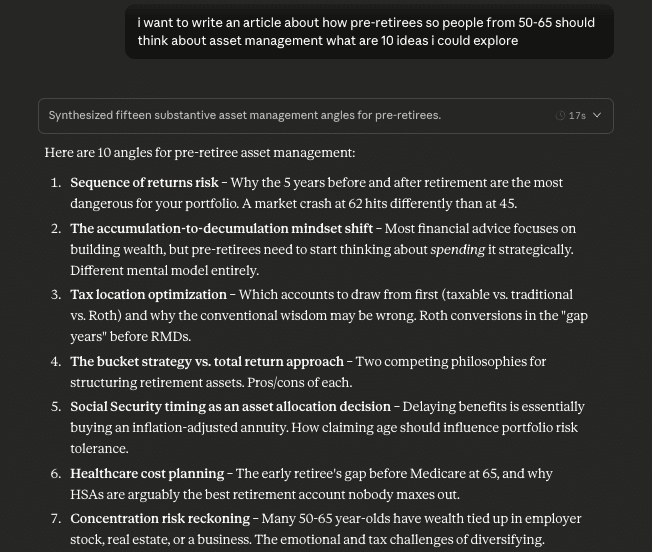
The Strategy: Use models like ChatGPT or Claude not to generate the final manuscript, but to force movement. Ask the system for ten distinct angles, five unconventional opening lines, or a comprehensive list of reader questions.
The Value: While most generated ideas will require refinement, the mere presence of text breaks cognitive paralysis, providing a concrete baseline to react against.
2. Streamlining Structural Outlining
Professional content requires rigorous organization before drafting begins. Moving directly from a concept to drafting often results in meandering prose and fragmented arguments.
The Strategy: Feed core thematic elements, target audience parameters, and initial research quotes into an AI workflow to generate preliminary structural outlines and subheadings.
The Value: Advanced users can establish standardized intake prompts—providing raw, messy thoughts about goals and data—allowing the AI to rapidly synthesize logical hierarchies that highlight overlooked angles or missing sections.
3. Elevating Research and Triage
Digital research involves reading dozens of dense reports, academic studies, and articles to extract isolated metrics or arguments.
The Strategy: Utilize tools designed for research, such as Perplexity Pro, which cross-references live web data and supplies direct citations. Paste lengthy texts into Claude or ChatGPT to rapidly surface key statistics, summarize core arguments, and isolate relevant themes.
The Value: This approach functions as an automated research assistant, allowing writers to quickly triage source material in minutes rather than spending hours reading dead-end documents.
4. Drafting Cold Outreach and Letters of Introduction (LOIs)
Initiating contact with prospective marketing agencies or corporate clients is a repetitive, fatiguing chore that frequently leads to procrastination.
The Strategy: Leverage AI to establish foundational drafts of cold emails and Letters of Introduction. Request multiple variations tailored to different agency sizes or campaign goals.
The Value: AI can rapidly construct 70% to 80% of the structural framework. However, the final human touch—such as referencing a company’s recent award, industry milestone, or specific piece of published research—must be added manually to prevent the message from looking like a mass-distributed template.
5. Crafting High-Impact Headlines and Hooks
An exceptional article can fail entirely if its headline or opening hook lacks psychological pull. Balancing curiosity with specificity without crossing into clickbait is an ongoing challenge.
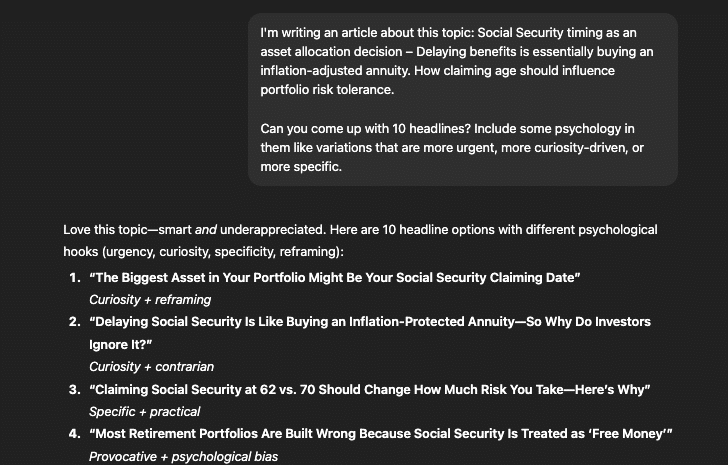
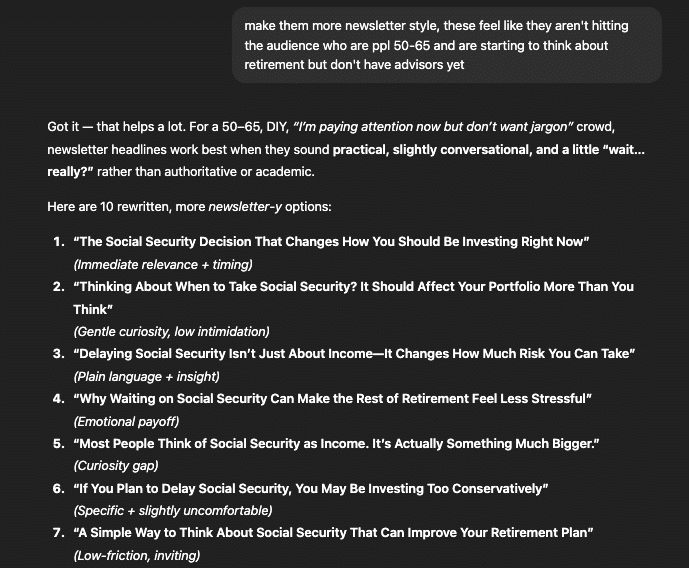
The Strategy: Prompt language models to generate ten distinct headline variants optimized for urgency, curiosity, or specificity. Use generated options as raw material to mix, match, and refine.
The Value: This eliminates the pressure of generating the single "perfect" title from scratch, utilizing rapid iteration to spark creative breakthroughs.
6. Intelligent Editing and Proofreading
Human editors frequently miss repetitive errors because the brain naturally fills in what it expects to see based on authorial intent.
The Strategy: Deploy dedicated proofreading platforms like Grammarly alongside conversational LLMs configured to act as critical developmental editors or target-audience reader focus groups.
The Value: AI helps flag structural wordiness, convoluted syntax, and confusing transitions. While specialized tools catch surface-level grammar, conversational models help identify conceptual gaps, ensuring the final copy resonates clearly with the intended reader.
7. Scalable Content Repurposing
Producing a comprehensive 1,500-word piece of long-form content requires significant cognitive effort, yet relying on a single distribution channel limits audience reach.
The Strategy: Feed finalized articles into an AI workspace and request specific derivative assets: a LinkedIn thought-leadership thread, an email newsletter teaser, or a breakdown of micro-statistics for social promotion.
The Value: Every foundational piece of writing can yield five to ten distinct promotional assets, transforming a single workflow into an omnichannel distribution machine without proportional increases in writing time.
8. Precision Interview Preparation
Conducting high-level Subject Matter Expert (SME) interviews requires sharp, informed inquiry to extract unique insights and authoritative quotes.
The Strategy: Input the interviewee’s background, professional history, and core article themes into an AI system to generate targeted, insightful interview questions.
The Value: This preparation prevents the interviewer from wasting valuable time on basic, easily Googleable questions, elevating the quality of the conversation and easing pre-interview anxiety.
9. Transcript Mining and Synthesis
Interviews frequently generate massive, unstructured walls of transcript text from tools like Otter.ai, making it difficult to locate crucial details later.
The Strategy: Utilize built-in transcript chat features to query recorded sessions. Ask the model to extract the top five thematic quotes, summarize technical explanations, or sort statements by specific topics.
The Value: This drastically cuts down post-interview organization time. Crucial Caveat: Every extracted quote must be manually cross-referenced against the original audio to ensure absolute fidelity and accuracy before publication.
10. Automated Marketing and Outreach Tracking
Many creative professionals struggle with administrative tasks, letting marketing tracking spreadsheets fall out of date and obscuring business metrics.
The Strategy: Use conversational tracking environments (such as Claude Cowork) to log outbound marketing activities in plain text: dates, contact names, outreach types, and responses. Periodically request monthly or weekly scorecards summarizing key performance indicators.
The Value: Over time, these automated logs reveal actionable business intelligence—such as response rates per niche, required volume to land a client, and conversion bottlenecks—motivating continuous refinement of outreach strategies.
Official Industry Statements & Ethical Guardrails
As integration deepens, industry leaders emphasize clear ethical boundaries to preserve the integrity of the profession.
"AI tools are designed to eliminate administrative drag, not creative ownership," notes Sean Ogle, founder of Location Rebel. "The freelancers who dominate this landscape use automation to handle the tedious mechanics of the business—outlining, tracking, research triage—so they can pour more energy into the deep thinking, personal interviews, and relationship-building that humans value most."
What NOT to Do With AI:
To maintain professional standing and client trust, freelancers must avoid specific pitfalls:
Full-Text Generation: Submitting unedited, raw AI outputs as finished professional writing.
Fabricated Sourcing: Trusting AI memory without verifying facts, statistics, and citations.
Impersonal Outreach: Sending uncustomized, machine-generated cold pitches that lack genuine knowledge of the prospect’s business.
Future Outlook
The trajectory of the freelance writing industry is clear: efficiency is the new baseline, but differentiation is driven entirely by human touch. As automated text generation becomes ubiquitous, the market value of raw words will continue to decline, while the value of original reporting, specialized expert interviews, authentic voice, and strategic insight will surge.
Freelancers who master the collaborative workflow—using AI as an operational force multiplier while retaining rigorous control over quality, voice, and accuracy—will scale their businesses, increase their output, and protect themselves against burnout. The future belongs not to the writers who resist technology, nor to the machines that attempt to mimic humanity, but to the strategic professional orchestrating both.