

Executive Overview
In the fast-paced ecosystem of digital publishing and freelance writing, the currency of the realm is time. For writers who specialize in deep-dive, authoritative content, subject matter expert (SME) interviews form the bedrock of credibility. However, capturing these rich conversations has traditionally exacted a heavy toll in time and cognitive load. A standard 20-minute expert interview can easily generate upwards of 3,000 words of dense dialogue, historically requiring grueling hours of manual transcription or painstaking back-and-forth review of audio recordings just to extract accurate quotes.
Enter AI-driven transcription tools, a technological shift that has fundamentally altered the production workflows of independent media creators. Among them, Otter.ai has emerged as a ubiquitous fixture for many professionals since its widespread adoption around 2020. This report investigates the real-world utility, economic return on investment (ROI), operational limitations, and competitive landscape of Otter.ai’s Pro tier—retailing at approximately $100 per year—through the lens of working freelance journalists and content creators.
Detailed Chronology of the Transcription Dilemma
To understand the transformative impact of automated transcription tools, one must examine the evolution of the modern freelance workflow. For decades, the process of conducting, recording, and transcribing interviews followed a rigid, analog-to-digital timeline fraught with inefficiencies.
The Era of Manual Note-Taking and Tape
In the early days of digital journalism, writers relied heavily on shorthand notebooks or digital voice recorders, followed by relentless transcription sessions. A single hour-long conversation could take anywhere from two to four hours to transcribe manually. This divided focus during the interview itself: the writer was perpetually caught between the competing demands of actively engaging with the SME to develop dynamic story angles and frantically recording verbatim notes. The inevitable result was twofold: compromised conversational depth and fragmented interview content.
The Rise of Human-Powered Services
As digital platforms matured, third-party human transcription services offered a reprieve, albeit a costly and slow one. Writers could upload audio files to services that promised high accuracy delivered by human transcribers. Yet, this workflow introduced a crippling bottleneck: turnaround times typically ranged from three to five business days. For modern freelancers operating under tight editorial deadlines—where an entire assignment from pitching to publication might span a single week—waiting days for a transcript was untenable unless the writer was willing to absorb steep rush fees.
The AI Inflection Point
The mainstream deployment of automatic speech recognition (ASR) and natural language processing (NLP) around 2018–2020 marked a definitive turning point. Tools like Otter.ai shifted the paradigm from asynchronous human labor to instantaneous algorithmic processing. Transcripts began appearing on screens the exact second a call concluded. For interview-reliant writers, this compression of the timeline eliminated the traditional post-interview lag, bridging the gap between field reporting and drafting text.

Supporting Context & Metrics: The Economics of AI Transcription
For independent contractors and small business owners, every software subscription must justify its place on the balance sheet. At roughly $100 annually for the Pro plan, Otter.ai demands a financial evaluation based on productivity metrics, hourly rates, and real-world efficiency gains.
Calculating the ROI for Freelance Writers
Consider a typical professional assignment: a 1,000-word article commissioned for $1,200, requiring a single SME interview. The standard workflow breaks down into distinct phases:
- Research & Prep: 1 hour
- Interview & Note Organization: 0.5 hours
- Outlining & Drafting: 3 hours
- Traditional Transcription & Verification: 1 to 1.5 hours
Without automated transcription, this totals roughly 5.5 hours of labor, yielding an effective hourly rate of approximately $218. By integrating a real-time transcription tool that reduces post-call administrative overhead to mere minutes of light cleanup, the administrative hour is effectively compressed. This shaves total project time down to roughly 4.5 hours, pushing the effective hourly rate north of $266.
When scaled across three or four complex, interview-heavy features per month, the time savings accumulate rapidly—often numbering between three and five hours saved monthly. Consequently, the software pays for itself within the first billing cycle.
Feature Performance Metrics
Real-world operational testing of Otter.ai reveals specific performance benchmarks:
- Transcription Accuracy: While marketing materials often cite accuracy rates approaching 95%, practical application in specialized fields—such as fintech, legal, or deep-tech reporting—puts real-world accuracy closer to 80% to 85%. Specialized terminology, industry acronyms, and proper nouns routinely require manual verification.
- Time-to-Text Latency: Transcripts are generated concurrently with the meeting or available within seconds of its termination, allowing for immediate text-based review.
- Plan Utilization: The Free tier offers a functional testing ground with 300 minutes per month (capped at 30 minutes per individual recording), while the Pro tier expands limits to 90 minutes per conversation, accommodating longer industry webinars and exhaustive expert panels.
Operational Mechanics: How Modern Creators Leverage Otter
Far from serving as a passive recording device, modern transcription software acts as an active workspace for content creators. Professionals rely on several key functionalities to streamline production:
1. Attentive Interviewing
When a call is actively recorded and transcribed in the background, the interviewer’s cognitive burden lifts. Freed from the anxiety of missing a critical quote, the writer can deviate from rigid interview scripts, explore spontaneous tangents, and build authentic rapport with the subject. The resulting conversation yields richer anecdotes and superior journalistic material.
2. AI Chat Search and Context Retrieval
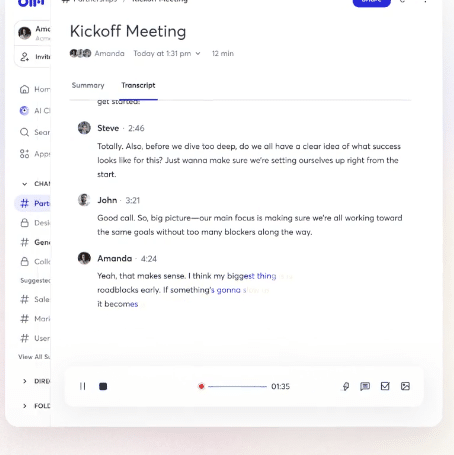
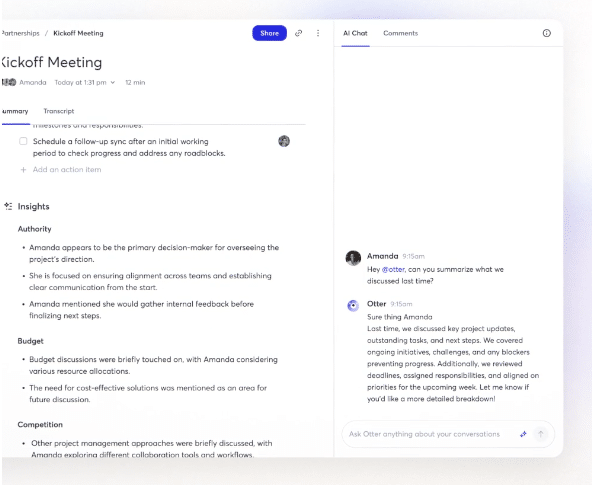
One of the most powerful advancements in recent iterations is conversational AI searchability. Rather than scrolling blindly through thousands of words of raw text, writers can query the transcript directly. Asking the built-in chatbot to locate discussions regarding specific themes—such as "credit card fraud" or "algorithmic personalization"—instantly surfaces the relevant verbatim sections accompanied by automated summaries. This capability proves indispensable when subjects introduce multi-part ideas across disjointed phases of a lengthy discussion.
3. Synchronized Audio-Text Playback
Because text generation is rarely flawless, Otter links every word of the transcript directly to the corresponding timestamp in the source audio. Clicking any segment of the text immediately triggers audio playback from that precise moment. This allows writers to audit garbled words, clarify ambiguous industry jargon, and ensure absolute fidelity to the speaker’s original intent before a single sentence goes to press.
Limitations and Operational Friction Points
Despite its utility, automated transcription is not without operational friction. Understanding these limitations is critical for setting realistic expectations before integrating the tool into a professional routine.
Hardware and Environmental Constraints
A notable technical limitation involves audio capture configurations. When a user employs headphones during a Zoom, Google Meet, or Microsoft Teams call, the software may inadvertently capture only the user’s voice while missing the remote participant. Overcoming this requires relying on computer speakers to route audio or utilizing specialized virtual audio cables. Consequently, maintaining absolute acoustic privacy in shared offices or public co-working spaces can become challenging.
Speaker Identification and Attribution Challenges
While multi-speaker diarization algorithms have improved significantly, automated identification remains imperfect. In dynamic conversations featuring participants with similar vocal timbres, or during broad industry webinars, the system occasionally misattributes dialogue, labeling speakers generically as "Speaker 1" or "Speaker 2." Human oversight remains mandatory to ensure proper attribution in multi-party features.
The Human Verification Tax
Automated tools do not eliminate the editor’s eye; they merely shift the labor. Because niche technical terms and proper nouns are frequently mangled by speech-recognition models, writers must spend a fraction of their time—typically 5 to 10 minutes per call—auditing the text. While exponentially faster than manual typing, this verification step is non-negotiable for journalistic integrity.
Competitive Landscape & Pricing Tiers
The market for AI-powered meeting assistants and transcription engines features robust alternatives, including Fireflies.ai, Fathom, and Rev. Each platform caters to slightly different user intents, ranging from corporate sales enablement to legal documentation. However, for freelance writers focused on editorial velocity, the core differentiator often boils down to user interface simplicity and cost-to-value ratio.
Otter.ai Pricing Structure Overview
- Basic (Free): Provides 300 monthly transcription minutes with a 30-minute ceiling per conversation. Ideal for testing workflows or managing light interview schedules.
- Pro ($8.33/month, billed annually): Tailored for individual professionals and freelancers. Expands the limit to 1,200 minutes per month (90 minutes per conversation), unlocks advanced search, and removes basic export restrictions. This tier represents the financial sweet spot for most independent writers.
- Business ($19.99/month, billed annually): Geared toward small teams and collaborative agencies requiring centralized admin controls, shared vocabularies, and usage analytics.
Learn How to Make Your First $1,000 Freelance Writing (in 30 Days or Less)
Join over 40,000 people who have taken our 6 part freelance writing course. Sign up below and let’s do this together.
By entering your email address you agree to receive emails from Location Rebel. We’ll respect your privacy and you can unsubscribe at any time.
Future Outlook: The Trajectory of AI in Content Creation
As natural language models continue to evolve at a breakneck pace, the boundary between raw audio capture and structured written content will continue to blur. Future iterations of transcription utilities are poised to move beyond simple text translation, offering automated first-draft synthesis, semantic theme clustering, and instantaneous quote extraction tailored specifically to journalistic standards.
For freelance writers and content creators navigating an increasingly competitive digital marketplace, adopting these technologies is no longer viewed as an experimental luxury. Rather, it has become a fundamental operational baseline. By offloading administrative burdens to intelligent software, writers can reclaim hours of deep-work capacity, redirecting their focus toward what matters most: sharp reporting, compelling narrative structure, and high-impact storytelling.