

Executive Overview
The intersection of professional collaboration and romantic entanglements has formed the bedrock of Hollywood folklore since the silent film era. When casting directors pair two magnetic personalities, the resulting chemistry is frequently evaluated by box-office returns, ratings metrics, and critical reception. However, behind the controlled environment of soundstages and location shoots, the human element frequently overrides the script.
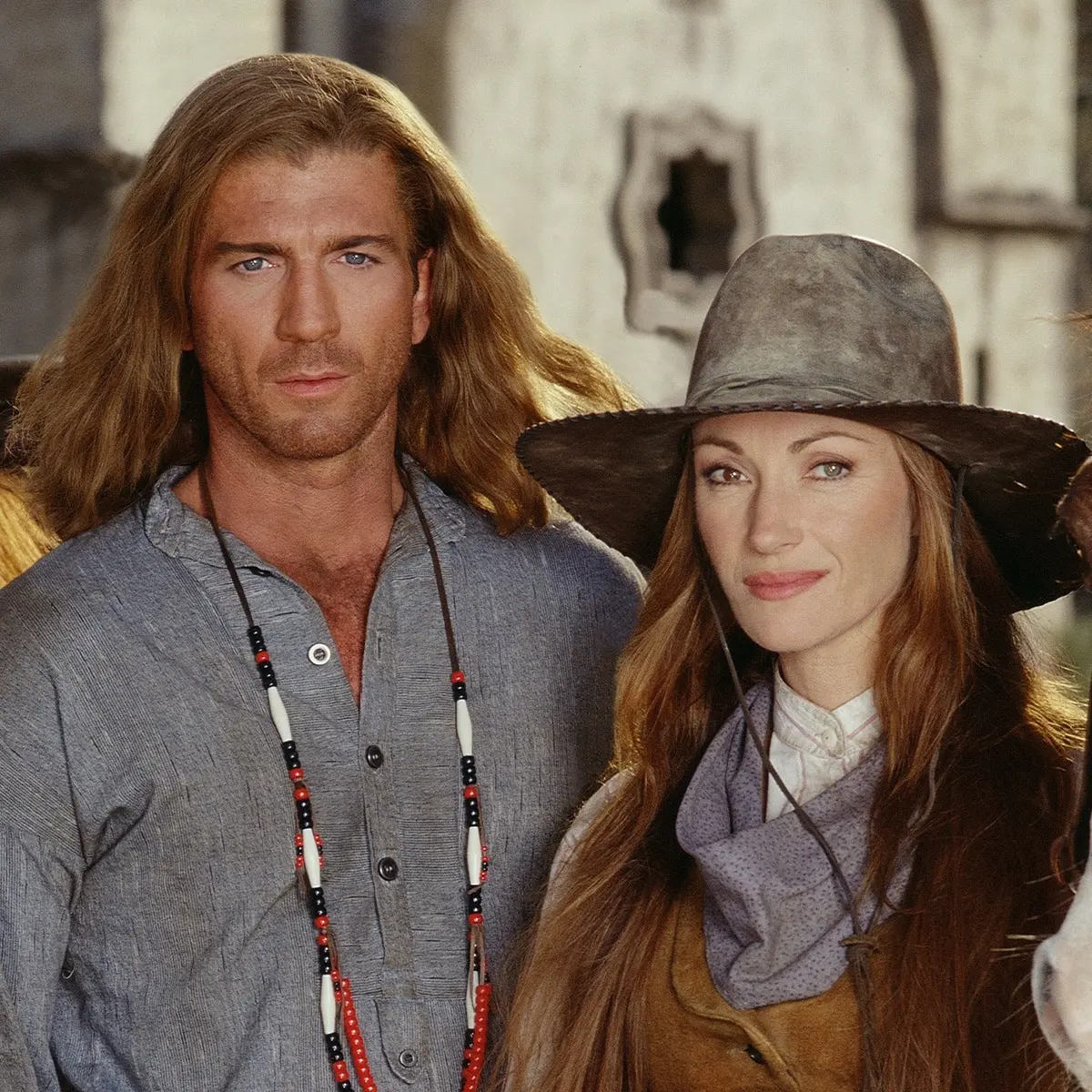
A prominent case study in this phenomenon involves legendary actress Jane Seymour and her Dr. Quinn, Medicine Woman co-star Joe Lando. Decades after the beloved CBS Western first aired in 1992, revelations continue to surface regarding the depth of their real-life romance, which mirrored the turbulent, high-stakes passion of their on-screen characters, Dr. Michaela Quinn and Byron Sully.
While Seymour and Lando ultimately charted different paths—with Seymour recently making headlines regarding her engagement to musician John Zambetti, and Lando building a decades-long marriage with Kirsten Barlow—their story underscores a broader Hollywood reality: the unique psychological hothouse of television and film production acts as a catalyst for profound, life-altering connections. This feature examines the anatomy of on-set romances, charting the chronology of Seymour and Lando’s secret love affair, analyzing the broader metrics of workplace relationships in the entertainment industry, and reviewing iconic pairings that successfully transitioned from fiction to lifelong partnership.
Detailed Chronology: The Dr. Quinn Genesis
The narrative of Jane Seymour and Joe Lando’s romance began in the spring of 1992, during the arduous casting and pilot production phase for a sweeping 19th-century frontier drama commissioned by CBS. Seymour, already an established international star and former Bond girl, was cast as the trailblazing Boston physician carving out a life in Colorado Springs. Lando, then a rising 30-year-old actor, was brought on to play the rugged mountain man Byron Sully.
Love at First Sight on the Frontier
According to Seymour, who recounted the genesis of their relationship during a retrospective panel at ’90s Con, the attraction was instantaneous and overpowering. Upon first laying eyes on Lando, the actress noted that she had not encountered a man of such striking appearance outside of an imaginary romance novel.
The professional boundary between actors quickly dissolved when real-life danger intervened. During an impromptu location shoot characterized by severe weather conditions, a sudden flash flood threatened the production crew. Demonstrating the resourcefulness of his character, Lando ushered Seymour into his pick-up truck, navigating treacherous terrain to safety.
What followed was an unscripted, impromptu date consisting of budget-friendly tacos and five-dollar margaritas. It was during this emergency evacuation that both actors acknowledged their mutual affection. Seymour has since confirmed that the intense emotional resonance captured in the pilot episode was entirely authentic—a rare instance where the scripted fiction was outpaced by genuine, unfolding emotion.
Divergent Futures and Life Path Realities
Despite the intensity of their connection, practical realities intervened. At the time of their involvement, Joe Lando envisioned a traditional family structure, characterized by the proverbial "four-child white picket fence" domestic ideal. Seymour, who was 11 years Lando’s senior, operated under the medical and personal assumption that she would be unable to have additional children.
Recognizing that their long-term life objectives were fundamentally misaligned, the couple made the mutual decision to terminate their romantic relationship before it could derail their professional obligations on a series slated for a multi-season run.
Fate, however, had unexpected narrative twists in store. Defying her own medical expectations years later, Seymour welcomed twin boys, John Keach and Kristopher Keach, in 1995 with her fourth husband, James Keach, compounding a family that already included children from her previous marriage to David Flynn.
[1992: Pilot Filming] ---> [Flash Flood & Truck Escape] ---> [Realization of Mutual Love]
                                                                        |
[Present Day: Close Friends] <--- [Separate Families Formed] <--- [Mutual Decision to Split: Differing Life Goals]
Transition to Platonic Longevity
Rather than suffering the bitter fallout common to many high-profile breakups, Seymour and Lando cultivated a resilient platonic bond that endured across six television seasons and two subsequent television movies. Today, their dynamic is frequently described by both parties as that of an "old married couple." As Seymour noted during retrospective interviews, their familiarity is so absolute that they are capable of finishing one another’s sentences and intuitively predicting each other’s emotional triggers.
Supporting Context & Metrics: The Psychology of On-Set Romances
The phenomenon wherein professional colleagues transition into romantic partners is well-documented by industrial psychologists and sociological researchers studying workplace environments. In the entertainment industry, these dynamics are amplified exponentially due to several distinct working conditions:
- The Proximity Effect: Film and television productions routinely require casts and crews to work 12-to-16-hour days in isolated, high-stress environments. This intense concentration of time accelerates interpersonal familiarity.
- Emotional Vulnerability: Actors are routinely tasked with simulating extreme emotional states—grief, terror, euphoria, and deep romantic devotion—on demand. When two actors share intimate scenes repeatedly, the psychological barrier between performance and reality frequently blurs.
- The Post-Production Cliff: Once a project wraps, the sudden cessation of intense daily contact can trigger separation anxiety, often prompting temporary or long-term romantic pairings as a mechanism to preserve the artificial community of the set.
Statistical analyses of Hollywood relationships indicate that while a significant percentage of on-set romances terminate shortly after a film or series wraps, those that survive the initial production cycle exhibit durability rates comparable to, or exceeding, traditional civilian marriages. This resilience is often attributed to the shared understanding of the industry’s unique demands, erratic schedules, and public scrutiny.
Official Statements and Industry Parallels
The trajectory experienced by Seymour and Lando is far from an isolated incident. Across the decades, television and cinema have served as matchmakers for some of the industry’s most enduring partnerships.
The Blueprint of Workplace Romance
- Kurt Russell and Goldie Hawn: Initially meeting on the set of The One and Only, Genuine, Original Family Band in 1968, their romance did not ignite until they reunited for 1984’s Swing Shift. Having spent over four decades together without a formal marriage certificate, they remain the gold standard for long-term industry partnerships. Reflecting on their ability to work together successfully, Russell famously quipped that the secret is simply to "do it every 33 years."
- Kevin Bacon and Kyra Sedgwick: Meeting on the set of the 1988 PBS production Lemon Sky, the couple married later that same year. Their marriage has endured for over three decades, yielding two children and serving as a frequent subject of study in how industry professionals balance high-profile careers with domestic stability.
- Ginnifer Goodwin and Josh Dallas: Cast as Snow White and Prince Charming on ABC’s fantasy hit Once Upon a Time, Dallas described falling for Goodwin as being hit by a "blinding light." A trip to Disneyland cemented their off-screen future, leading to a 2014 marriage and two children, demonstrating how genre television can foster lasting domesticity.
- Matthew Rhys and Keri Russell: Meeting a decade prior before officially connecting while playing married KGB spies on FX’s The Americans, the couple integrated their real-life relationship seamlessly with their grueling production schedule, welcoming a son in 2016 and maintaining a private, stable family life away from the relentless Los Angeles spotlight.
Modern Paradigm Shifts
In contemporary media, the public’s appetite for behind-the-scenes romances has only accelerated, fueled by social media platforms that allow actors to broadcast their relationships directly to consumers. However, the foundational mechanics remain unchanged: whether it is Ryan Gosling and Eva Mendes finding common ground on The Place Beyond the Pines, or Blake Shelton and Gwen Stefani finding solace in mutual vulnerability on The Voice, the entertainment workplace remains uniquely equipped to forge unbreakable personal bonds out of professional assignments.
Future Outlook
As the entertainment landscape continues to evolve with the rise of streaming platforms, shortened seasonal orders, and virtual production techniques, the physical environment of the traditional television set is undergoing transformation. Shorter filming blocks and fragmented production schedules may reduce the prolonged, immersive hothouse environments that historically catalyzed deep interpersonal relationships among casts.
Nevertheless, the human element of filmmaking remains immutable. As demonstrated by Jane Seymour and Joe Lando—whose friendship survived the cancellation of their series, the passage of decades, and the formation of separate families—the connections forged under the bright lights of a soundstage can transcend the original script.
Whether these relationships evolve into lifelong marriages, enduring creative collaborations, or resilient platonic friendships, they remain an integral part of cinematic history. For fans of Dr. Quinn, Medicine Woman and similar cultural touchstones, the knowledge that the passion witnessed on screen was, at least for a fleeting moment on a rainy Colorado roadside, entirely real, adds a permanent layer of authenticity to the fiction we consume.