

Executive Overview
In the sprawling, often chaotic landscape of digital product creation, a foundational truth remains universally acknowledged yet remarkably difficult to execute: naming is hard.
Whether it is crafting an intuitive design token taxonomy, establishing scalable HTML and CSS class structures, aligning UI component libraries, or labeling new product features to drive user engagement, language is the invisible framework that dictates digital comprehension. The lexicon we choose does not merely describe our work; it actively shapes our cognitive models and dictates the cross-functional conversations held between designers, developers, product managers, and end users.
Miscommunication in digital product development rarely stems from a lack of technical capability. Instead, it frequently originates from semantic fragmentation—the phenomenon where multidisciplinary teams speak about the exact same artifact using entirely different internal dialects. Designers rely on visual metaphors, developers lean toward structural abstractions, product managers focus on business outcomes, and users operate within the realm of immediate task execution. When these vocabularies collide, friction mounts, cognitive overhead increases, and overall productivity stalls.

This comprehensive guide explores the structural anatomy of naming in modern web development and design systems. Drawing from industry-leading frameworks, open-source repositories, and case studies from tech giants like Intuit and Vodafone, we examine practical strategies, resources, and conventions designed to eliminate ambiguity, foster cross-team alignment, and build resilient, scalable digital ecosystems.
Detailed Chronology: The Evolution of Naming Challenges in Digital Design
As digital products matured from static web pages into complex, multi-platform, multi-themed applications, the challenge of naming evolved in tandem. Understanding how we arrived at our current methodologies requires tracing the historical trajectory of web taxonomy.
Phase 1: The Wild West of Custom Styling (Early Web Era)
In the infancy of web design, naming conventions were virtually nonexistent. Developers crafted HTML tags and CSS class names based on immediate visual appearance rather than semantic value—using terms like .red-text, .big-box, or .left-sidebar.

This approach presented severe scalability bottlenecks. When a brand color shifted from red to blue, codebases required exhaustive, manual refactoring. The nomenclature was too tightly coupled to presentational states, offering zero flexibility for reuse.
Phase 2: The Rise of Methodologies (BEM, SMACSS, and OOCSS)
Recognizing the unsustainable nature of ad-hoc naming, the industry entered a structural renaissance. Methodologies such as BEM (Block, Element, Modifier), SMACSS, and Object-Oriented CSS introduced strict syntactical rules.
While these frameworks successfully solved specificity wars and improved code maintainability, they often imposed rigid naming constraints that felt overly verbose to newer practitioners. Naming things became an exercise in strict adherence to syntax rather than intuitive communication.

Phase 3: The Design Systems Boom and Tokenization
With the advent of design systems—comprehensive repositories uniting design and code—the stakes of nomenclature skyrocketed. Design systems had to serve multiple masters: Figma libraries for UI/UX designers, React or Vue component APIs for engineers, and documentation sites for stakeholders.
This era birthed design tokens—atomic design decisions stored as variables (colors, spacing, typography). Suddenly, teams were forced to invent taxonomies that could span multiple brands, themes, platforms, and viewports without breaking down. The challenge shifted from merely naming a CSS class to engineering a comprehensive, multi-tiered semantic hierarchy.
Supporting Context & Metrics: The Anatomy of Effective Nomenclature
To select the right name, practitioners must navigate a delicate equilibrium: names that are too generic leave engineers and designers guessing at their precise intent, while names that are too specific eradicate flexibility and prevent component reuse.

Industry analyses indicate that teams waste up to 15% of their development sprints simply debating nomenclature, untangling conflicting variable names, or rewriting poorly discovered features. Resolving these inefficiencies requires adhering to established guidelines for various layers of the digital stack.
1. General Coding & Class Names
When struggling to name HTML classes, CSS properties, or JavaScript functions, looking beyond standard tech vocabulary can unlock fresh perspectives.
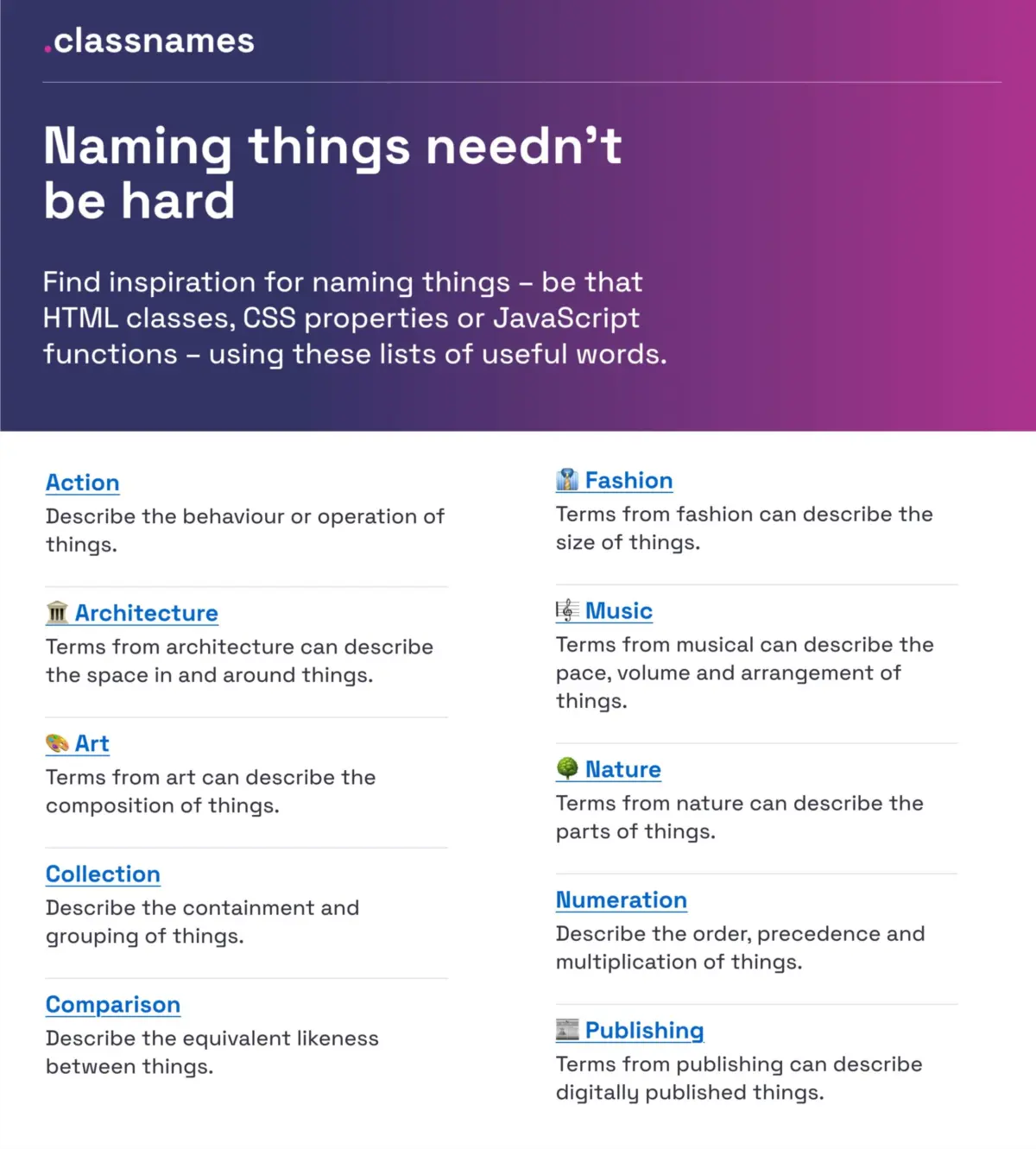
- Resource Spotlight: Tools like Classnames (curated by Paul Robert Lloyd) provide thematically grouped lists of words categorized by behavior, likeness, order, grouping, and association.
- Expanding the Lexicon: Classnames incorporates specialized terminology drawn from nature, art, theater, music, architecture, fashion, and publishing—helping teams break free from repetitive, uninspired naming patterns.
2. Color Palettes and Semantic Tokens
Naming colors has traditionally relied on either literal hex codes or subjective aesthetic labels (e.g., "forest-green" vs. "emerald-dark").

- Resource Spotlight: David Aerne’s monumental Color Names repository offers a staggering collection of over 30,355 unique, community-contributed color names paired with color pickers and search utilities.
- Strategic Shift: Moving from literal color names to functional tokens (e.g., mapping
blue-500tocolor-action-primary) ensures that brand refreshes require updates in a single configuration file rather than across thousands of lines of production code.
3. Layers, Groups, and Components in Design Tools
In design platforms like Figma, messy layer panels (Rectangle 4 Copy, Group 12) poison collaboration between designers and developers. Javier Cuello’s widely referenced Naming Best Practices outlines foundational rules for structural clarity:
- Core Principles: An effective layer or component name must possess a logical structure, remain concise, carry universal meaning, and intentionally avoid direct ties to visual properties.
- Scalability: Names should describe what a component is or does within a system, rather than how it looks at a single breakpoint.
4. UI Components and Real-World Design Systems
When designers or developers are unsure what a newly built interface pattern is officially called, consulting established industry standards prevents reinventing the wheel.
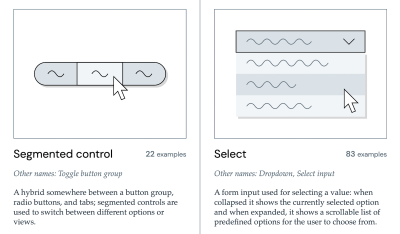
- Resource Spotlight: Iain Bean’s Component Gallery aggregates real-world examples and alternative names for over 50 distinct UI components—ranging from ubiquitous elements like accordions to specialized utilities like visually hidden text containers.
- Visual Validation: Complementary utilities like Name That UI function as visual dictionaries, accelerating the identification of obscure interface patterns.
Official Case Studies & Expert Frameworks
Examining how enterprise organizations handle large-scale nomenclature reveals masterclasses in architectural tokenization and feature naming.
Intuit’s Multi-Brand Design Token Taxonomy
Managing design tokens for a massive portfolio of household financial products—including Mailchimp, QuickBooks, TurboTax, and Mint—presents a monumental naming challenge. Nate Baldwin documented Intuit’s journey toward creating a flexible design token taxonomy capable of transcending individual brand themes.
By establishing strict architectural criteria, Intuit moved away from fragile, ad-hoc variables. Their taxonomy separated foundational primitive values (raw color palettes, base scale numbers) from semantic aliases (interactive states, background surfaces) and component-specific tokens. This structure ensured that updates made at the foundational level cascaded predictably across dozens of disparate software products without breaking accessibility standards or visual consistency.
Vodafone UK’s Variables Taxonomy Map
The Vodafone UK Design System team addressed the complexities of a multi-brand, multi-themed telecommunications ecosystem by releasing a comprehensive Variables Taxonomy Map on Figma.

Built upon Nathan Curtis’s seminal work on design token naming, Vodafone’s system maps out four distinct collections that dictate token connections:
- Brand Foundations: High-level global parameters.
- Primitives: Raw aesthetic values.
- Semantics: Context-aware roles (e.g.,
feedback-error-surface). - Pages/Contexts: Localized application overrides.
This meticulous categorization ensures that any developer or designer inspecting a token name can instantly deduce where it is implemented, what theme it belongs to, and what functional purpose it serves.
Erin Gannon on Naming New Features
Poor feature adoption is frequently disguised as a UX failure when it is fundamentally a semantic failure. If a feature cannot be easily discovered, understood, and integrated into existing workflows, it will be ignored.

Erin Gannon’s practical framework for feature naming emphasizes that optimal names must be driven by user needs rather than internal corporate terminology.
- The "Job-to-Be-Done" Principle: Feature names should explicitly signal value or outcome.
- The User Lexicon: Product teams should record how target users naturally describe their pain points during user testing, lifting exact phrases and mental models directly into the product’s navigational taxonomy.
Future Outlook: The Horizon of Automated Semantics
As we look toward the future of digital product design, the mechanics of naming are poised for radical transformation.
1. AI-Driven Semantic Consistency
Large Language Models (LLMs) and integrated design-to-code plugins are beginning to act as real-time semantic linchpins. Future design systems will likely feature automated linting tools that monitor layer names, CSS classes, and design tokens against enterprise ontologies—flagging generic names (button-new) and automatically suggesting semantically sound alternatives (action-button-primary-subtle) based on context.

2. Living Design Tokens and Automated Sync
The manual overhead of maintaining taxonomy maps in spreadsheets or design tools is gradually being replaced by unified token pipelines (utilizing formats like W3C Design Tokens Community Group specifications). As these pipelines mature, the gap between designer intent in Figma and engineer implementation in code repositories will narrow, reducing the likelihood of naming drift.
3. Cross-Disciplinary Ubiquitous Language
Inspired by Domain-Driven Design (DDD), forward-thinking product organizations are beginning to codify formal "ubiquitous languages"—living glossaries shared explicitly across product, engineering, design, and marketing. As these practices become standardized, the friction of translation between internal team dialects will dissipate.
Conclusion & Actionable Takeaways
Nomenclature is not merely a superficial administrative task to be rushed through before shipping code or finalizing a Figma file. It is the core architecture of your product’s digital language.

When teams speak in conflicting dialects—designer versus developer versus product manager versus user—frustration and inefficiency inevitably follow. By investing time in establishing robust naming conventions, leveraging community resources like Classnames, Color Names, the Component Gallery, and Onym, and studying enterprise frameworks like those from Intuit and Vodafone, teams can drastically reduce confusion.
Key Action Items for Product Teams:
- Audit Your Vocabulary: Review your current design system token names and component libraries for ambiguity. Are names tied too closely to visual presentations rather than functional roles?
- Establish a Shared Glossary: Create a centralized, cross-functional documentation hub for terminology, ensuring product managers, designers, and engineers agree on core definitions.
- Prioritize User Language: When naming features or user-facing workflows, defer to the vocabulary of your users rather than internal corporate jargon.
- Address Naming Debt: Treat naming conflicts and semantic inconsistencies with the same urgency as technical debt, maintaining an active backlog to resolve them iteratively.
By refining the language of our digital systems, we build cleaner codebases, more intuitive interfaces, and—above all—stronger bridges between the humans who build technology and the humans who use it.