

Executive Overview
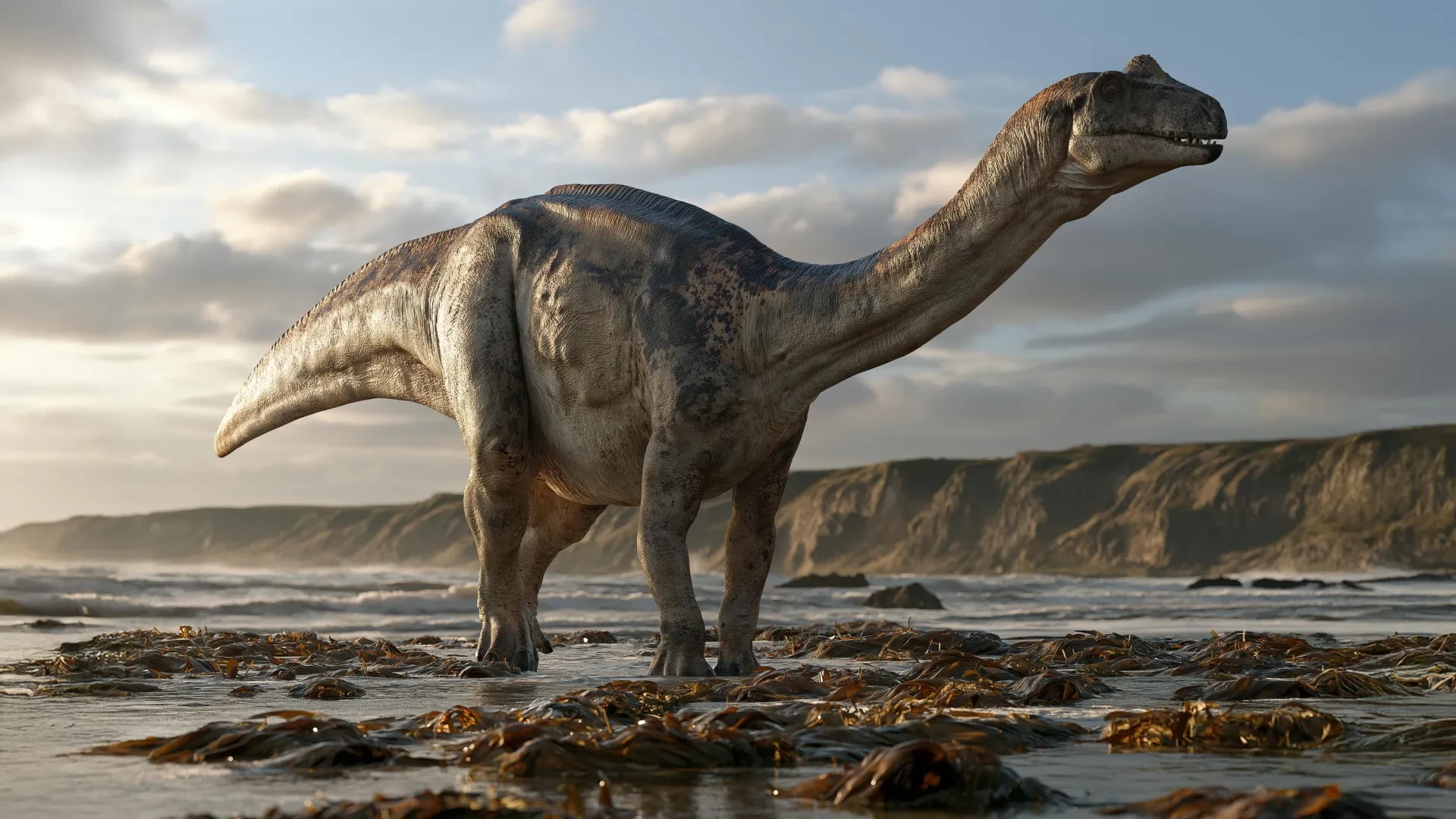
For generations, humanity’s vision of the dinosaur has been shaped by terrestrial landscapes: towering sauropods stripping high canopy foliage from prehistoric ferns, apex predators stalking through dense inland conifers, and herds of ceratopsians grazing across sprawling floodplains. However, a groundbreaking study published in the journal Frontiers in Ecology and Evolution shatters this exclusively inland perspective. New geochemical evidence reveals that dinosaurs living along ancient coastlines supplemented their diets with marine resources washed ashore by primeval storms—with seaweed playing a starring role in the prehistoric menu.
This phenomenon, known scientifically as marine subsidization (MS), occurs when oceanic materials are deposited onto land, providing a critical caloric and nutritional bridge for terrestrial life. While marine subsidization is well-documented in modern coastal ecosystems—where animals ranging from coastal bears to island deer gorge on washed-up kelp during seasonal shortages—this study provides the first definitive proof that the ecological pipeline linking the ocean to land was fully active more than 100 million years ago.
By analyzing the carbon isotope signatures preserved in the fossilized tooth enamel of dinosaurs, crocodiles, turtles, and fish from the Cretaceous Period, an international team of researchers unlocked a long-standing paleontological mystery. For decades, scientists puzzled over anomalously high carbon-13 ($delta^13textC$) values in dinosaur teeth, readings that defied explanation under traditional models of purely terrestrial diets. The new research points decisively to an unexpected culinary habit: plant-eating dinosaurs roaming prehistoric beaches were foraging on marine macroalgae.
This discovery not only reshapes our understanding of ancient dinosaur behavior and nutritional ecology, but it also underscores the enduring, ancient interconnectedness of marine and terrestrial ecosystems across hundreds of millions of years of Earth’s history.
Detailed Chronology: Unraveling the Geochemical Mystery
The Cretaceous Context: A World of Inland Seas
To understand how dinosaurs accessed the ocean’s bounty, researchers had to reconstruct the geography of the Cretaceous Period, specifically focusing on two distinct intervals: the early Albian (approximately 113 to 107 million years ago) and the early Cenomanian (approximately 100 to 96 million years ago).
During this era, global greenhouse climates drove sea levels significantly higher than they are today. In North America, the Western Interior Seaway—a massive inland body of water—split the continent in two, creating vast coastal environments that stretched for thousands of miles. Other prime study areas included the ancient, shifting coastlines of the Gulf of Mexico.
These coastal zones were dynamic, storm-swept frontiers where the terrestrial realm collided directly with the marine. Just as modern tropical storms and seasonal hurricanes cast vast quantities of kelp, seagrass, and marine detritus onto modern beaches, ancient Cretaceous storms routinely washed oceanic biomass ashore.
The Carbon Isotope Puzzle
The investigation began with a persistent anomaly in the geochemical data collected from dinosaur fossils. Carbon exists in nature as two stable isotopes: the lighter carbon-12 ($textC-12$) and the heavier carbon-13 ($textC-13$). As plants photosynthesize, they absorb these isotopes in varying proportions, leaving a distinct chemical fingerprint, or $delta^13textC$ value, that passes up the food chain into the herbivores that consume them and, subsequently, into the carnivores that prey upon the herbivores.
In living animals, the carbon isotope signature in tooth enamel is typically predictable, showing a reliable enrichment factor—an increase of roughly 11 to 13 parts per thousand ($text‰$) compared to the animal’s diet. However, for years, geochemical assays of dinosaur tooth enamel revealed $delta^13textC$ values that were inexplicably high. These numbers simply could not be accounted for by a diet consisting solely of inland terrestrial plants, which inherently possess lower $delta^13textC$ signatures than most marine photosynthetic systems.
Investigating the Fossil Record
To crack the case, the research team—led by Dr. Clayton Forster, a geologist at the University of Arkansas—assembled a comprehensive suite of fossil samples. They extracted powdered enamel from the teeth of a diverse array of Cretaceous fauna, including multi-ton megaherbivores, predatory dinosaurs, crocodiles, turtles, and fish.
Crucially, the team sampled fossils from two distinct ecological contexts:
- Coastal Locations: Specimens recovered directly from deposits bordering the ancient Western Interior Seaway and the ancient Gulf of Mexico.
- Inland Environments: Specimens recovered from deep within the North American landmass, far away from marine influence.
By comparing the isotopic signatures across these geographic boundaries, as well as across different latitudes and geological ages, the researchers sought to isolate the variable driving the high carbon readings.
The Emerging Pattern
When the laboratory results were compiled, a stark and undeniable geographic pattern emerged. Fossils unearthed from coastal environments consistently displayed significantly elevated $delta^13textC$ values when compared to their inland counterparts.
Remarkably, these coastal signatures remained remarkably uniform across different fossil sites, regardless of latitude or whether they originated from the early Albian or early Cenomanian intervals. This spatial and temporal consistency ruled out localized geological artifacts or post-mortem fossilization quirks (diagenesis). If groundwater or mineral replacement over millions of years had altered the teeth, the anomalous readings would have appeared randomly. Instead, the elevation was strictly tethered to proximity to the ancient coast.
The conclusion was inescapable: a dietary carbon source unique to coastal environments was entering and moving through the prehistoric food chain.
Supporting Context & Metrics
The Marine Subsidization (MS) Framework
In modern ecology, marine subsidization is a recognized driver of biodiversity. When marine nutrients—whether in the form of washed-up kelp, stranded marine mammals, or fish carcasses—are deposited on land, they supercharge terrestrial food webs.
[Ocean Environment]
       │
       ▼ (Storms / Tides / Stranding)
[Coastal Zone / Beaches] ──> Marine Macroalgae (Seaweed)
       │
       ▼ (Consumption)
[Coastal Herbivores / Megafauna]
       │
       ▼ (Predation / Scavenging)
[Apex Predators / Crocodiles / Fish]
This ecological subsidy can be vital during periods of environmental stress. For instance, when inland droughts decimate terrestrial vegetation, coastal zones rich in marine debris become vital feeding grounds. The Cretaceous research suggests that dinosaurs exploited these exact ecological windfalls tens of millions of years ago.
Isolating the Culprit: Why Seaweed Fits the Profile
To identify the specific vector responsible for the chemical signatures, the research team evaluated potential candidates against three strict ecological criteria:
- Low Trophic Level: The source had to enter the food chain near its base because the elevated $delta^13textC$ signal was detected across an immense trophic spectrum—from primary-consuming megaherbivores all the way up to secondary and tertiary predators like fish and crocodiles.
- Coastal Restriction: The resource had to be abundant along ancient coastlines while being entirely absent or unavailable in landlocked interior environments.
- Deep Time Availability: The food source needed to be a persistent, reliable ecological fixture capable of supporting these signatures across millions of years.
While driftwood and land-based estuarine plants were considered, they failed to match the broad isotopic footprint. Marine macroalgae and macrophytes—commonly known as seaweed—emerged as the sole viable candidate. Seaweed naturally exhibits higher $delta^13textC$ values, grows prolifically in shallow coastal waters, washes ashore in massive quantities during storm events, and has deep evolutionary roots extending well back into the Mesozoic Era.
The Exception That Proves the Rule: Tenontosaurus tilletti
Science is often validated by its exceptions, and this study provided a textbook example. While the vast majority of coastal dinosaur fossils exhibited the heavy carbon signatures indicative of a marine-subsidized diet, one notable taxon bucked the trend: Tenontosaurus tilletti.
Tenontosaurus was a common, large-bodied herbivorous ornithopod that roamed Cretaceous North America. Despite its frequent presence in coastal fossil deposits, its tooth enamel yielded $delta^13textC$ values that aligned perfectly with a strictly terrestrial, land-based plant diet.
The presence of Tenontosaurus fossils with entirely inland-matching carbon profiles in the exact same coastal ecosystems as marine-subsidized dinosaurs provided the ultimate control for the experiment. It proved conclusively that the elevated carbon levels were not an environmental contamination affecting all teeth equally, but rather reflected active, species-specific behavioral choices regarding foraging and diet. While some dinosaurs actively foraged on beach-cast seaweed, Tenontosaurus seemingly maintained a strict inland palate.
Official Statements and Expert Insights
The study’s authors emphasize that these findings fundamentally alter how paleontologists must view coastal dinosaur habitats. Rather than treating coastlines as mere barriers where land met water, scientists must now view them as dynamic, nutrient-rich transitional zones.
"We show that coastal terrestrial organisms in the greenhouse climates of the Cretaceous relied on marine resources to supplement their diets in a similar way that modern organisms do," stated Dr. Clayton Forster, lead author of the study and a geologist at the University of Arkansas.
"We can identify that marine resources are passed along the food chain and incorporated in the minerals of bones and teeth of dinosaurs, crocodiles, turtles, and fish."
Dr. Forster further elaborated on how the isotopic data eliminated ambiguity regarding the food source:
"Coastal-dwelling organisms must have eaten some kind of organic matter from the ocean, or prey that had done so. This pattern is shared from fish to megaherbivores and indicates that the extra carbon source must have been low in the food-chain to affect both aquatic and terrestrial animals."
"Few organisms meet these criteria besides marine macroalgae or macrophytes—seaweeds. Given the almost ubiquitous behavior of large coastal herbivores today to supplement their diet with seaweeds, it’s likely that most of the sampled herbivorous dinosaurs were no different."
Looking at the broader implications for earth history, Dr. Forster underscored the profound continuity of ecological systems:
"Our study emphasizes the connections between terrestrial and marine ecosystems. They are deeply intertwined and have been for hundreds of millions of years. It highlights the importance of environmental linkages across time and space and protecting them where they exist today."
Future Outlook & Unanswered Questions
While this study successfully bridges a major knowledge gap in Mesozoic paleodietary research, it also opens several exciting avenues for future scientific inquiry. The authors acknowledge that several critical questions remain on the horizon:
- Latitudinal Breadth: The current fossil dataset is geographically limited by preservation biases. Specifically, the analyzed fossil specimens from the early Albian and early Cenomanian do not include comprehensive samples from extreme polar or equatorial regions. Researchers are eager to determine whether marine subsidization was a global phenomenon utilized by dinosaurs in ancient polar forests or tropical margins alike.
- Deep-Time Expansion: The current study focuses exclusively on specific intervals of the Cretaceous Period. Paleontologists are now turning their attention to other pivotal epochs in Earth’s history—such as the earlier Jurassic Period and the subsequent early Cenozoic Era—to investigate whether marine subsidization played a similar role in shaping the diets of earlier or later terrestrial faunas.
- Behavioral Dynamics of Megafauna: Detailed trace-fossil analysis, including potential bite marks on petrified wood or fossilized kelp holdfasts, could eventually provide direct physical evidence to complement the geochemical data. Understanding how dinosaurs interacted with coastal seaweed beds—whether through active beach-combing or passive foraging during low tides—remains an intriguing challenge for behavioral paleoecologists.
Conservation and Modern Parallels
Beyond shedding light on the lost ecosystems of the Mesozoic, this research carries unexpected weight for modern ecological conservation. By demonstrating that land-sea linkages have been critical to the survival and vitality of terrestrial megafauna for over 100 million years, the study emphasizes the folly of managing marine and terrestrial habitats in isolation.
As modern coastlines face unprecedented pressures from climate change, rising sea levels, and human shoreline development, understanding the ancient, enduring reliance of land-dwelling creatures on ocean resources serves as a stark reminder: what happens in the sea rarely stays in the sea. Protecting these delicate boundary zones is an evolutionary imperative that spans deep time—from the shores of the Cretaceous Western Interior Seaway to the coastlines of the modern world.
