

Executive Overview
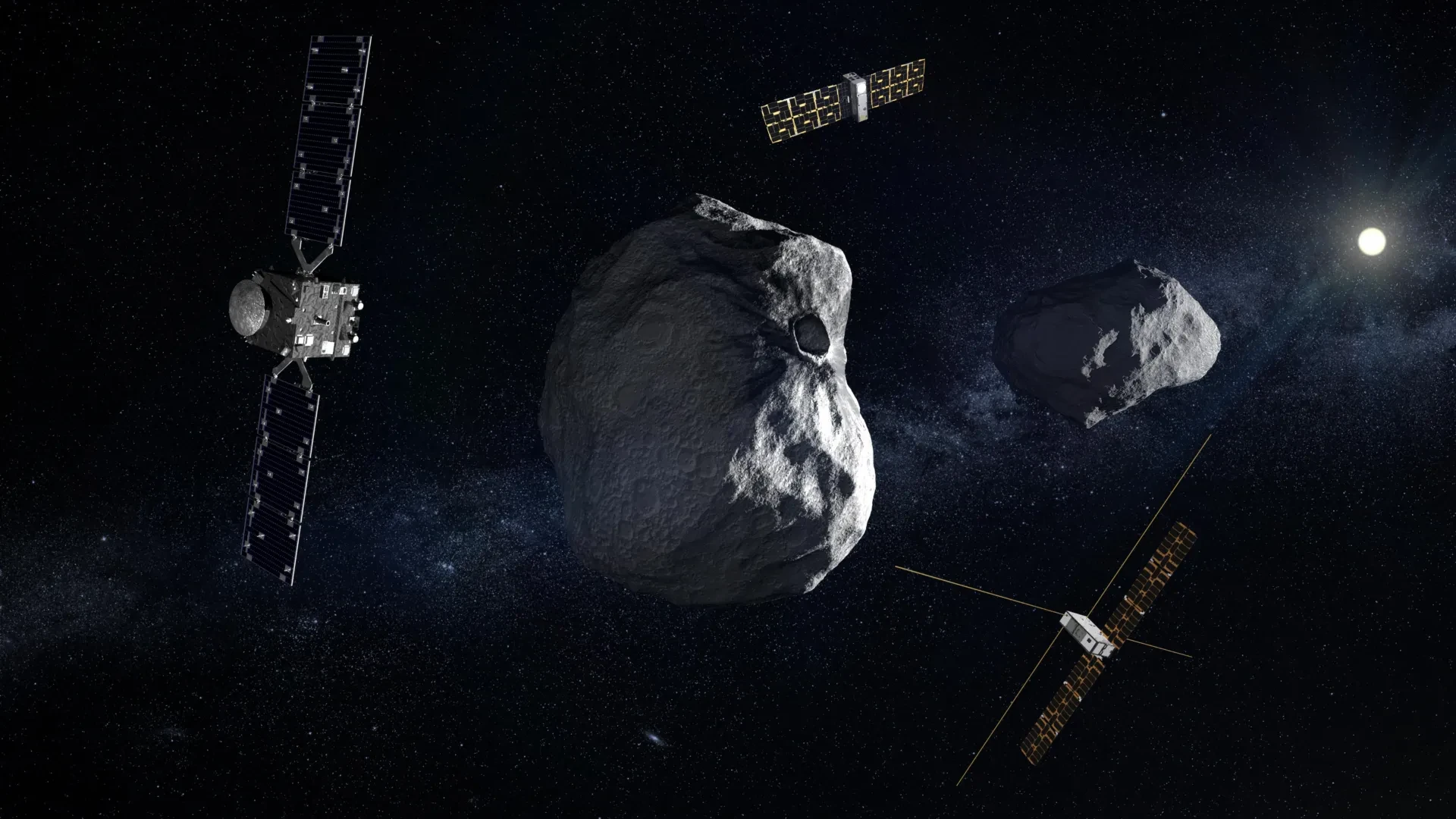
Humanity’s quest to secure Earth from the cosmic hazards of deep space has reached a pivotal milestone. The European Space Agency’s (ESA) Hera spacecraft has successfully completed its long-range interplanetary cruise, arriving in the vicinity of the Didymos binary asteroid system. Roughly the size of a small car, Hera is currently stationed 25 to 30 kilometers from the binary pair, initiating its first critical phase of scientific observations. This arrival marks the transition of planetary defense from theoretical modeling and isolated kinetic experiments to rigorous, forensic-level investigation.
Hera’s primary mission objective is to perform a comprehensive post-mortem of NASA’s historic Double Asteroid Redirection Test (DART) mission, which deliberately impacted the smaller of the two asteroids, Dimorphos, in September 2022. While DART proved that humanity possesses the mechanical capability to alter an asteroid’s trajectory, it left fundamental questions unanswered regarding the internal mechanics, structural composition, and overall morphological response of the target body. By deploying advanced imaging suites, laser altimetry, and shoebox-sized CubeSats, Hera will decode the physical consequences of the world’s first artificial hypervelocity impact. The findings will determine whether kinetic impactors can be reliably transformed into a dependable, predictable shield for planet Earth.
Detailed Chronology: From Interplanetary Cruise to Orbital Ballet
The journey of the Hera spacecraft is a masterclass in deep-space navigation, precision engineering, and orbital mechanics. Reaching a binary asteroid system 196.5 million kilometers from Earth required careful planning and execution by ESA’s Flight Dynamics team and mission controllers at the European Space Operations Centre (ESOC) in Darmstadt, Germany.
The Early Characterization Phase
Upon arrival, Hera entered its "early characterization phase." This initial observational window is designed to provide researchers with a holistic, macro-level understanding of the Didymos-Dimorphos system and its immediate space environment. Operating from a standoff distance of 25 to 30 kilometers, Hera’s onboard optical navigation cameras are capturing the first global portraits of a small asteroid body that has undergone a hypervelocity impact. These early images are vital for contextualizing the vast debris field and shedding light on the large-scale structural changes inflicted by DART.
The Physics of Weak Gravity and Rectangular Orbits
Navigating in the vicinity of an asteroid presents challenges fundamentally distinct from exploring planets or moons. The primary body, Didymos, measures approximately 780 meters across and possesses a gravitational field roughly 40,000 times weaker than Earth’s. Its companion, Dimorphos, spans a mere 151 meters, with a gravitational pull approximately 200,000 times weaker than our planet’s.
Under such microgravity conditions, establishing a traditional, continuous circular orbit is mathematically and operationally impossible. If a spacecraft attempts a standard orbit, the complex gravitational interplay of the two bodies will inevitably destabilize its trajectory.
To overcome this, Hera employs a novel navigation strategy. Instead of orbiting a single mass, the spacecraft travels around the shared center of gravity (barycenter) of the two asteroids at a crawl: approximately 12 centimeters per second—roughly the speed of an insect walking across the ground.
Rather than executing a smooth, continuous curve, Hera moves along near-linear trajectories. At alternating intervals of three and four days, the spacecraft fires its reaction-control thrusters while translating away from the asteroids, executing precise 90-degree vector changes. These maneuvers generate a unique "rectangular orbit" profile that maintains the spacecraft at a safe distance of 25 to 30 kilometers.
This innovative trajectory design was partly inspired by lessons learned during ESA’s Rosetta comet-chase mission. Furthermore, it offers a crucial safety buffer: if a scheduled thruster firing fails, Hera’s natural momentum will cause it to drift outward into deep space rather than tumbling downward into a catastrophic collision with the asteroids. Because the spacecraft moves at such low velocities, course corrections consume minimal propellant, maximizing mission longevity.
The Upcoming Detailed Characterization and Bowtie Trajectories
Next month, Hera will graduate to its "detailed characterization phase," shifting closer to the binary system. The spacecraft will transition from its rectangular flight paths to complex, hyperbolic trajectories shaped like bowties, initializing operations from a proximity distance of roughly 20 kilometers. This phase will allow high-resolution spectrometers, thermal imagers, and stereoscopic cameras to map every boulder, crater, and fracture across both surfaces, culminating eventually in close-proximity landing operations and deployment of surface-scanning payloads.
Supporting Context & Metrics: Decoding DART and the Asteroid Threat
To fully appreciate Hera’s mission, one must examine the event it was built to investigate. On September 26, 2022, NASA’s 580-kilogram DART spacecraft slammed into Dimorphos at an astonishing speed of 6.1 kilometers per second (approximately 22,000 kilometers per hour).
[DART Spacecraft] ---> (6.1 km/s) ---> [Dimorphos (151m wide)]
                                           |
                                           v
                       Orbital Period Shortened by ~33 Minutes
                       Debris Plume Spread Across 10,000 km
The kinetic impact was an unmitigated engineering triumph. The collision excavated a massive plume of debris that streamed thousands of kilometers into space, and it successfully altered the orbital period of Dimorphos around Didymos, shortening its lap time by approximately 33 minutes. This proved beyond doubt that a kinetic impactor can deflect an incoming near-Earth object (NEO) given sufficient lead time.
However, the aftermath presented planetary scientists with a profound mystery: the orbital change was significantly larger than pre-impact computer models had predicted.
Current impact models span a wide spectrum of possibilities regarding how an asteroid reacts to stress. Did the hypervelocity impact carve out a localized crater, or did the shockwave travel through the entire porous, rubble-pile structure, causing the asteroid to globally deform or "remodel" itself? Because Dimorphos is not a monolithic rock but rather a loosely bound aggregate of boulders and dust held together by negligible gravity, its internal mechanics remain poorly understood.
Hera’s suite of instruments is designed to answer these lingering questions by measuring:
- Mass and Density: Precise determination of Dimorphos’ mass to calculate the momentum transfer efficiency factor ($beta$).
- Internal Structure: Internal radar and radio science experiments to probe whether the asteroid is solid, fractured, or a rubble pile.
- Surface Topography: High-resolution mapping of the impact scar to identify whether DART created a discrete crater or fundamentally restructured the body.
Without these metrics, scientists cannot reliably scale kinetic impact technology to protect Earth from asteroids of varying sizes, densities, and compositions. Hera provides the missing empirical ground truth.
Official Statements & Expert Insights
The international scientific community has closely monitored Hera’s arrival, viewing the mission as the indispensable second half of a global planetary defense enterprise.
Mission scientist Michael Kueppers emphasized the overarching goals of the current phase:
"Our aim right now is to gather the big-picture findings of relevance to supporting the mission’s planetary defense goals. During this phase, our images will reveal for the first time what a small asteroid looks like globally, having experienced a hypervelocity impact in the context of the first asteroid deflection test, when NASA’s DART spacecraft impacted it to change its orbit in 2022."
Addressing the uncertainties that plagued pre-impact computer models, Kueppers added:
"Previous predictions by our impact models suggested many different ways the asteroid body might react, but Hera will reveal which forecast was the correct one – if any!"
Behind the scenes, executing this interplanetary rendezvous requires relentless coordination. Operating from ESOC in Germany, flight controllers maintain daily contact with Hera—despite the vast 196.5-million-kilometer abyss separating the spacecraft from Earth. Communication is facilitated through four monumental 35-meter-diameter Deep Space Antennas strategically positioned across the globe in Argentina, Spain, and Australia, ensuring unbroken radio links as the Earth rotates.
The ESOC operations team collaborates continuously with ESA’s Flight Dynamics specialists. By analyzing Doppler shifts, telemetry, and optical navigation data transmitted across these deep-space channels, engineers calculate Hera’s exact position within the weak gravitational wells of Didymos and Dimorphos, generating precise guidance commands to keep the spacecraft on its intricate rectangular path.
Future Outlook: The Road Ahead for Hera and Planetary Defense
Over the coming months, Hera’s mission profile will intensify. Beyond its remote-sensing instruments, the spacecraft carries two advanced CubeSats—named Milani and Juventas—each roughly the size of a shoebox.
- Milani is equipped with a near-infrared spectrometer and a micro-dust analyzer, designed to study the surface mineralogy and analyze the dust environment surrounding the asteroids.
- Juventas carries a low-frequency radar to peer deep into the interior of Dimorphos, mapping its internal architecture, as well as a gravimeter to measure surface gravity variations.
These miniature probes will venture even closer to the asteroid system than the mothership, eventually attempting daring close-proximity operations and surface touchdowns.
The data returned by Hera and its CubeSats will transform planetary defense from an empirical art into a precise predictive science. By understanding precisely how Dimorphos absorbed DART’s energy, humanity will gain the calibration data needed to design effective deflection missions for any future hazardous space rocks.
As Hera settles into its rectangular dance around Didymos and Dimorphos, it carries with it the aspirations of a planet learning to safeguard its own deep-future—turning celestial observation into active stewardship of the cosmos.
