


Executive Overview
In the hyper-competitive landscape of digital freelance writing, acquiring high-paying clients is rarely a matter of luck. It is a game of persistence, strategy, and timing. Every day, thousands of ambitious writers polish their portfolios, curate impressive samples, and draft introductory emails to prospective editors, content managers, and business owners. Yet, the vast majority of these freelancers walk away empty-handed, lamenting a dry pipeline and blaming market saturation.
According to industry veterans and sales data, the root cause of this widespread failure is not a lack of writing talent, nor is it poorly crafted initial pitches. The fatal flaw lies in a single, glaring omission: the failure to follow up.
Most freelancers subscribe to a "one-and-done" methodology, sending a solitary cold email, waiting in vain for a response, and ultimately abandoning the lead when silence ensues. In reality, the modern inbox is a chaotic battleground of noise and distraction. Decision-makers are perpetually overwhelmed, meaning that a lack of response to an initial outreach rarely signals a flat rejection; more often than not, it simply indicates bad timing.
By failing to execute a structured, respectful, and personalized follow-up cadence, freelancers leave thousands of dollars on the table. This report investigates the psychology of cold outreach, examines the hard data behind sales cadences, and provides an authoritative framework for transforming ignored emails into lucrative, long-term client relationships.
Detailed Chronology: The Anatomy of a Modern Outreach Campaign
To understand why traditional freelance outreach so often collapses, one must examine the typical lifecycle of a cold email campaign. The process usually begins with high hopes and a blank spreadsheet, but quickly deteriorates due to a lack of systematic execution.
Phase 1: The Initial Prospecting and Sourcing
The campaign kicks off when a writer identifies a target business or publication. The writer researches the brand, locates the appropriate decision-maker (such as a Content Marketing Manager or Editor-in-Chief), and drafts an introductory letter. At this stage, the effort level is typically high. The writer spends time reviewing the company’s recent blog posts, identifying content gaps, and crafting a tailored pitch.
Phase 2: The First Dispatch and the Great Silence
The email is sent. Then, the waiting game begins. For 24 to 48 hours, the writer checks their inbox obsessively. When no reply arrives, anxiety sets in. By day four, the initial enthusiasm wanes. Convinced that the prospect simply hated the pitch, the writer closes the tab, abandons the lead, and moves on to the next target. This is the exact moment the campaign fails.
Phase 3: The Missing Link—The Strategic Follow-Up
In a successful outreach framework, the initial email is merely the opening handshake. It is not designed to close a deal on the spot; rather, it is designed to plant a flag.
If a writer introduces a structured follow-up sequence—waiting two to five days after the initial message, followed by periodic, value-driven check-ins over the subsequent weeks and months—the entire dynamic shifts. Instead of being viewed as a one-off spammer, the persistent writer transforms into a familiar, reliable presence.
When the prospect’s current writer suddenly quits, or when a new marketing budget is approved three months down the line, who is the prospect most likely to hire? It will not be the stranger who emailed once in January; it will be the professional who checked in respectfully in February, May, and August.

Supporting Context & Metrics: The Science of Persistence
The reluctance of freelancers to send follow-up emails is largely psychological. Writers fear being perceived as annoying, aggressive, or desperate. However, empirical sales data starkly contradicts this emotional fear, revealing that persistence is not only effective—it is mandatory.
The Sales Contact Curve
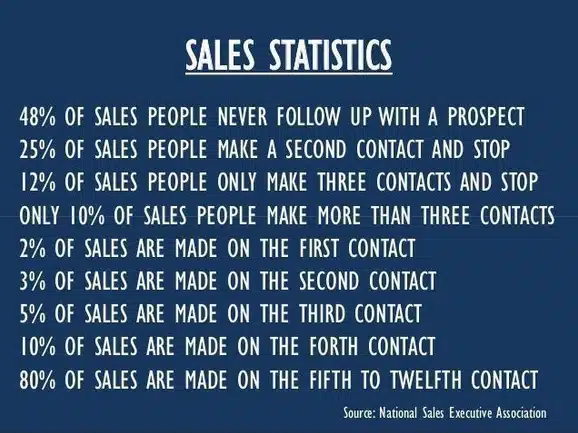
Industry benchmarks in sales and business development demonstrate a profound disconnect between how often salespeople attempt contact and how often sales are actually closed:
- 44% of salespeople give up after a single follow-up attempt.
- 22% give up after two attempts.
- 14% give up after three attempts.
- 12% give up after four attempts.
This means that roughly 92% of all sales professionals abandon their prospects after four or fewer touchpoints.
Conversely, sales statistics compiled across multiple B2B industries indicate that up to 80% of all sales are made between the fifth and twelfth contact. If a freelance writer stops after the first email, they are operating within the 8% margin of effort, entirely bypassing the zone where the vast majority of conversions actually occur.
[Initial Outreach] ---> [1st Follow-Up] ---> [2nd/3rd Follow-Up] ---> [4th+ Follow-Up]
   (Rarely Converts)      (Low Conversion)       (Moderate Conversion)     (80% of Sales Closed Here)
The Problem with Mass Automation and AI Spam
Compounding the follow-up crisis is the rise of low-effort, automated outreach. In the age of generative artificial intelligence, inboxes are flooded with generic, poorly personalized cold emails. These mass-blasted messages are instantly recognizable by their hollow praise, awkward phrasing, and complete lack of genuine research.
When these initial pitches fail, automated sequences often trigger aggressive, unpersonalized follow-up blasts every 24 hours. This practice has severely damaged the reputation of cold emailing as a whole, breeding deep cynicism among editors and business owners.
However, this phenomenon creates a massive advantage for professional freelancers who execute outreach correctly. Because the baseline of incoming cold email quality is so abysmally low, a writer who demonstrates even a modest amount of genuine personalization—such as referencing a specific company milestone or critiquing a recent article in the opening sentence—instantly rises to the top of the inbox.
When that personalized opening is paired with a thoughtful, non-intrusive follow-up cadence, the writer ceases to look like a spam bot and begins to look like a valuable, long-term partner.
Official Industry Frameworks: Timing, Cadence, and Etiquette
Executing a successful follow-up campaign requires striking a delicate balance between staying top-of-mind and respecting the prospect’s time. A haphazard approach can quickly cross the line from persistent to obnoxious. Industry experts recommend a structured, measured approach to cadence and personalization.
The Recommended Timing Cadence
- Initial Outreach: The bespoke, research-backed introductory email.
- First Follow-Up: Wait 2 to 5 days. This window is wide enough to avoid appearing frantic or impatient, yet tight enough that the original email is still fresh in the recipient’s memory.
- Subsequent Touchpoints: Transition to a seasonal or milestone-based cadence. Rather than hounding the prospect every week, space subsequent check-ins across natural business cycles (e.g., quarterly touchpoints).
Quarterly touchpoints align seamlessly with natural calendar shifts, providing organic talking points. For instance:
- Late Autumn / Pre-Holiday Season: Offering assistance with end-of-year content backlogs, holiday campaigns, or clearing out the editorial queue before the office closes.
- Mid-January: Wishing the team a Happy New Year, checking in on Q1 content initiatives, and inquiring about upcoming project expansions.
- Spring and Summer: Checking in as mid-year marketing strategies pivot, or offering support while internal teams take summer vacations.
The "Easy Out" Technique
One of the most effective psychological tools in cold outreach is providing the prospect with an "easy out." When crafting a follow-up, writers should explicitly relieve the pressure of an immediate response.
By including a concluding line such as, "If you’re fully staffed right now, no worries at all—just let me know and I’ll check back in a few months," the dynamic of the interaction changes entirely. This non-intrusive approach disarms the prospect, lowers their guard, and keeps the door open for future communication without triggering defensiveness.
Future Outlook: Modern Tools for Managing Outreach
In the past, managing a multi-touch outreach campaign across dozens or hundreds of prospective clients required complex spreadsheets, manual calendar reminders, and an immense amount of administrative overhead. If a freelancer fell behind on their tracking, the entire system collapsed.
Fortunately, the technological landscape for freelance business development has evolved dramatically. Modern tools allow writers to automate the administrative burden of tracking leads, freeing up cognitive bandwidth to focus on writing and relationship-building.
1. Gmail-Integrated CRM Solutions
Tools like Streak have revolutionized how independent operators manage pipeline development. By transforming a standard Gmail inbox into a lightweight Customer Relationship Management (CRM) system, freelancers can track when emails are sent, monitor whether messages have been opened, and attach detailed notes to specific contacts. Automated reminders ensure that a writer never misses a scheduled follow-up window, turning chaotic email threads into an organized, linear sales pipeline.
2. AI-Assisted Pipeline Management
While generative AI has been widely criticized for producing low-quality spam, advanced conversational AI models (such as Claude or ChatGPT) serve as exceptional organizational assistants when utilized correctly. Freelancers can maintain a running log within an AI chat interface, detailing outreach dates, prospect details, and communication histories.
By prompting the AI periodically—asking for weekly or monthly progress summaries, conversion metrics from cold emails to discovery calls, and reminders for upcoming follow-ups—writers can effectively employ a virtual marketing assistant that never forgets a lead.
Conclusion
Freelance writing success is rarely determined by raw writing skill alone; it is equally dependent on business discipline. The most talented wordsmith in the world will struggle to build a sustainable career if their pipeline remains empty.
By acknowledging the reality of modern inbox fatigue, shifting away from the failed "one-and-done" email mindset, and implementing a disciplined, personalized follow-up cadence, freelancers can fundamentally transform their business trajectories.
Do not let hours of careful research and portfolio curation go to waste. Respect the data, honor the science of persistence, and commit to the follow-up. That extra effort is the definitive bridge between an overlooked freelancer and a thriving, six-figure writing business.
