

Executive Overview
Humanity’s reach into the cosmos has long been defined by wheels grinding across rocky terrain, camera lenses peering from static landers, and orbiters mapping the contours of alien worlds from high above. Yet, a fundamental shift in planetary exploration occurred on April 19, 2021, when NASA’s Ingenuity Mars Helicopter achieved powered, controlled flight on another world for the very first time. Ingenuity proved that aerodynamics could conquer an alien sky. However, that pioneering scout was an exploratory technology demonstrator, fundamentally constrained by design and engineering caution. It carried no scientific instruments, relying entirely on a single navigation camera to document its historic hops.
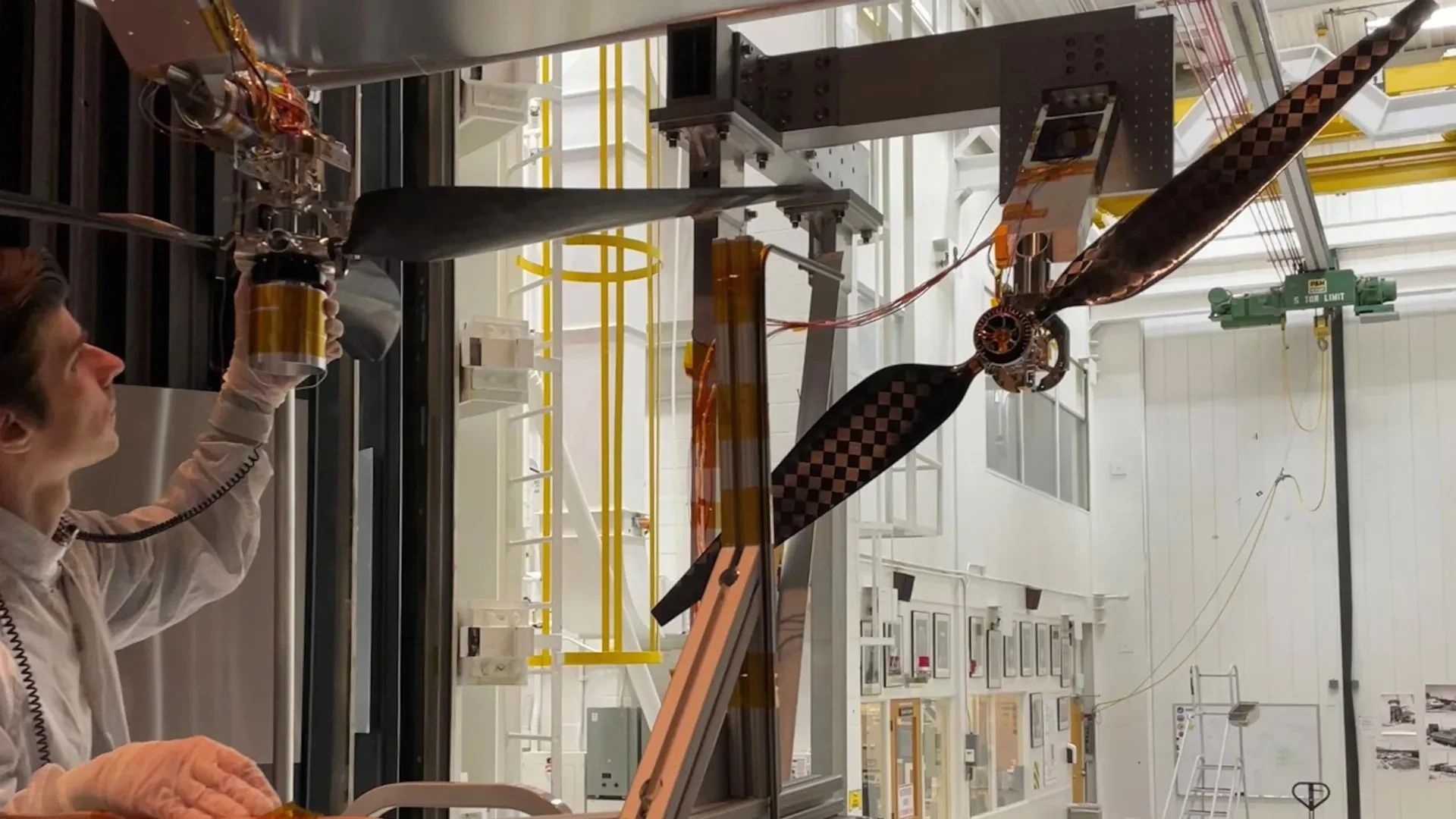
Now, NASA is aggressively pushing past those historical limitations. Engineers at NASA’s Jet Propulsion Laboratory (JPL) in Southern California have successfully completed a rigorous, high-risk campaign of rotor-blade testing designed to shatter atmospheric boundaries once thought insurmountable. In a specialized environmental chamber capable of replicating the bitter, carbon-dioxide-rich void of the Martian exosphere, researchers pushed experimental helicopter blade tips past the speed of sound.
The achievement is more than a mere numerical milestone. By driving rotor tips past Mach 1—reaching a maximum velocity of Mach 1.08 during a series of 137 grueling test runs—engineers achieved a staggering 30% increase in lift capability. This aerodynamic leap forward promises to fundamentally transform the future of interplanetary exploration. While Ingenuity operated under strict safety margins to avoid the chaotic physics of the sound barrier, next-generation aircraft like NASA’s newly announced SkyFall project will leverage these supersonic breakthroughs. Scheduled for a targeted launch in December 2028, these advanced aerial vehicles will be equipped to carry heavy scientific instrumentation, complex sensors, and extended-life power supplies. They are poised to unlock aerial cartography, deep-canyon reconnaissance, and sample acquisition across treacherous Martian terrain that has remained perpetually out of reach for traditional wheeled rovers.
Detailed Chronology: Inside the Mars Simulation Chamber
The path to breaking the Martian sound barrier was forged inside one of the most historically significant and technologically demanding testing facilities in modern aerospace engineering: JPL’s historic 25-Foot Space Simulator. The road to the March testing breakthrough required meticulous planning, high-stakes fabrication, and an unflinching tolerance for structural risk.
Designing the Next-Generation Blades
The physical architecture of the experimental rotor systems was developed and manufactured by AeroVironment in Simi Valley, California—the same visionary industrial partner that helped bring Ingenuity to life. Drawing lessons from Ingenuity’s 72 historic flights, which utilized foam-cored, carbon-composite blades limited to a conservative 2,700 revolutions per minute (RPM), engineers drafted completely new aerodynamic profiles.
Two distinct rotor configurations were prioritized for evaluation:
- The Three-Bladed Rotor: A compact, multi-blade configuration explicitly optimized for high-density thrust generation under extreme atmospheric constraints.
- The Long-Blade Configuration (SkyFall Design): A two-bladed system featuring extended span lengths designed to maximize leverage and aerodynamic efficiency at lower rotational speeds.
Recreating the Martian Atmosphere
To evaluate these systems under authentic extraterrestrial conditions, the engineering team sealed the test articles inside the 25-Foot Space Simulator. Researchers evacuated the chamber’s ambient air and introduced a meticulously measured, pressurized volume of carbon dioxide ($CO_2$). Because Mars possesses an atmosphere composed primarily of carbon dioxide at roughly 1% of Earth’s surface pressure, replicating this chemical and barometric profile was vital to acquiring accurate aerodynamic telemetry.
Once the Martian environment was successfully locked inside the chamber, the test runs commenced. Because driving a rotor system into supersonic regimes introduces catastrophic structural instability—where a localized blade fracture could send shrapnel tearing through expensive testing hardware—engineers took extraordinary safety precautions. They reinforced critical sections of the chamber’s interior with heavy-duty sheet metal. Researchers operated the systems from a control room stationed just yards away, continuously monitoring real-time data feeds and high-speed optical camera arrays.
Pushing Past the Limit
The testing protocol was deliberately incremental. For the three-bladed rotor, engineers systematically increased the rotational speed of the shaft. As the RPM climbed past 3,000 and pushed toward 3,500, the acoustic signature within the simulator shifted dramatically.
When the rotor reached 3,750 RPM, the physical velocity of the blade tips approached Mach 0.98, hovering immediately beneath the threshold of sound. To complicate matters further, the test engineers introduced a specialized axial fan system into the chamber, generating simulated headwinds designed to disrupt the aerodynamic flow across the rotating blades.
In aviation, when a moving airfoil encounters a headwind, its relative airspeed spikes. For Ingenuity, this interaction posed an unacceptable risk: a sudden Martian dust devil or wind gust could push the blade tips past the sound barrier unexpectedly, plunging the vehicle into the unpredictable, turbulent physics of transonic flow.
Rather than avoiding this phenomenon, the JPL team leaned directly into it. Continuing their progressive runs, they increased the rotational velocity and headwind resistance simultaneously. On the final sequence of the test campaign, the rotor tips punched definitively through the sound barrier, hitting Mach 1.08. Remarkably, the advanced composite materials held firm. The blades survived the brutal aerodynamic forces without structural failure, marking an unprecedented triumph in extraterrestrial rotorcraft engineering.
Immediately following the three-bladed trials, the team evaluated the two-bladed SkyFall configuration. Because its blades possessed a larger overall diameter, they achieved near-supersonic speeds at a lower rotational velocity of 3,570 RPM before simulated headwinds were factored in. The data captured during these sessions confirmed that the structural integrity and aerodynamic lift characteristics met—and frequently exceeded—all pre-test computer modeling expectations.
Supporting Context & Metrics: The Physics of Martian Flight
To understand why driving helicopter rotor blades past the speed of sound on Mars is an engineering masterpiece, one must examine the hostile atmospheric physics that govern the Red Planet.
Atmospheric Density vs. Gravitational Pull
On Earth, standard atmospheric pressure at sea level provides a rich density of air molecules that helicopter rotors can effortlessly push against to generate lift. Mars offers no such luxury. The Martian atmosphere is exceptionally thin, boasting a density equivalent to just 1% of Earth’s sea-level atmosphere.
Compounding this deficit is the issue of planetary gravity. While Mars is smaller than Earth and exhibits a gravitational pull roughly 38% of Earth’s, that gravitational force is still substantial enough to demand significant thrust to achieve liftoff. An aircraft attempting to fly on Mars is trapped in an unforgiving aerodynamic paradox: it must generate high-altitude lift in an environment that offers virtually no air mass to compress, while simultaneously fighting planetary gravity.
To generate the necessary thrust under these conditions, a helicopter must adopt one of two strategies: drastically increase the surface area of its rotor blades or spin those blades at extreme rotational velocities. Because larger blades add dead weight and structural vulnerability, aerospace engineers rely on hyper-velocity rotation.
The Dynamics of Sound: Earth vs. Mars
The speed of sound—known as Mach 1—is not a universal constant; it varies depending on the temperature, molecular weight, and composition of the gas through which a pressure wave travels.
- Earth (Sea Level): The speed of sound is approximately 760 mph (1,223 kph). Atmospheric conditions are warm and rich in nitrogen and oxygen. Small, high-performance terrestrial helicopters can spin their rotors at thousands of RPM, but the density of the air means their blade tips remain well below supersonic speeds during normal operation.
- Mars: The speed of sound drops precipitously to roughly 540 mph (869 kph). This reduction is driven primarily by the frigid ambient temperatures of the Martian climate and the heavy molecular weight of a carbon dioxide-dominated atmosphere.
The Transonic Danger Zone
When an aircraft’s components approach or exceed Mach 1, they enter the transonic and supersonic regimes. Airflow over the curved surface of a rapidly spinning rotor blade accelerates faster than the vehicle itself. Consequently, even if the central hub of a helicopter rotor is spinning at subsonic speeds, the tips of the blades can encounter local supersonic flow long before the overall aircraft reaches Mach 1.
As Jaakko Karras, rotor test lead at JPL, aptly noted, referencing legendary test pilot Chuck Yeager: "Things can get squirrely around Mach 1."
As a blade tip hits the sound barrier, shockwaves form across its upper surface. These shockwaves cause abrupt, localized shifts in pressure, boundary-layer separation, and severe aerodynamic buffeting. On Ingenuity, engineers established an ironclad operational ceiling: they strictly limited the rotor blade tips to Mach 0.7 during calm conditions. This left a protective buffer zone to ensure that if the craft encountered an unexpected Martian headwind or gust, the blade tips would never inadvertently slip into the unpredictable turbulence of Mach 1.0.
By proving that next-generation blades can not only survive but thrive at Mach 1.08, NASA has effectively cleared the transonic barrier for interplanetary flight. This breakthrough yields a direct 30% boost in lift capability, transforming the payload calculus for future Mars missions.
Official Statements: Perspectives from the Leadership Team
The success of the JPL wind-chamber testing campaign has generated immense enthusiasm and validation across NASA’s leadership and research divisions. The transition from proof-of-concept technology demonstrations to operational scientific utility marks a philosophical turning point for robotic exploration.
Al Chen, Mars Exploration Program manager at JPL, emphasized the sheer difficulty of the engineering hurdle while honoring the legacy of the vehicle that paved the way:
"NASA had a great run with the Ingenuity Mars Helicopter, but we are asking these next-generation aircraft to do even more at the Red Planet. That’s not an easy ask. While everything about Mars is hard, flying there is just about the hardest thing you can do. That’s because its atmosphere is so incredibly thin that it is hard to generate lift, and yet Mars has significant gravity."
Detailing the calculated risks taken in the 25-Foot Space Simulator, Jaakko Karras, rotor test lead at JPL, highlighted the shift from Ingenuity’s cautious operational limits to the aggressive performance metrics demanded by future missions:
"If Chuck Yeager were here, he’d tell you things can get squirrely around Mach 1. With that in mind, we planned Ingenuity’s flights to keep the rotor blade tips at Mach 0.7 with no wind so that if we encountered a Martian headwind while in flight, the rotor tips wouldn’t go supersonic. But we want more performance from our next-gen Mars aircraft. We needed to know that our rotors could go faster safely."
Shannah Withrow-Maser, an aerodynamicist from NASA’s Ames Research Center in Silicon Valley and a core member of the test team, expressed astonishment at the performance margins recorded during the final data readouts:
"The successful testing of these rotors was a major step toward proving the feasibility of flight in more demanding environments, which is key for next-gen vehicles. We thought we’d be lucky to hit Mach 1.05, and we reached Mach 1.08 on our last runs. We’re still digging into the data, and there may be even more thrust on the table. These next-gen helicopters are going to be amazing."
Future Outlook: SkyFall and the 2028 Horizon
The successful supersonic characterization of these advanced rotor blades is not a theoretical exercise; it has immediate, highly practical implications for upcoming flight hardware. Engineers working on NASA’s recently announced SkyFall project have already integrated the empirical data gathered in March into the project’s official engineering design specifications.
The SkyFall Mission Architecture
Inspired directly by the historic, paradigm-shifting performance of Ingenuity—which far outlived its original 30-day mission profile to complete 72 extraordinary flights—SkyFall represents the operational maturation of interplanetary aviation.
The mission concept is audacious: SkyFall is slated to transport a fleet of three next-generation helicopters to the Martian surface, with a targeted launch window in December 2028.
Unlike Ingenuity, which functioned primarily as a flying camera platform to demonstrate aerodynamic viability, the SkyFall aircraft are engineered as true working science vehicles. Armed with the 30% boost in lift capacity unlocked by supersonic rotor optimization, these next-generation helicopters will be capable of carrying:
- Advanced Scientific Sensors: Miniature spectrometers, atmospheric gas analyzers, and multispectral imaging systems.
- Heavy Instrument Payloads: Specialized drills and geochemical assay tools capable of analyzing surface regolith in-situ.
- Extended-Capacity Power Systems: Larger lithium-ion battery arrays and high-efficiency solar panels to support longer flight durations and wider operational radii.
Expanding the Frontiers of Planetary Science
The deployment of a three-helicopter fleet in 2028 will fundamentally alter how scientists investigate the Red Planet. Traditional rovers, while marvels of mechanical endurance, remain restricted by topography. Sand dunes, steep crater walls, deep chasms, and chaotic boulder fields present insurmountable barriers to wheeled locomotion.
Aerial reconnaissance changes the equation entirely. Operating at low altitudes, SkyFall helicopters will be able to swoop down into ancient river deltas, peer beneath the overhangs of towering cliffs, and cross treacherous crater floors in a matter of minutes—distances that would take rovers months to traverse.
Furthermore, these aerial platforms will serve an invaluable scouting role for future human exploration. By mapping localized surface hazards, monitoring atmospheric particulate density in real-time, and identifying high-value geological samples from the air, next-generation helicopters will clear the path for the eventual arrival of astronauts.
By breaking the sound barrier in a simulated Martian sky, NASA’s engineers have done more than validate an aerodynamic equation. They have opened a new chapter in interplanetary exploration—one where the skies of alien worlds are no longer just a barrier to be crossed, but a highway to discovery.
