

Executive Overview
Deep within the stratigraphic architecture of our planet lies one of the most confounding enigmas in modern geosciences: the Great Unconformity. Spanning hundreds of millions—and in some locations, well over a billion—years of missing geological history, this massive stratigraphic gap represents a missing chapter in the Earth’s autobiography. For decades, geologists, stratigraphers, and geodynamicists have debated the mechanisms responsible for this continental erasure. Was it the scouring action of global glaciation ("Snowball Earth"), tectonic fragmentation, sea-level volatility, or an amalgamation of surface forces?
Now, groundbreaking research published in the journal Nature points to a profound subterranean driver. Led by Santosh Dhungana, a PhD candidate at the University of Wollongong (UOW), alongside co-author Associate Professor Nicolas Flament, a new study demonstrates that the answer may lie thousands of kilometers beneath our feet, buried deep within the convective churn of Earth’s mantle.
Utilizing sophisticated computational models that simulate mantle dynamics over hundreds of millions of years, the UOW research team has illustrated how ancient continental landmasses gradually rose and subsided in response to thermal currents within Earth’s interior. This multi-hundred-million-year cycle of vertical land movements exposed massive swaths of continental crust to relentless subaerial erosion, shaving off towering volumes of rock before sweeping seas advanced to bury and preserve the remaining foundations.
By linking surface stratigraphy directly to deep-Earth geodynamics, this study transitions the Great Unconformity from an isolated catalog of localized anomalies into a globally unified consequence of planetary breathing—the rhythmic rise and fall of whole continents driven by the slow, relentless engine of mantle convection.
Detailed Chronology: Unraveling the Missing Billion Years
To understand the magnitude of the discovery, one must first grasp the normal mechanics of planetary sedimentation. Under standard geological conditions, sedimentary strata accumulate incrementally over vast spans of time, creating a chronological archive where older, deeper layers are systematically overlain by younger deposits. This stratigraphic succession serves as Earth’s primary historical text, allowing paleoclimatologists, paleontologists, and geologists to reconstruct ancient ecosystems, atmospheric composition, and tectonic configurations.
Yet, this archive features a dramatic and widespread interruption. Across multiple continents, sedimentary strata dating to the Cambrian period—roughly 540 million years ago—rest in stark, unconformable contact directly atop intensely weathered, ancient crystalline basement rocks, such as granites and metamorphic complexes aged one billion years or older. The intervening chapters of Earth’s history are entirely missing.
[Younger Sedimentary Strata (~540M years ago - Cambrian)]
=========================================================  <-- The Great Unconformity
[Ancient Crystalline Basement Rocks (1+ Billion years old)]
The Grand Canyon and Global Equivalents
One of the most visually stunning and heavily studied manifestations of this geological discontinuity is exposed within the walls of the Grand Canyon in the United States. Here, younger Paleozoic strata sit unconformably upon ancient Vishnu Schist and Zoroaster Granite, skipping a vast expanse of time. However, the Grand Canyon is far from an isolated geological curiosity. Similar configurations have been systematically cataloged across the globe, spanning ancient continental blocks in North America (Laurentia), northern Europe (Baltica), Australia, Africa, and Asia.
Crucially, the temporal scale of the missing record is profoundly variable depending on the geographic locale. In some regions, approximately 200 million years of geological history have vanished without a trace, while in others, the stratigraphic gap stretches past an astonishing 1.2 billion years. This variability has long hindered efforts to pinpoint a singular, globally cohesive mechanism, leaving scientists to weigh competing local hypotheses against one another.
The Geodynamic Catalyst: Simulating the Mantle
To break through this decades-long analytical impasse, Dhungana and Flament adopted a macro-scale approach. Rather than focusing exclusively on localized surface phenomena, they developed numerical simulations tracking the evolution of Earth’s mantle over deep geological time.
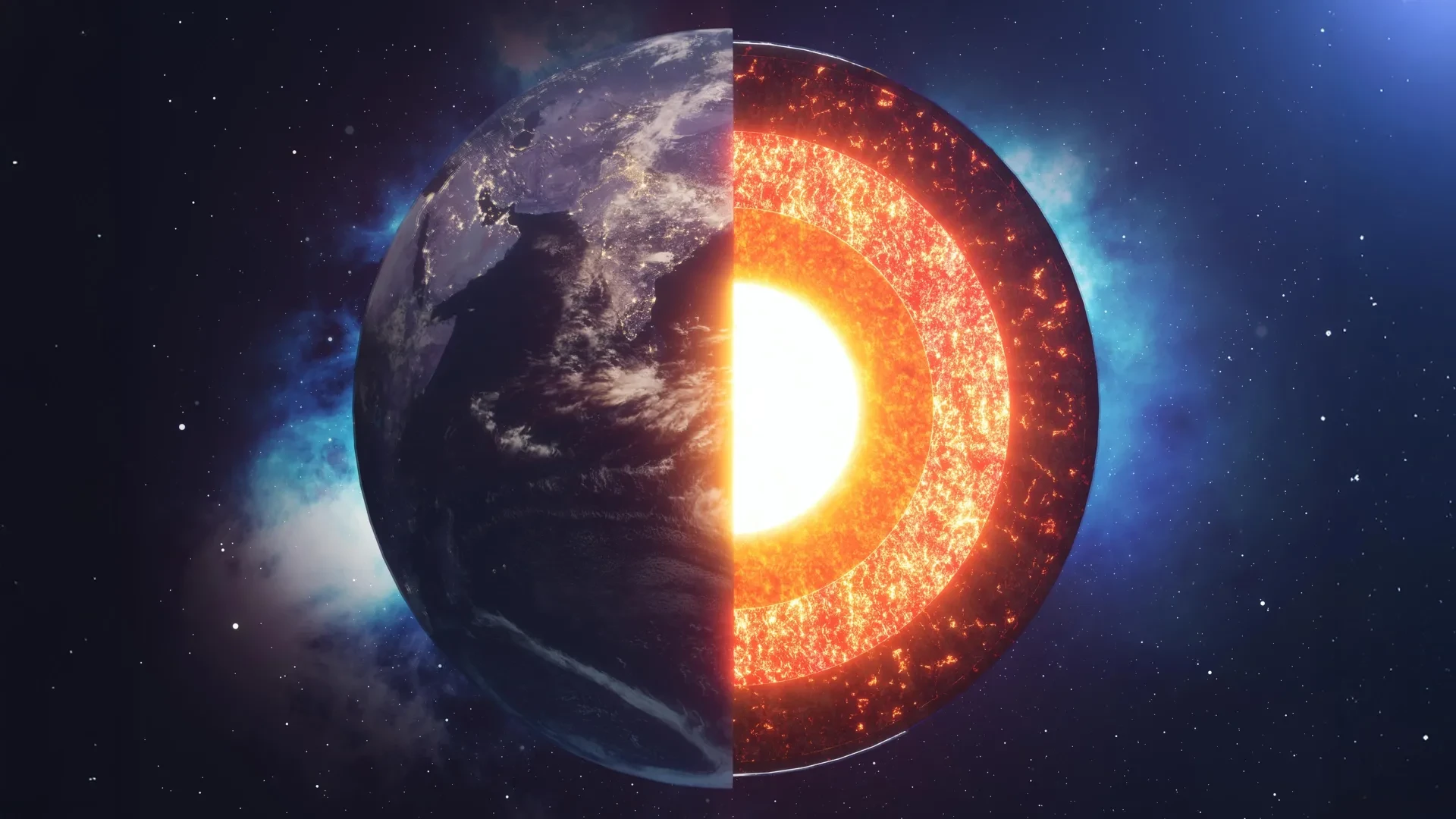
The mantle—an immense shell of hot, predominantly solid rock situated between the crust and the liquid outer core—behaves under immense pressures and temperatures like a sluggish fluid over hundreds of millions of years. Driven by internal thermal energy, this mantle material undergoes slow convection, wherein hot plumes rise toward the lithosphere while cooler, denser slabs sink back toward the core-mantle boundary.
These convective currents exert dynamic topography on the underside of Earth’s crust, causing entire continental plates to warp upward or subside over immense timeframes. The UOW simulations revealed that during the Neoproterozoic Era—spanning roughly one billion to 540 million years ago—mantle convection forced major ancient continental cores, including Laurentia, Baltica, and North China, to undergo prolonged, broad-scale uplift.
As these continental platforms rose hundreds of meters above base level, they were exposed to atmospheric weathering, wind, and fluvial systems. Over hundreds of millions of years, this prolonged exposure acted like a planetary planer, stripping away vast vertical columns of older rock.
Subsequently, as mantle circulation patterns shifted during the Phanerozoic eon (the past 540 million years), these elevated continental regions experienced regional subsidence. As the land sank, shallow epicontinental seas advanced across the eroded continental interiors, depositing fresh blankets of sediment directly onto the ancient, truncated basement rocks. This sequence of basin inversion, prolonged uplift, intense subaerial erosion, subsequent subsidence, and marine transgression forged the globally distributed stratigraphic signature we recognize today as the Great Unconformity.
Supporting Context & Metrics
Evaluating the robustness of this new geodynamic model requires analyzing the quantitative spatial and temporal parameters matching the computer simulations to empirical field geology.
Key Geological Epochs and Timelines
- Neoproterozoic Era (1 Billion – 540 Million Years Ago): The critical interval characterized in the models by widespread mantle-driven continental uplift, setting the stage for extensive subaerial erosion and the generation of the primary stratigraphic hiatus.
- The Cambrian Period (~540 Million Years Ago): The threshold marking the abrupt appearance of complex, heavily skeletonized animal life (the Cambrian explosion), occurring immediately above the unconformity boundary.
- Phanerozoic Eon (540 Million Years Ago to Present): The era of continental subsidence, marine transgression, and sedimentary burial that preserved the eroded basement interface.
Geographic Distribution Matrix
The computer models generated by the University of Wollongong team did not merely predict random uplift; their outputs mapped with remarkable precision to the exact regions where the Great Unconformity is most prominently exposed and documented:
- Laurentia (North America): Exemplified by classic exposures in the Grand Canyon and the Canadian Shield, exhibiting long-term Neoproterozoic uplift followed by Phanerozoic marine inundation.
- Baltica (Northern Europe): Demonstrating high correlation between modeled mantle-induced dynamic topography and the observed absence of Mesoproterozoic to Neoproterozoic strata.
- North China: Showcasing synchronous vertical crustal motions that align with the regional removal of ancient rock formations prior to Cambrian deposition.
Official Statements and Expert Perspectives
The publication of these findings in Nature has generated substantial discussion within the international geosciences community, bridging the traditionally siloed disciplines of deep-Earth geodynamics and surface stratigraphy.
Lead author Santosh Dhungana emphasized the conceptual framework of the study, drawing an intuitive analogy to help contextualize the scale of the missing history:
"Imagine a book where a huge section in the middle has been ripped out. The Great Unconformity is that gap in Earth’s story, with the narrative jumping from the early chapters straight to a much later part of the story. Our research suggests these pages weren’t lost by chance."
Dhungana further noted the methodological leap forward achieved by the research team, pointing out the necessity of testing historical hypotheses against the physical realities of planetary evolution:
"Many explanations for the Great Unconformity had been proposed but few had been tested against how the Earth actually behaves over time. It is a thrill to be able to propose a solution to this geological puzzle."
Co-author Associate Professor Nicolas Flament highlighted how this research reframes our understanding of what geological absences can communicate about planetary history:
"Sometimes what is missing can tell us more about the story of Earth than what we can see. A single, long period of uplift followed by a long period of sinking would have been the ideal recipe for removing the rock and preserving the worn surface."
Flament stressed that while mantle convection may not represent the exclusive variable operating in every localized outcrop worldwide, the model establishes a unified, testable baseline for explaining why a vast swath of Earth’s antiquity vanished and how the remaining physical evidence survived the passage of deep time.
Future Outlook: Implications for Earth Sciences
The integration of deep-mantle geodynamics with surface-level stratigraphy marks a pivotal methodological shift in geology. For decades, researchers treated surface erosion and interior mantle processes as largely decoupled phenomena, with stratigraphers focusing on surface basins and geophysicists modeling deep internal circulation.
By demonstrating that mantle convection can orchestrate continental-scale uplift and erosion over hundreds of millions of years, the Wollongong study opens several new avenues for ongoing research:
- Refining Global Tectonic Models: Future geodynamic simulations will likely incorporate higher-resolution constraints to map localized variations in mantle viscosity, thermal plume distributions, and ancient plate tectonic reconstructions with greater fidelity.
- Reassessing Biogeochemical Cycles: The timing of the Great Unconformity closely precedes the Cambrian explosion—a major evolutionary radiation of animal life. By clarifying when vast amounts of continental rock were weathered and eroded into ancient oceans, scientists can better model how calcium, phosphorus, and other essential nutrients were delivered to early marine ecosystems, potentially linking mantle dynamics to the origins of complex biological diversity.
- Extraterrestrial Comparative Planetology: Understanding how internal thermal engines reshape planetary crusts over deep time provides vital comparative frameworks for studying geological archives—or the lack thereof—on neighboring rocky bodies such as Mars and Venus.
Ultimately, the missing billion years of Earth’s history may no longer be viewed as a frustrating blank space in our planet’s archive. Instead, as this new research demonstrates, the very forces that erased the rocks are the ones that wrote the deeper story of a living, breathing, geodynamically active world.
