

Executive Overview
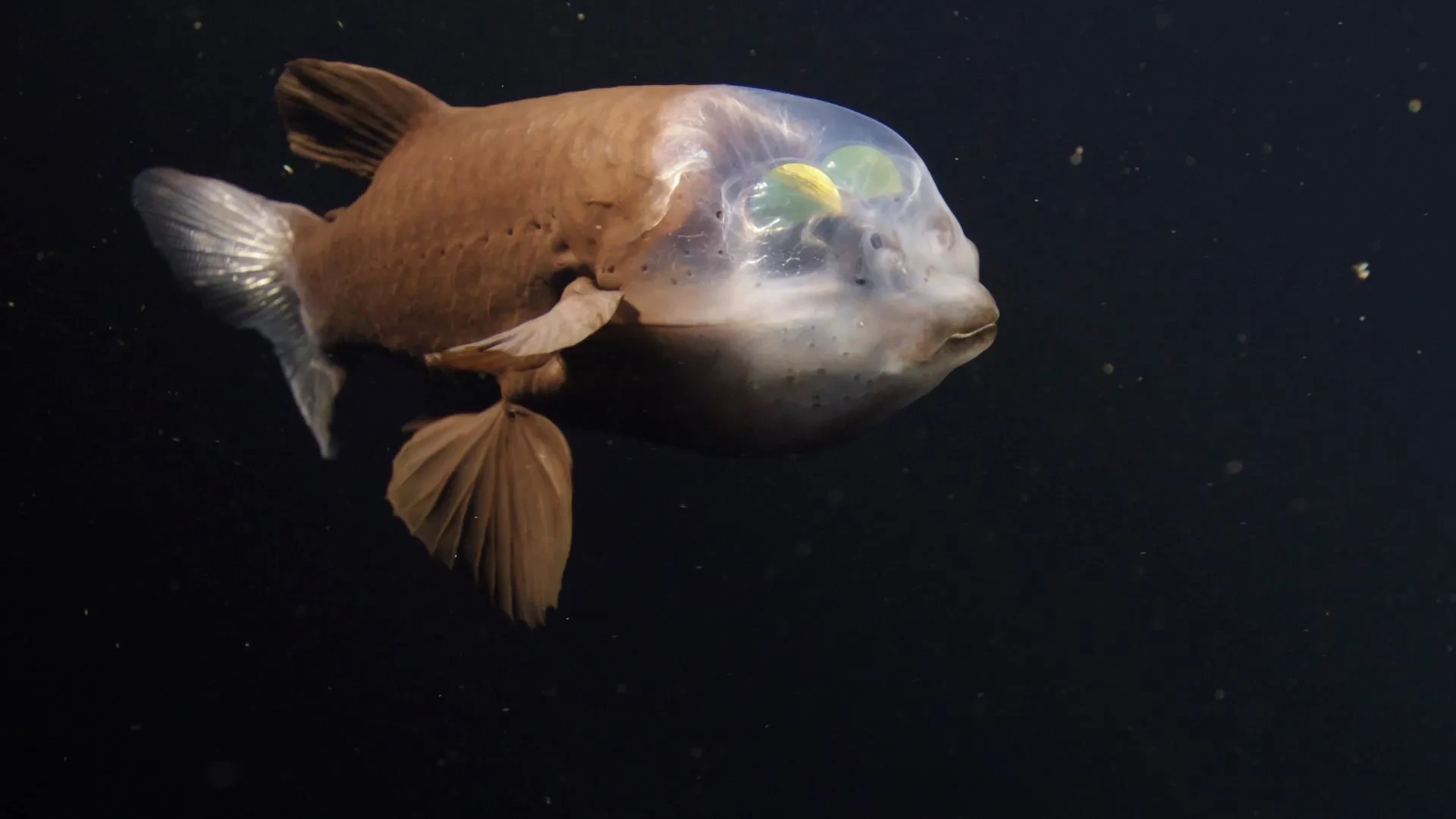
Nearly 2,000 feet beneath the restless surface of the Pacific Ocean, in a realm of perpetual twilight where sunlight fades to an absolute monochrome void, marine researchers achieved a milestone of deep-sea exploration. During an expedition aboard the research vessel David Packard, scientists from the Monterey Bay Aquarium Research Institute (MBARI) recorded an extraordinary encounter with one of the ocean’s most enigmatic and visually striking inhabitants: the barreleye fish (Macropinna microstoma).
Distinguished by its completely transparent, fluid-filled head shield and tubular, rotating green eyes, Macropinna microstoma is a creature of almost mythic rarity. This landmark sighting marks only the eleventh time in nearly four decades of rigorous ocean exploration that MBARI scientists have successfully documented the living animal in its natural habitat. More significantly, the expedition yielded the institute’s first-ever ultra-high-definition 4K footage and immersive 3D stereo imagery of the species, offering unprecedented insights into its physiology, behavior, and evolutionary adaptations.
The discovery highlights the sophisticated methodologies of modern deep-sea research. It underscores the vital role advanced remotely operated vehicles (ROVs) play in unlocking the secrets of the mesopelagic—or "twilight"—zone. As human pressures on marine ecosystems mount, encounters with such specialized organisms serve not only to expand our biological horizons, but also to reinforce the critical imperative for global ocean stewardship.
Detailed Chronology
The "Diving Deep for Delicate Drifters" Expedition
The extraordinary encounter unfolded during the closing hours of an intensive, eight-day marine research mission designated as the Diving Deep for Delicate Drifters expedition. Led by MBARI’s Biodiversity and Biooptics Team, the primary scientific objective of the voyage was to investigate gelatinous marine organisms—including fragile siphonophores, deep-sea jellyfish, and delicate ctenophores (comb jellies). Researchers sought to understand the evolutionary mechanisms that allow these delicate creatures to withstand the immense hydrostatic pressures and dynamic currents of the open ocean.
To capture a holistic view of the midwater ecosystem, the research team deployed a multi-tiered observational strategy. This combined shallow, blue-water scuba diving near the ocean surface with heavy-duty robotic submersible surveys hundreds of meters below. By integrating these complementary approaches, the scientists could map biological interactions across different strata of the water column.
The Twilight Zone Sighting
The discovery of the barreleye fish occurred approximately 90 kilometers (55 miles) offshore, just as the day’s underwater operations were wrapping up. At approximately 600 meters (1,970 feet) beneath the surface, the expedition’s workhorse remotely operated vehicle (ROV), Doc Ricketts, was beginning its ascent toward the surface for recovery after a long day of filming and biological sampling.
As ROV pilots navigated the vehicle upward, Research Specialist Shannon Johnson caught a glimpse of an unusual, spectral shape in the vehicle’s high-definition camera feed. Recognizing the silhouette instantly, Johnson instructed the pilots to halt the ascent and hold position.
At that moment, most of the scientific personnel had already retreated to the ship’s wet lab to process, catalog, and preserve specimens collected earlier in the day. However, once word of the sighting crackled over the ship’s internal communication system, a frantic exodus ensued. Scientists and ship crew members rushed back to the control room, crowding around the monitors to witness the ethereal apparition suspended in the beam of the ROV’s lights.
For roughly 20 minutes, the team observed the barreleye as it maintained an almost motionless posture in the midwater. Using specialized lighting configurations on Doc Ricketts, researchers meticulously illuminated the fish’s transparent head shield, capturing crisp, unprecedented visual data before the animal melted back into the impenetrable blackness of the deep ocean.
Supporting Context & Metrics
Anatomy of an Evolutionary Marvel
The barreleye’s bizarre morphological adaptations are not mere evolutionary eccentricities; they are finely tuned survival mechanisms engineered for hunting in the ocean’s twilight zone (200 to 1,000 meters deep). In this faint zone, direct sunlight is virtually nonexistent, and visual predation relies entirely on detecting subtle optical cues against downwelling surface light or biological luminescence.
For decades, the mechanics of how Macropinna microstoma hunted remained an open question. Pioneering observations by MBARI Senior Scientist Bruce Robison and Research Specialist Kim Reisenbichler eventually unlocked the functional secrets of the fish’s anatomy:
- Tubular Eyes and the Transparent Dome: The fish’s most striking feature is its barrel-shaped, bright green eyes, which are encased entirely within a transparent, fluid-filled protective shield on top of its head. Normally, these tubular eyes are locked in an upward-facing position. This orientation allows the fish to scan the water column above for the faint, silhouetted shapes of passing prey, such as small crustaceans, copepods, and siphonophores.
- Rotational Mobility: When the barreleye detects a potential meal, its eyes are capable of rotating forward within the fluid-filled dome. This mechanical flexibility allows the fish to maintain constant visual contact with its prey as it maneuvers its body to strike.
- The Siphonophore Connection: The transparent shield serves a secondary, highly defensive purpose. MBARI researchers discovered that Macropinna frequently targets small crustaceans trapped within the stinging tentacles of deep-sea siphonophores—colonial organisms armed with potent stinging cells. The protective fluid dome shields the fish’s sensitive eyes from defensive stings while it navigates the tentacles to harvest its prey.
- Station-Keeping Stability: Unlike many pelagic fish that must swim constantly to maintain buoyancy, the barreleye utilizes large, flat, horizontal fins to remain virtually motionless in the water column. This hydrodynamic stability allows the fish to hover silently, conserving energy while waiting for prey to drift into its field of view.
Technological Breakthroughs in 4K and 3D
The recent encounter marked a major technological leap forward for MBARI. For the first time in the institute’s history, researchers captured ultra-high-definition 4K video footage of Macropinna microstoma. Furthermore, ROV Pilot and Technician Cameron Law maneuvered Doc Ricketts close enough to deploy the vehicle’s specialized virtual reality camera system.
This yielded high-resolution 3D stereo imagery, giving scientists a multidimensional perspective on the barreleye’s physical proportions and swimming dynamics. These digital assets transcend raw scientific utility; they are slated for integration into upcoming public outreach initiatives and educational curricula, designed to foster broader public interest in deep-sea ecosystems.
Statistical Rarity: By the Numbers
To contextualize the magnitude of this discovery, one must look at the immense scale of MBARI’s operational history:
- Operational Lifespan: Nearly 40 years of continuous deep-sea oceanographic exploration.
- Submersible Dives: Approximately 7,000 remotely operated vehicle (ROV) dives conducted across various marine trenches, canyons, and pelagic zones.
- Archived Video Footage: More than 41,000 hours of high-definition deep-sea video recorded and cataloged.
- Confirmed Sightings: Exactly 11 documented encounters with Macropinna microstoma.
This statistical rarity underscores how exceptionally difficult it is to encounter this species, cementing the David Packard expedition as a historic high-water mark for the research institute.
Official Statements
The emotional resonance of the discovery was palpable among the expedition crew. Reflecting on the momentous sighting, Senior Scientist Steven Haddock emphasized the dual nature of deep-sea research—balancing rigorous empirical inquiry with a profound sense of aesthetic wonder:
"Seeing a barreleye fish is a rare treat. Crew from across the ship joined the science team in the control room, mesmerized by this remarkable animal. Deep-sea animals capture the imagination, creating wonder and awe that we hope will inspire stewardship of the largest living space on Earth," stated Haddock.
Elaborating on the broader evolutionary implications of the midwater environment, Haddock added:
"Macropinna reminds us of the surprising ways that animals have adapted to thrive in the ocean’s midwater. So many of them survive by looking for subtle optical cues, like a shadow passing overhead, and this sets off evolutionary competition, pitting bioluminescent camouflage against increasingly sophisticated visual capabilities."
Future Outlook
Expanding Horizons in Midwater Research
The successful documentation of Macropinna microstoma during the Diving Deep for Delicate Drifters expedition heralds a new era for MBARI. As the institute’s new flagship research vessel, the David Packard, continues to deploy advanced robotic platforms and sensor arrays, marine biologists anticipate an accelerated rate of discovery in regions of the ocean that remain largely uncharted.
The technological advancements utilized during this expedition—ranging from enhanced optical lighting suites to 3D stereoscopic imaging—are setting a new benchmark for marine science. These tools enable researchers to study fragile, soft-bodied organisms in their natural states without causing physiological trauma or disrupting delicate behavioral patterns.
Comparative Deep-Sea Discoveries
The barreleye sighting does not exist in a vacuum. It coincides with an increasing global focus on midwater and benthic biodiversity. Earlier this summer, researchers collaborating with the Schmidt Ocean Institute in the mid-Atlantic Ocean documented another rare and bizarre deep-sea relative: the binocular fish (Winteria telescopa).
Together, these parallel discoveries across different ocean basins emphasize how much remains unknown about the inhabitants of the deep sea. As scientists piece together the physiological puzzles of creatures like Macropinna and Winteria, they gain crucial insights into how marine organisms adapt to extreme environmental pressures, low light levels, and shifting climatic baselines.
Ultimately, encounters with species as specialized and elusive as the barreleye fish serve as a powerful reminder of the ocean’s hidden complexity. By bridging advanced technology with dedicated scientific inquiry, researchers are slowly lifting the veil on the largest habitat on Earth—ensuring that the wonders of the deep twilight zone continue to inspire awe and motivate environmental stewardship for generations to come.
