

Executive Overview
In the high-stakes, fast-paced world of digital publishing and commercial freelance writing, time is the ultimate currency. For professionals who rely heavily on primary research—such as interviewing Subject Matter Experts (SMEs), conducting client onboarding calls, and synthesizing dense industry briefings—the bottleneck has historically been transcription. A standard 20-minute conversation with an expert can yield over 3,000 words of dialogue. Traditionally, unlocking those insights meant enduring a grueling, repetitive cycle: listening to recordings five or six times, frantically scribbling notes, or spending hours manually transferring spoken words to the page.
Enter artificial intelligence transcription. Among the myriad software solutions populating the productivity landscape, Otter.ai has emerged as an industry staple. Having been utilized continuously since 2020 by seasoned fintech and B2B writers—such as Location Rebel’s operations manager Liz Froment—Otter promises to eliminate the friction of manual transcription.
This comprehensive review evaluates whether Otter.ai is genuinely worth its $100-per-year Pro subscription for freelance writers and content creators. Through an analysis of practical workflows, return on investment (ROI) metrics, technical limitations, and comparisons with alternative human and AI solutions, this report provides an authoritative guide for professionals seeking to optimize their writing operations.
Detailed Chronology: How the AI Transcription Workflow Operates
To understand the value proposition of Otter.ai, one must examine how it fundamentally alters the timeline of a typical freelance writing assignment.
Phase 1: The Interview and Real-Time Capture
In a traditional reporting scenario, a writer enters an SME interview with a split focus. They must actively engage the interviewee, guide the narrative arc, ask dynamic follow-up questions, and simultaneously type or handwrite notes to capture critical quotes. This divided attention often results in superficial interviews and missed narrative threads.
With Otter integrated into the workflow, the paradigm shifts entirely. Operating via calendar synchronization on laptops and mobile devices, the AI tool can auto-join scheduled Zoom, Google Meet, or Microsoft Teams meetings, or be summoned on the fly.
- The Action: The writer hits record (with explicit permission from the participant).
- The Result: The writer’s cognitive load is instantly unburdened. Attention is locked at 100% on the speaker, allowing the conversation to flow organically, wander into unexpected insights, and dig deeper into complex topics without the anchor of note-taking.
Phase 2: Immediate Post-Call Processing
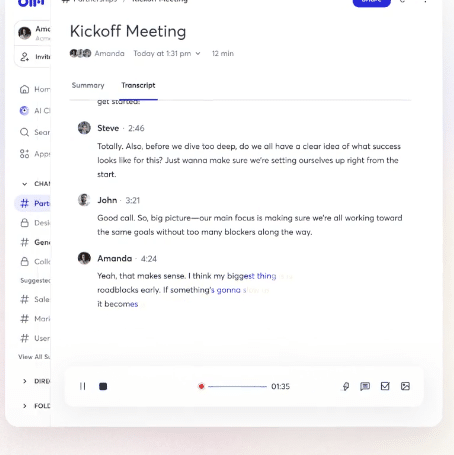
The moment the call concludes, Otter generates a synchronized transcript. Unlike human transcription services that require days of turnaround time, the AI-driven text is available instantly.
[Traditional Workflow]  Interview (20m) ➔ Manual Review (60m+) ➔ Drafting (3h) = Total Time: 4h 20m+
[Otter.ai Workflow]     Interview (20m) ➔ Instant Transcript (0m) ➔ Cleanup & Verification (10m) ➔ Drafting (3h) = Total Time: 3h 30m
Even factoring in a 10-minute review window to correct inevitable artificial intelligence misinterpretations, the writer leaps straight into the outlining and drafting phases while the conversation remains fresh in their mind.
Phase 3: Post-Processing and AI Chat Search
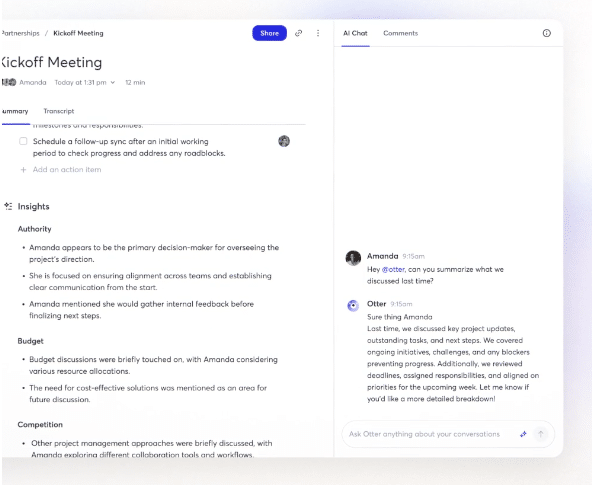
Once the transcript is populated, the writer interacts with the document using Otter’s built-in AI chat search features. Rather than manually scrolling through thousands of words to find a specific mention of a niche topic—such as "credit card fraud liabilities" or "AI-driven customer personalization"—the user can query the AI chatbot. The system instantly isolates and summarizes the relevant sections, bridging the gap when speakers wander onto tangents or reference interconnected points across different moments of the call. Furthermore, clicking any line in the text triggers audio playback linked directly to that exact timestamp, facilitating rapid verification of garbled words or technical jargon.
Supporting Context & Metrics: Calculating the Freelance ROI
For self-employed professionals and independent contractors, software subscriptions must prove their financial utility. Let us examine the economic mechanics that make a $100/year tool justifiable within a standard freelance budget.
The Math Behind the Time Savings
Consider a standard assignment: a writer is commissioned to write a 1,000-word reported article featuring one SME interview, for which they are compensated $1,200.
-
Without AI Transcription:
- Research & Prep: 1 hour
- Interview & Manual Transcription/Review: 1.5 hours
- Outlining & Drafting: 3 hours
- Total Time Invested: 5.5 hours
- Effective Hourly Rate: $218.18/hour
-
With Otter.ai Pro:
- Research & Prep: 1 hour
- Interview & Instant AI Transcription (with 10-minute cleanup): 0.5 hours
- Outlining & Drafting: 3 hours
- Total Time Invested: 4.5 hours
- Effective Hourly Rate: $266.66/hour
By saving roughly one hour per interview-based article, a writer producing three to four such pieces per month reclaims three to four hours of billable or rest time. Across a single month, the time saved easily eclipses the monthly equivalent cost of the Pro plan (roughly $8.33/month billed annually).
Comparative Feature and Pricing Tiers
To contextualize the market positioning, Otter.ai offers three primary subscription tiers:
-
Basic Plan (Free):
- Offers 300 transcription minutes per month.
- Imposes a 30-minute limit per individual recording.
- Verdict: Generous enough for prospective users to test on two or three real calls to evaluate workflow compatibility before committing capital.
-
Pro Plan ($8.33/month billed annually / ~$100/year):
- Offers 1,200 transcription minutes per month.
- Imposes a 90-minute limit per recording.
- Includes advanced search, custom vocabulary additions, and export options.
- Verdict: The undisputed "sweet spot" for independent freelance writers and content creators.
-
Business Plan ($19.99/month billed annually):
- Designed for small teams and agencies.
- Offers 6,000 minutes per month with a 4-hour limit per recording.
- Includes centralized billing, team management, and administrative controls.
Technical Limitations & Objective Realities
While the productivity gains are substantial, an authoritative evaluation must acknowledge the structural limitations and friction points associated with automated transcription technology.
1. The "Speaker Mode" Hardware Catch
Otter relies heavily on the computer’s audio environment to capture conversations. If a user has headphones plugged directly into their workstation during a call, Otter may capture only the user’s voice, failing to record the remote participant. Capturing both sides requires routing audio through computer speakers or utilizing specific acoustic setups. While manageable in a private home office or a soundproofed coworking booth, this limitation creates friction for professionals working in public spaces or environments requiring audio privacy.
2. Accuracy Realities: 80% to 85% Real-World Fidelity
While marketing materials often tout up to 95% accuracy, real-world deployment during technical SME interviews reveals a fidelity closer to 80–85%.
- The Challenges: Niche industry terminology, acronyms, brand names, and fast-paced colloquialisms are frequently mangled or misheard by the language model.
- The Safeguard: Professional writers cannot blindly copy-paste raw AI transcripts. Verifying quotes via audio playback is mandatory. However, because professional journalists inherently verify their quotes prior to publication, this verification step represents a nominal incremental tax rather than a catastrophic workflow failure.
3. Speaker Identification Flaws
In multi-speaker environments, webinars, or rapid-fire panels, Otter’s algorithmic speaker diarization can falter. Voices with similar timbres often result in mislabeled attributions (e.g., confusing Speaker 1 with Speaker 2). Writers covering panel discussions must manually audit speaker tags to ensure absolute accuracy in attribution.
Alternatives Analysis: Why Not Human Transcription or Competitors?
When evaluating transcription methodologies, writers generally weigh AI tools against two primary alternatives: human transcription services and competing AI software.
Human Transcription vs. Otter.ai
Human-powered transcription agencies undeniably deliver superior verbatim accuracy, effortlessly navigating complex accents and obscure jargon. However, they suffer from a fatal flaw in modern digital journalism: latency.
- Human transcription typically requires a 3-to-5-day turnaround time.
- In contemporary digital publishing, assignments often carry strict one-week turnarounds (encompassing sourcing, interviewing, researching, drafting, and editing). Waiting days for a human-generated transcript destroys tight editorial deadlines unless a steep financial "rush fee" is paid.
- Otter provides immediate text availability, removing deadline anxiety entirely.
Competing AI Solutions
The market features several notable alternatives, including Fireflies.ai, Fathom, and Rev. While these platforms offer compelling features—such as automated meeting summaries and CRM integrations—long-term users of Otter emphasize that software stickiness is often driven by habituation and interface simplicity. Freelancers handling high volumes of interviews are encouraged to leverage free trials across competing platforms to determine which user interface best aligns with their cognitive preferences.
Future Outlook: The Trajectory of AI in Content Creation
As artificial intelligence models continue to advance at an exponential rate, the landscape of freelance writing and editorial research is undergoing structural evolution.
- Hyper-Personalized Vocabulary Models: Future iterations of transcription engines will increasingly allow writers to upload niche glossaries (e.g., specific fintech regulations, medical terminology, or legal jargon) prior to a call, instantly shrinking the 80% accuracy gap toward near-perfection.
- Deeper Synthesizing Capabilities: Beyond simple text transcription, tools like Otter are shifting toward proactive content synthesis—automatically generating article outlines, extracting pull-quotes, and drafting executive summaries the moment a conversation concludes.
- The Human Element Remains Paramount: Despite fears that AI will replace human writers, tools like Otter reinforce the irreplaceable value of human editorial judgment. By automating the mechanical burden of transcription, AI frees creators to focus on what humans do best: critical thinking, narrative structuring, empathetic interviewing, and creative storytelling.
The Verdict
Otter.ai is not a magical panacea. It requires occasional cleanup, demands mindfulness regarding hardware configurations, and occasionally stumbles over complex industry nomenclature. Yet, for independent writers, journalists, and content creators who conduct regular interviews, its net utility is undeniable.
At approximately $100 per year—roughly equivalent to a single hour of billable professional work—the investment pays for itself within the first month of operation. For anyone looking to scale their freelance writing output, reduce administrative friction, and reclaim hours of valuable time, Otter.ai stands as an essential fixture in the modern digital workspace.
