

Executive Overview
As space agencies and private aerospace corporations look toward a permanent human footprint on the Moon, one immense logistical barrier continues to dominate mission planning: the tyranny of the rocket equation. Every pound of payload launched from Earth incurs staggering financial and energetic costs, making the prospect of ferrying thousands of tons of heavy construction materials across 238,000 miles of space entirely unfeasible.
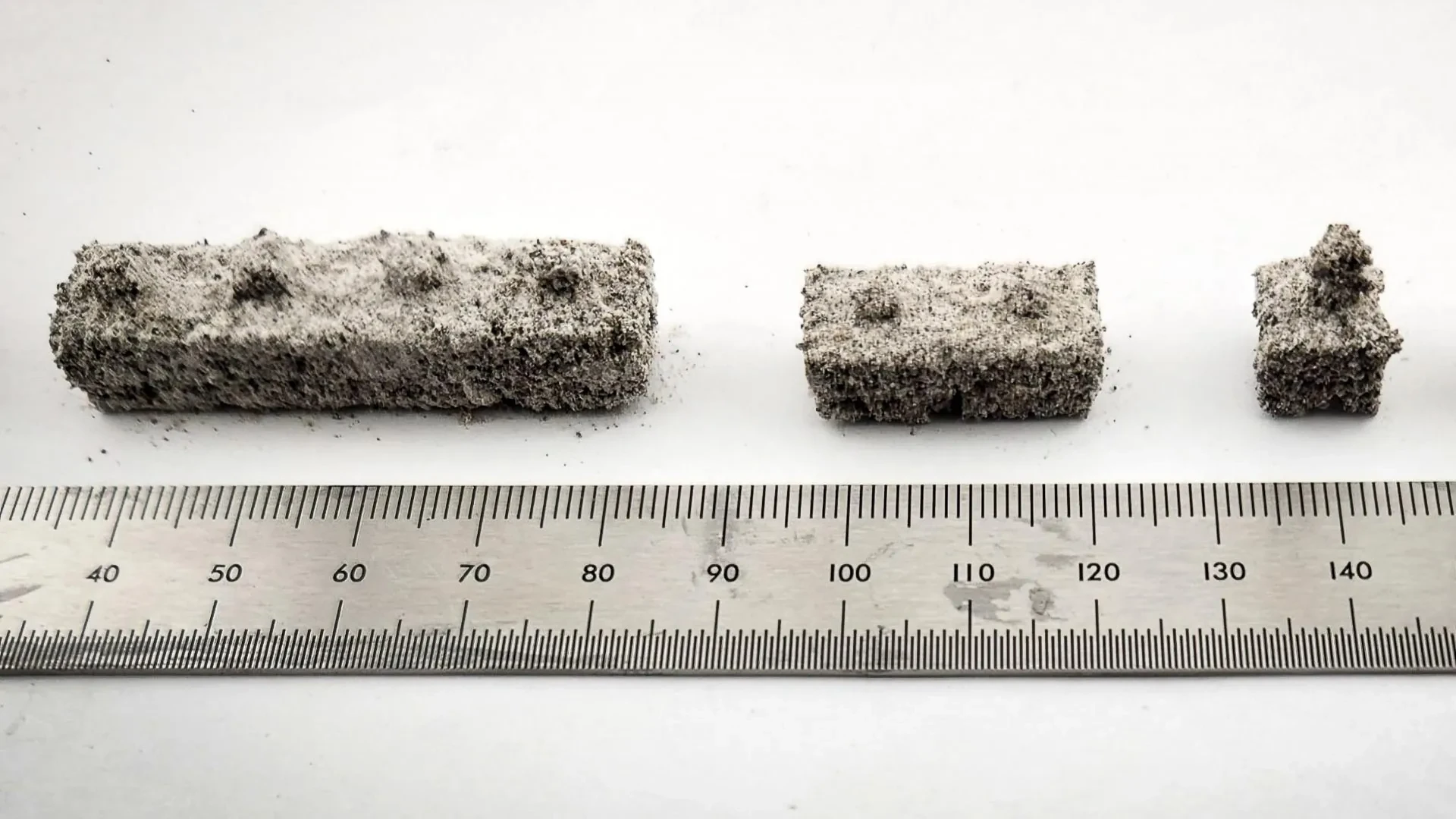
To bypass this bottleneck, a pioneering team of researchers at the University of Arkansas has introduced a groundbreaking in-situ resource utilization (ISRU) technique. Led by undergraduate researcher Cole McCallum and senior author Dr. Wan Shou, assistant professor of mechanical engineering, the team has successfully demonstrated a method to 3D print simulated lunar dust directly into interlocking, LEGO-like construction blocks.
Published in the esteemed journal NPJ Advanced Manufacturing, the study outlines a process utilizing laser powder bed fusion (LPBF) to sinter raw regolith simulant without the use of chemical or physical binders. By relying entirely on direct particle-to-particle bonding, the technique hints at a future where autonomous lunar rovers can harvest the ground beneath them and fabricate modular habitats brick by brick. This breakthrough significantly trims the payload mass required for initial lunar habitation modules, marking a vital step forward in humanity’s quest to become a multi-planetary species.
Detailed Chronology of the Breakthrough
Genesis in the Laboratory: The Undergraduate Spark
The roots of this technological leap trace back to the early undergraduate days of Cole McCallum at the University of Arkansas. Hailing from Little Rock, Arkansas, McCallum sought out research opportunities early in his academic career, crossing paths with Dr. Wan Shou, who maintains a firm institutional philosophy regarding undergraduate empowerment in advanced laboratory settings.
"He had this really strong belief that undergrads should get involved more with research," McCallum recalled, reflecting on the mentorship that positioned him at the bleeding edge of aerospace manufacturing.
Working within Shou’s advanced manufacturing lab, McCallum and the research team set out to solve a fundamental problem in space architecture: how to build durable structures on planetary bodies without importing heavy, foreign binding agents. The traditional additive manufacturing paradigms for extraterrestrial construction often required mixing regolith with liquid or polymer binders imported from Earth. The University of Arkansas team chose a far more audacious route: total material autonomy.
Mastering Laser Powder Bed Fusion (LPBF)
To achieve this, the team deployed laser powder bed fusion, a sophisticated form of additive manufacturing normally used on Earth for high-precision aerospace alloys and medical implants.
- Powder Spreading: The process initiates by spreading a microscopically thin, uniform layer of lunar regolith simulant across a build platform.
- Thermal Sintering: A highly concentrated, relatively low-power light source systematically traces predefined geometries across the powder bed, heating the jagged mineral particles just enough to prompt atomic diffusion and fusion without reaching a complete liquid melt.
- Layer Progression: Once a layer is sintered, the printing platform steps downward by a fraction of a millimeter. A fresh veil of powder is swept across the surface, and the laser repeats the trace.
- Component Generation: Gradually, through thousands of iterative passes, a fully three-dimensional, solid object emerges from the loose bed of gray particulate.
By meticulously calibrating the laser’s energy density, beam diameter, and scan speed, the researchers managed to achieve self-supporting consolidation of the simulant entirely on its own merits.
The Interlocking Geometric Innovation
Moving beyond solid blocks or crude piles of sintered dust, the Arkansas team pushed the technology into modular engineering. They successfully printed small bricks, measuring just a few centimeters across, fashioned into complex geometries including cross shapes and the letter "H."
These geometries were deliberately engineered to mimic the interlocking properties of commercial LEGO bricks. By designing structural elements that snap together mechanically, the team laid the groundwork for large-scale robotic assembly. Rather than relying on wet mortars or complex mechanical fasteners—which are prone to failure in thermal extremes and hard vacuums—future lunar constructors could simply snap modular components into place, locking habitats, landing pads, and radiation shields together with mechanical precision.
Supporting Context & Metrics: The Chemistry and Logistics of Lunar Regolith
The Nature of Regolith: An Alien Aggregate
To fully appreciate the gravity of the University of Arkansas team’s achievement, one must understand the unique and hostile nature of lunar soil. Unlike terrestrial soil, which is enriched with organic matter, weathered by millennia of biological activity, and softened by wind and water erosion, lunar regolith is a pristine yet violent geological medium.
The Moon lacks an atmosphere and a protective magnetic field. For over 4.5 billion years, its surface has been continually hammered by asteroids, comets, and a relentless rain of high-velocity micrometeorites. This cosmic bombardment has pulverized the surface bedrock into a fine, highly abrasive dust composed of sharp, angular, jagged fragments. Furthermore, it contains high concentrations of glass shards formed by hypervelocity impact melts.
TERRESTRIAL SOIL vs. LUNAR REGOLITH:
+------------------------+-------------------------------------------------+
| Metric / Feature       | Terrestrial Soil      | Lunar Regolith          |
+------------------------+-------------------------------------------------+
| Organic Material       | Present (Humus, etc.) | Zero                    |
| Particle Morphology    | Rounded, Weathered    | Sharp, Jagged, Angular  |
| Formation Agents       | Water, Wind, Biology  | Impacts, Micrometeorites|
| Chemical Reactivity    | Low-to-Moderate       | High (Dangling Bonds)   |
+------------------------+-------------------------------------------------+
Because actual lunar samples returned by the Apollo missions are scarce, tightly guarded, and scientifically invaluable, the research team utilized Lunar Highlands Regolith Simulant (LHS-1). This commercially available proxy is chemically and physically formulated to mimic the anorthosite-rich highland soils sampled during the Apollo 16 mission, providing a reliable baseline for mechanical testing.
Eliminating the Binder Dilemma
Previous iterations of extraterrestrial 3D printing—pioneered by various space agencies and academic institutions—frequently relied on chemical binders, geopolymers, or sulfur-based cements. While these agents successfully agglomerate loose dust into hard concrete-like structures, they introduce severe logistical liabilities:
- Mass Penalty: Every kilogram of binder liquid or powder must be launched from Earth, overcoming Earth’s deep gravity well at exorbitant financial cost.
- Storage Degradation: Liquid binders are susceptible to freezing, boiling off in a vacuum, or reacting prematurely during transit.
- Toxicity and Off-Gassing: Many chemical binders release volatile organic compounds (VOCs) that could contaminate closed-loop life support systems inside early lunar habitats.
By demonstrating that LHS-1 particles can bond directly to one another via direct laser sintering, the University of Arkansas team neutralized these liabilities. "There’s nothing else it’s binding to. The regolith powder is binding to itself," McCallum emphasized. This pure in-situ approach ensures that 100% of the raw material for structural shells can be harvested locally, turning the lunar landscape itself into a raw materials quarry.
Official Statements and Expert Perspectives
The breakthrough has generated substantial enthusiasm within the materials science and aerospace engineering communities, though the researchers remain refreshingly candid about the hurdles that lie ahead.
"These structures we’re making can be self-supported, but I would be hesitant to say our process could be used for something that’s supporting other loads at this moment yet."
— Cole McCallum, First Author and Aerospace Graduate Student at ISAE-SUPAERO
While the bricks successfully bond and hold their interlocking shape, structural analysis reveals that objects produced entirely from un-doped regolith via direct sintering possess higher internal porosity than their binder-assisted counterparts. This porosity translates directly to lower compressive and tensile strength—a critical metric when considering the structural loads of overburden shielding or pressurized habitat walls.
Dr. Wan Shou, senior author of the study and guiding force behind the research, contextualized the findings within the grander vision of space exploration:
"Before we can deploy this on the lunar surface, we have to understand how microgravity and the extreme vacuum of the Moon will alter thermal transfer during the laser sintering process. Optimizing the density and mechanical resilience of these printed bricks remains our primary engineering objective."
— Dr. Wan Shou, Assistant Professor of Mechanical Engineering, University of Arkansas
Shou maintains that despite current structural limitations, the fundamental physics demonstrated in their laboratory experiments prove that binder-free lunar additive manufacturing is not only possible, but scalable. As optimization of laser power profiles and powder granulation continues, these technical gaps are expected to narrow significantly.
Future Outlook: The Path to Permanent Lunar Settlements
Engineering for the Extremes
Translating a laboratory benchtop laser-sintering process into an autonomous extraterrestrial construction system requires navigating some of the most punishing environmental conditions in the solar system:
- Thermal Extremes: The lunar surface experiences violent temperature swings, plunging to -208°حيان (-130°C) during the two-week lunar night and rising to +250°F (+120°C) during the lunar day. Printing systems must manage extreme thermal gradients without warping or cracking freshly sintered components.
- Reduced Gravity: Operating under one-sixth of Earth’s gravity ($1.62 text m/s^2$) changes how loose powders settle, fluidize, and respond to recoating blades within a 3D printer’s build chamber.
- Dust Mitigation: Lunar dust is electrostatically charged by solar wind and highly abrasive. It clings tenaciously to mechanical joints, optical lenses, and laser systems, necessitating novel self-cleaning mechanisms or magnetic shielding for autonomous printers.
The Artemis Era and Beyond
As NASA’s Artemis program presses toward establishing sustainable, long-term infrastructure at the lunar South Pole—where permanent shadows harbor water ice—the demand for local construction capabilities becomes acute. Habitats must be shielded against galactic cosmic rays (GCRs), solar particle events (SPEs), and hypervelocity micrometeorites.
Thick shells of interlocking regolith bricks, piled over inflatable habitat modules or sintered directly into monolithic radiation vaults, represent the most viable architectural strategy for long-duration human outposts. The University of Arkansas methodology provides a crucial blueprint for this future: light, modular, self-sustaining, and entirely untethered from terrestrial supply lines.
A Launchpad for Future Scientists
For Cole McCallum, the journey from undergraduate researcher in Fayetteville to aerospace graduate student in Europe underscores the profound impact of hands-on laboratory experience. Graduating in May with dual degrees in mechanical engineering and physics, McCallum’s academic excellence earned him selection as a member of the inaugural class of Lafayette Fellows—a hyper-competitive program selecting just 30 scholars from a pool of over 3,400 applicants to commemorate the 250th anniversary of the United States.
Currently pursuing his master’s degree in aerospace engineering at ISAE-SUPAERO in Toulouse, France—widely recognized as one of Europe’s elite aerospace institutions—McCallum credits his early setbacks in Shou’s lab with shaping his scientific acumen.
"It helps you refine and overcome all the problems you have as a researcher. There are a lot of mistakes that I made the first time through," McCallum reflected. "It was really nice to have a head start on everyone else and make those mistakes early."
As McCallum studies advanced aerospace systems in France and Dr. Shou’s lab continues to refine laser-sintering parameters in Arkansas, humanity moves one step closer to making science fiction a reality. The bricks may only measure centimeters today, but the foundation they represent is vast enough to support a permanent human civilization among the stars.
