

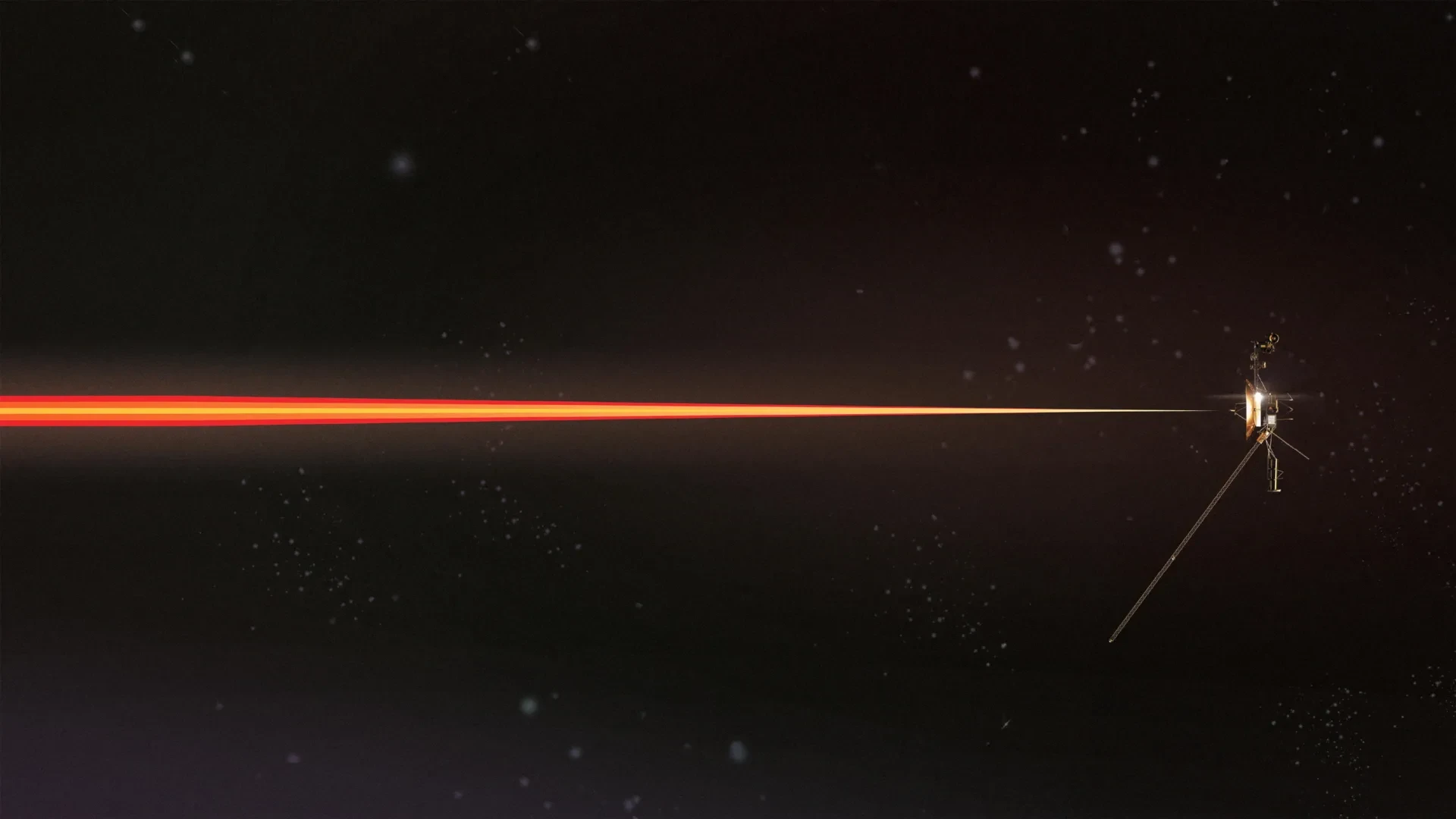
In a historic and unprecedented milestone for human spaceflight, NASA’s Voyager 1 spacecraft has officially crossed the threshold of one light-day from Earth. Operating successfully for nearly half a century, humanity’s most distant emissary is now cruising through the dark expanses of interstellar space at approximately 16.1 billion miles (25.9 billion kilometers) away from the planet that launched it. At this incomprehensible distance, even a radio signal traveling at the absolute maximum speed physically possible in our universe—the speed of light—requires an entire 24-hour cycle to make a one-way trip.
The landmark achievement was formally registered on November 18 at 2:16 a.m. PST (5:16 a.m. EST). Operators and engineers stationed at NASA’s Jet Propulsion Laboratory (JPL) in Southern California—managed by Caltech—received a definitive confirmation signal from the probe early Thursday, exactly 24 hours after the spacecraft breached the critical mathematical distance. This accomplishment further cements Voyager 1’s legacy as the most remote human-made object in history, an engineering marvel that continues to survive decades beyond its initial operational life expectancy while pushing past the final frontiers of our solar system.
Yet, this achievement arrives during a period of complex operational hurdles. Mission specialists are currently working to diagnose a sudden drop in scientific and engineering telemetry data that began on November 14. Although complex instrument data has temporarily halted, Voyager 1’s foundational carrier radio signal remains active, allowing navigation teams to calculate its precise trajectory and confirm its historic passage into the one light-day zone. As NASA works to troubleshoot the anomaly from millions of miles away, the mission stands as a profound testament to relentless human ingenuity, deep space persistence, and an enduring curiosity about the cosmos.
Detailed Chronology: From the Grand Tour to Interstellar Isolation
The narrative of Voyager 1 is a sweeping epic that spans generations, tracing a path from the drawing boards of the 1970s to the edge of interstellar space.
The Planetary Alignment of 1977
Voyager 1 and its twin spacecraft, Voyager 2, were conceived during a rare geometric alignment of the outer solar system planets that occurs only once every 176 years. This unique positioning allowed a spacecraft to harness the gravitational pulls of Jupiter and Saturn (and, in Voyager 2’s case, Uranus and Neptune) to slingshot from one planet to the next.
Launched on September 5, 1977—shortly after its twin—Voyager 1 embarked on what was originally designated as a modest planetary reconnaissance mission. Instead, the "Grand Tour" revolutionized our understanding of the outer planets. The probe delivered humanity’s first crisp, high-resolution imagery of the swirling storms of Jupiter, the complex ring systems of Saturn, and the active, icy worlds of their respective moons.
Breaking the Boundaries of the Heliosphere
Having successfully completed its planetary objectives, Voyager 1 did not slow down. It directed its trajectory upward, out of the ecliptic plane of the solar system, toward the ultimate unknown
.
- 2012: Voyager 1 achieved another monumental first by crossing the boundary of the heliosphere—the vast, protective magnetic bubble generated by our Sun that shields the solar system from high-energy galactic cosmic rays. By stepping past this termination shock and into the interstellar medium, it became the first human object to touch the space between the stars.
- 2018: Voyager 2 successfully duplicated this feat along a different trajectory, joining its twin in the pristine, particle-dense expanse of interstellar space.
Today, both probes continue to stream unique telemetry back to Earth, acting as humanity’s only direct physical probes of the interstellar medium. They provide unprecedented in-situ measurements of the Sun’s fading magnetic influence, data that is fundamentally impossible to gather from terrestrial observatories or Earth-orbiting telescopes.
Supporting Context & Metrics: Decoding Cosmic Scale and Technical Survival
To truly grasp the magnitude of Voyager 1’s current location, one must contextualize the sheer immensity of cosmic distances and the staggering engineering challenges required to maintain communication.
The Physics of a Light-Day
Astronomers measure deep space not in miles or kilometers, but in the time it takes light to traverse the void. Light moves through a vacuum at roughly 186,000 miles (299,000 kilometers) per second.
- Earth to the Moon: Sunlight makes this brief commute in about 1.3 seconds.
- Earth to Neptune: Light takes roughly 4 hours to reach the outermost recognized planet of our solar system.
- Neptune to Voyager 1: Crossing the frozen expanse from Neptune out to Voyager 1 consumes an additional 20 hours.
A single light-day equals the distance light covers in 24 hours—approximately 16.1 billion miles (25.9 billion kilometers). By contrast, a single light-year (the distance light travels in 365 days) measures roughly 5.88 trillion miles (9.46 trillion kilometers). Voyager 1 is currently moving through space at a staggering velocity of approximately 38,000 mph (61,155 kph), yet it has only scratched the surface of interstellar distances.
The 48-Hour Communications Loop
This immense physical separation creates profound logistical obstacles for JPL mission controllers. When a command is compiled and beamed out to Voyager 1 via NASA’s Deep Space Network, it takes a full 24 hours to reach the spacecraft. Once received, processed, and acknowledged, the probe’s response requires another 24 hours to journey back across the dark void.
A complete, closed-loop diagnostic exchange now spans 48 full hours. This latency turns routine troubleshooting into a high-stakes, methodical chess match played across interstellar space.
The Power Crisis and Inventive Engineering
Voyager 1’s longevity is all the more miraculous given that its hardware is nearly 50 years old. The spacecraft’s primary power source is a radioisotope thermoelectric generator (RTG)—essentially a nuclear battery that generates electricity from the heat produced by the natural radioactive decay of plutonium dioxide.
As the plutonium slowly decays, the RTG’s electrical output drops by roughly four watts every year. To keep the critical systems alive, mission engineers have continually made difficult compromises:
- Non-essential heaters have been systematically deactivated.
- Scientific instruments have been powered down one by one.
- Earlier in 2026, engineers executed a high-stakes power-reallocation maneuver, turning off three older devices and switching to lower-power alternatives to stretch the diminishing energy reserves.
These conservation measures are projected to supply enough electrical current to keep at least a baseline suite of scientific instruments operating until at least the summer of 2027, when both Voyager probes will mark their milestone 50th launch anniversaries.
Official Statements: Perspectives from NASA Leadership
The crossing of the one light-day mark prompted reflection from top-tier administrators, scientists, and engineers across NASA and academia, who praised both the scientific harvest and the human perseverance behind the mission.
"Traveling a light-day is a singular feat for a spacecraft, but Voyager is so much more than a distant traveler," said Joe Westlake, director of the Heliophysics Division at NASA Headquarters in Washington. "The Voyager mission would be remarkable just for what it contributed to planetary science with the Grand Tour of the outer planets. But it went on to become central to NASA’s fleet of heliophysics missions, offering insights into the star that we all revolve around, the Sun."
Reflecting on the collaborative institutional effort, Dave Gallagher, director of JPL, emphasized the human element behind the telemetry data:
"Voyager 1 crossing the light-day threshold is yet another historic feat on an extraordinary voyage of discovery," Gallagher noted. "Above all, this milestone stands as a testament to the exceptional teams who built, programmed, and fly these spacecraft today, and who have overcome countless challenges to keep them connected to Earth across the vastness of space. As NASA pushes toward new frontiers in human and robotic exploration, Voyager and the people behind its success continue to inspire us to reach farther and dream bigger."
Caltech President Ray Jayawardhana underscored the cultural and philosophical resonance of the mission, drawing attention to its architects:
"Nearly half a century after leaving Earth, the Voyager mission continues to push the boundaries of human exploration," Jayawardhana stated. "Its epic journey reflects the vision of Ed Stone, the Caltech physicist and JPL director who guided the mission for decades, and the curiosity and tenacity of generations of scientists and engineers who have carried that vision forward. Beyond its immense contributions to science, Voyager also captures something profound about the human spirit. We may never know where its journey will ultimately lead, but it will venture on, an enduring affirmation that humanity was here and we yearned to explore."
Future Outlook: The Golden Record and the Silent Ambassadors
As Voyager 1 continues its lonely trajectory outward into the Milky Way, its mission profile is slowly shifting from an active scientific survey to an eternal interstellar legacy.
Housed within both Voyager spacecraft is the Golden Record—a gold-plated copper phonograph record designed by a committee chaired by astronomer Carl Sagan. Packed with greetings spoken in 55 human languages, the sounds of Earth (ranging from whale songs and thunderstorms to the music of Bach and Chuck Berry), and 115 analog images depicting human anatomy, landscapes, and civilization, the record serves as a time capsule for any spacefaring intelligence that might encounter the probes millions of years from now. Long after electrical power fails and the radio transmitters go permanently dark, the Golden Record will endure as humanity’s introduction to the galaxy.
Back on Earth, the daily vigilance continues. NASA’s Deep Space Network—a global array of massive radio antennas situated in California, Spain, and Australia—maintains its steady vigil, pinging the spacecraft and listening for the faint whispers returning from the edge of the night.
"We listen to Voyager 1 every day and send commands to the spacecraft weekly. It just takes a little longer to communicate than it used to," summarized Suzanne Dodd, Voyager project manager at JPL. "Even traveling at the speed of light, signals now take 24 hours to reach the spacecraft and 24 hours to reach us. One day in the future, when it can no longer communicate with Earth, Voyager 1 will become humanity’s silent ambassador to the stars."
