

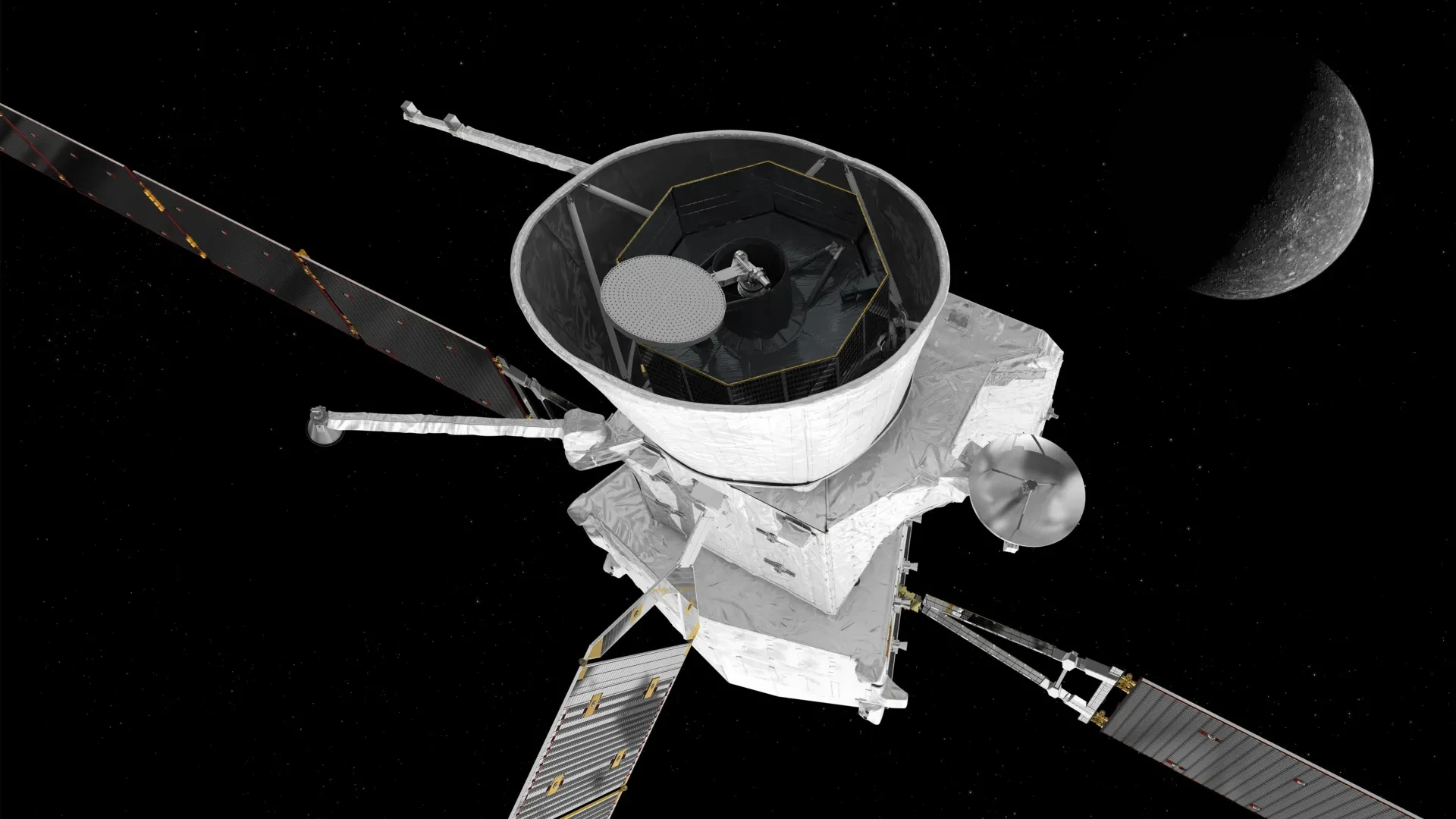
After logging a staggering 10 billion kilometers over an eight-year cosmic Odyssey, a pioneering British-built X-ray telescope bound for Mercury has successfully captured its first "first light" observations of a distant celestial body. The instrument, known as the Mercury Imaging X-ray Spectrometer (MIXS), trained its optics on the Crab Nebula—one of the brightest and most thoroughly documented X-ray sources in the known universe—marking a monumental triumph for the joint European Space Agency (ESA) and Japan Aerospace Exploration Agency (JAXA) BepiColombo mission.
Scientists stationed at the University of Leicester are currently reviewing telemetry and imaging data from MIXS, which is traveling aboard the multi-module spacecraft. The initial returns are nothing short of extraordinary. These diagnostic results arrive at a critical juncture, perfectly timed as BepiColombo finalizes its high-stakes approach to Mercury ahead of its orbital insertion scheduled for November 21.
The successful calibration run not only proves that the instrument survived the brutal, radiation-heavy environment of deep space intact, but it also demonstrates that MIXS is operating with a level of optical precision slightly superior to its pre-flight laboratory benchmarks set over a decade ago. As the smallest and least-explored rocky world in our solar system prepares to reveal its long-held secrets, this technological tour de force
paves the way for an unprecedented mapping of Mercury’s atomic and chemical composition.
Detailed Chronology: From Earth-Bound Basements to the Vacuum of Deep Space
The realization of the MIXS instrument is a saga spanning decades of meticulous engineering, arduous space travel, and mechanical choreography executed millions of miles from Earth.
The Long Cruise and Separation Phase
Since its launch, the MIXS telescope has been enclosed within the architecture of the BepiColombo spacecraft stack, shielded from the direct vacuum and radiation of space while relying on intermittent health checks managed by mission engineers. Because of its protective housing, the instrument was physically blocked from observing the cosmos until September of this year.
The turning point occurred when the Mercury Transfer Module (MTM) successfully separated from the two primary science orbiters: the European-built Mercury Planetary Orbiter (MPO) and JAXA’s Mercury Magnetosphere Orbiter (MMO, also known as Mio). With its view finally unobstructed, MIXS could shed its digital blindfolds and undertake the critical series of calibration tests required before the spacecraft enters the harsh gravitational well of the solar system’s innermost planet.
The Crab Nebula Campaign
To rigorously test the optical fidelity and structural integrity of MIXS after eight grueling years in transit, mission scientists selected a benchmark target: the Crab Nebula. Located approximately 6,500 light-years from Earth, this supernova remnant provides a fiercely strong, stable, and predictable X-ray emission profile.
The primary observation campaign was executed over a 39-hour window on September 11 and 12. During this period, the spacecraft performed 55 carefully choreographed, highly controlled orientation maneuvers to sweep the telescope across the nebula. Researchers used this campaign to measure the instrument’s angular resolution—its capacity to discern fine, intricate details within an X-ray image—by analyzing how broadly the Crab Nebula’s emissions dispersed across the detector array.
To the astonishment of the engineering team, MIXS demonstrated an angular resolution slightly sharper than the baseline measurements recorded during its final ground tests in a University of Leicester basement laboratory back in 2015.
Approaching the Final Destination
Following the successful Crab Nebula calibration, BepiColombo initiated its final arrival sequence. The separation of the MTM set the stage for the spacecraft’s insertion into Mercury’s orbit on November 21. This will be followed closely by the separation of the MPO and Mio orbiters on December 9 and 10, positioning each craft to independently configure its systems for the upcoming multi-year science campaigns, culminating in the official commencement of primary science operations in April 2027.
Supporting Context & Metrics: Engineering Marvels and Planetary Science Goals
The success of the MIXS instrument is underscored by technical specifications and mission parameters that push the boundaries of planetary exploration.
+--------------------------------------------------------------------+
|                   BI-METRIC MISSION SNAPSHOT                       |
+------------------------------+-------------------------------------+
| Total Distance Traveled      | 10 Billion Kilometers               |
| Duration in Deep Space       | 8 Years                             |
| Target Celestial Body        | Mercury (Smallest Terrestrial Planet|
| Primary Target (Calibration) | Crab Nebula (6,500 Light-Years Away)|
| Key Instrument               | MIXS (Mercury Imaging X-ray Spec)   |
| Lead Academic Institution    | University of Leicester (UK)        |
| Launch Agencies              | ESA & JAXA                          |
+------------------------------+-------------------------------------+
Unprecedented Technology Under Extreme Conditions
Developing an imaging X-ray telescope for a planetary mission is an extraordinary engineering hurdle. Unlike visible light telescopes, X-rays require specialized grazing-incidence optics to focus photons without absorbing them. Approximately 80% of the technology integrated into MIXS was entirely new at the time of its development, custom-built to withstand the extreme thermal swings and high-radiation environment found close to the Sun.
Post-calibration data analysis revealed several key operational metrics regarding the health of the instrument:
- Stray Light Mitigation: Engineers detected zero anomalous optical photons infiltrating the system, confirming the housing remains completely light-tight.
- Cosmic Ray Filtering: While galactic cosmic rays and self-fluorescence—triggered when solar radiation strikes the instrument’s optics—did register on the detectors, these signals are fully understood and can be cleanly filtered out during data post-processing.
- Radiation Resistance: Despite eight years of direct exposure to open space, the detector array showed zero signs of cumulative radiation degradation.
Unlocking Mercury’s Geological Mysteries
Mercury remains one of the most enigmatic worlds in our cosmic neighborhood. Its disproportionately large metallic core, tenuous exosphere, and survival close to the solar furnace challenge standard models of planetary formation.
MIXS will play an indispensable role in unraveling these mysteries. Operating aboard the Mercury Planetary Orbiter, it is the first imaging X-ray spectrometer ever deployed on a planetary science mission. The instrument functions by capturing fluorescent X-rays emitted from the Mercurial surface. When intense solar X-rays bombard the planet’s bare crust, individual elements within the surface rocks absorb and re-emit X-rays at characteristic atomic wavelengths.
By reading these spectral signatures, MIXS will generate a high-resolution, global map detailing the distribution of elements across Mercury’s surface without requiring physical sample returns. Operating in tandem with the Solar Intensity X-ray and particle Spectrometer (SIXS)—which monitors incoming solar radiation—MIXS will also investigate X-rays generated on the planet’s nighttime hemisphere when charged particles from Mercury’s dynamic magnetic field collide with the crust.
Official Statements: Perspectives from the Leadership Team
The milestone has drawn immense praise from the scientific community, particularly among the researchers who have dedicated their professional lives to the instrument’s realization.
Professor Emma Bunce, Principal Investigator for MIXS and Director of the Institute for Space at the University of Leicester, expressed profound admiration for the international collaboration that brought the project to fruition.
"We have waited a long time to make measurements with MIXS and it is fantastic to see it operating brilliantly in space," stated Professor Bunce. "This is testament to our engineering and technical team, and our international partners who we have worked with over many years to build this incredible instrument. Eighty percent of the technology on MIXS is new!"
Refining her assessment of the in-flight diagnostics, Professor Bunce added: "During our calibration observations we have determined that MIXS is generally performing fantastically well in space! We have no effects in our images that are associated with ‘stray light’… And the detector has suffered no radiation damage after eight years in space. We see some effects in the instrument that we are still studying and expect to undertake some optimization procedures during the Mercury commissioning phase to fine tune MIXS in preparation for the science phase."
For Dr. Adrian Martindale, MIXS Instrument Scientist at the University of Leicester, the successful first light images represent a deeply personal milestone spanning more than two decades. Dr. Martindale began working on the project in 2003 as an undergraduate student, touching nearly every physical component of the telescope prior to launch.
"BepiColombo, and MIXS in particular, are like part of my family," said Dr. Martindale. "I’ve been involved since I was an undergraduate and touched almost every part of the instrument before it was launched. This first data is mind-blowing to me. The last time we could see through this telescope it was in the basement under the School of Physics and Astronomy in Leicester, but after a rocket launch, eight years in space and 10 billion kilometers traveled, it looks just the same. I can’t wait to see the science data it produces when we get into orbit."
The triumph is also tinged with emotional resonance for the team, honoring the enduring legacy of Professor George Fraser, the instrument’s original Principal Investigator and the visionary behind its groundbreaking optical design, who passed away in March 2014.
"We are thinking of George as we operate MIXS fully in space for the first time," Professor Bunce reflected, "and know that he would be very, very proud of the team and delighted at our first light observations."
Future Outlook: The Road to 2027 and Beyond
With the Crab Nebula successfully imaged and the instrument’s baseline health thoroughly verified, the focus of the MIXS team now pivots to the final operational milestones of the BepiColombo mission.
As the spacecraft hurtles toward its November 21 orbital insertion around Mercury, engineers will execute minor optimization protocols to fine-tune the telescope’s software and thermal systems. Following the subsequent separation of the MPO and Mio orbiters in December, the mission will enter a prolonged commissioning phase designed to calibrate all onboard suites against Mercury’s unique environment.
When the primary science phase officially commences in April 2027, MIXS will begin its historic mapping campaign. By peeling back the layers of Mercury’s chemical composition through high-precision X-ray spectroscopy, the instrument will provide foundational data that could rewrite our understanding of how rocky planets form, evolve, and survive in the blistering domains close to their host stars.
Supported by the UK Space Agency, the Science and Technology Facilities Council (STFC), the European Space Agency, and the University of Leicester, the success of MIXS stands as a testament to European engineering excellence and sets a high-water mark for the future of interplanetary X-ray astronomy.
