

Executive Overview
The digital landscape has been gripped by a wave of alarmist headlines warning of “drastic measures,” “crippling fines,” and “sweeping new AI rules” taking effect across the European Union. However, beneath the hyperbole lies a much more targeted, pragmatic, and sensible regulatory framework. Far from banning innovation or penalizing every automated tool, the European Union’s new transparency mandates are designed to bring clarity to where it matters most: ensuring that users can easily and unambiguously recognize when they are interacting with artificial intelligence, particularly concerning AI-generated or manipulated content.
Effective as of August 2, 2026, the EU AI Act introduces strict legal requirements for mandatory AI labelling. Crucially, much like the General Data Protection Regulation (GDPR) and the European Accessibility Act (EAA), this legislation transcends geographic borders. It applies to any company worldwide—whether based in Silicon Valley, Tokyo, or London—that offers products, services, or AI outputs utilized by citizens residing within the European Union.
For product designers, UX engineers, legal teams, and executives, this marks a pivotal shift. The ubiquitous "sparkle" icon, long used as a catch-all indicator for any AI-powered feature, is no longer sufficient. Under the new guidelines, organizations must move away from ambiguous decorations and adopt clear, standardized, and accessible disclosures. This article provides a comprehensive analysis of what the new EU transparency rules actually require, where the fine line between human-edited and machine-generated content lies, why AI sparkles fall short, and how global compliance patterns are reshaping the future of digital product design.
Detailed Chronology: The Path to the 2026 AI Transparency Mandates
Understanding the current regulatory environment requires a look back at the legislative milestones that have shaped European and global AI policy. The road to the August 2026 enforcement date has been carefully paced to allow organizations time to adapt, though many are only now recognizing the operational gravity of the mandates.
- April 2021: The European Commission proposes the initial framework for the Artificial Intelligence Act, pitching it as the world’s first comprehensive legal framework on AI.
- December 2023: European Parliament and Council negotiators reach a provisional agreement on the Artificial Intelligence Act, establishing risk categories and foundational transparency rules under Article 50.
- March 2024: The European Parliament formally adopts the AI Act with an overwhelming majority, setting the stage for phased implementation timelines.
- May/June 2024: The AI Act officially enters into force, initiating countdown timers for various compliance tiers, including prohibited practices, high-risk systems, and general-purpose AI models.
- Late 2025 – Early 2026: The European Commission, alongside the newly formed AI Office, releases successive drafts of the Code of Practice on AI-generated content, detailing practical guidelines for watermarking, technical markings, and UI label placement.
- August 2, 2026: The transparency obligations outlined under Article 50—including mandatory labelling for specific categories of AI-generated text, audio, images, and video—officially take full legal effect.
This timeline demonstrates that the rules are not a sudden overnight decree, but the culmination of years of iterative policy-making designed to balance consumer protection with digital commerce.
What Actually Needs Labelling? Scope and Legal Obligations
The overarching objective of the EU AI Act’s labelling provisions is straightforward: to empower individuals to recognize, in a clear, distinct, and unambiguous manner, when content has been artificially generated or manipulated.

According to Article 50(4) of the AI Act, mandatory disclosure applies to specific, high-impact use cases where deception carries societal risks:
- Deepfakes and Synthetic Media: Any image, audio, or video content that artificially portrays real people, places, or events in a way that could reasonably be mistaken for authenticity.
- Public Interest Text Generation: AI-generated text published with the explicit purpose of informing the public on matters of public interest (spanning health, safety, environmental, economic, financial, political, scientific, or cultural domains), unless subject to substantive human editorial review.
- Chatbots and Conversational Agents: Systems interacting directly with natural persons must disclose that the user is communicating with an AI, unless it is entirely obvious from the context.
Providers vs. Deployers: Shared Responsibility
A common misconception is that licensing an AI tool from a third-party vendor absolves a downstream company of legal liability. Under the EU framework, legal obligations are bifurcated between providers (those who build or supply the foundational AI system) and deployers (those who integrate and deploy the system in a commercial setting).
Similar to compliance structures seen in data privacy laws, a company cannot bypass Article 50 simply by pointing the finger at an external API or pre-packaged AI model. If your enterprise serves EU citizens and deploys AI outputs that fall under the mandatory disclosure categories, your organization holds direct responsibility for ensuring those outputs are properly labelled.

Not All AI-Generated Content Must Be Labelled
Despite the panic surrounding the regulation, the vast majority of day-to-day AI-assisted work remains exempt from these rigid transparency rules. Understanding the boundaries of the law is crucial for preventing over-compliance, which could clutter user interfaces with unnecessary disclaimers.
The Human Editorial Exemption
The disclosure obligation does not apply where AI-generated text or content has been reviewed, modified, and structurally shaped by a human who takes formal editorial responsibility for the final output. However, the Commission has made it clear that a superficial skim or a simple "published after an AI draft" note does not suffice. The human intervention must be substantive, with a clearly named person or legal entity taking editorial control.
Public Interest Thresholds
Content creators must pay close attention to the definition of "public interest." If an AI-generated marketing campaign, corporate blog post, or product description touches upon sensitive areas such as health claims, financial advice, environmental impact, or political commentary, the disclosure rule is triggered. Conversely, purely creative fiction, internal workplace brainstorming memos, or closed enterprise documentation generally fall outside the scope of public transparency mandates.

Commercial Illustration and Marketing
Legal experts and specialized law firms strongly recommend labelling realistic AI-generated illustrations, photographs, and promotional graphics as a precautionary measure. In advertising, marketing, and PR, any visual asset that resembles a real person, product, location, or event must carry a clear AI disclosure to protect consumers from misleading commercial claims.
The Fine Line Between “Edited” and “AI-Generated” Content
One of the most nuanced challenges facing product teams and creators is determining the precise threshold where human editing transforms machine-generated content into human-authored work—or vice versa.
The European Commission’s guidance offers some clarity, though certain grey areas remain:

- Exempt Assistive Edits: Routine, minor digital touch-ups do not convert an asset into "AI-generated" content. This includes spellcheck, basic grammar correction, text formatting, image cropping, color correction, and standard automated translation.
- Triggered AI Generation: Substantive structural changes—such as AI-generated summaries, composite imagery generated via prompt injection, major rewrites of paragraphs, or the generative addition/removal of objects in a photograph—require formal disclosure.
In practice, fine-tuning a sentence that a human writer drafted from scratch is permissible without a label. However, generating an entire paragraph or argument via a large language model and merely polishing the syntax requires explicit notification. The underlying principle separates intentional manual craftsmanship from automated generation.
Why AI Sparkles Are No Longer Enough
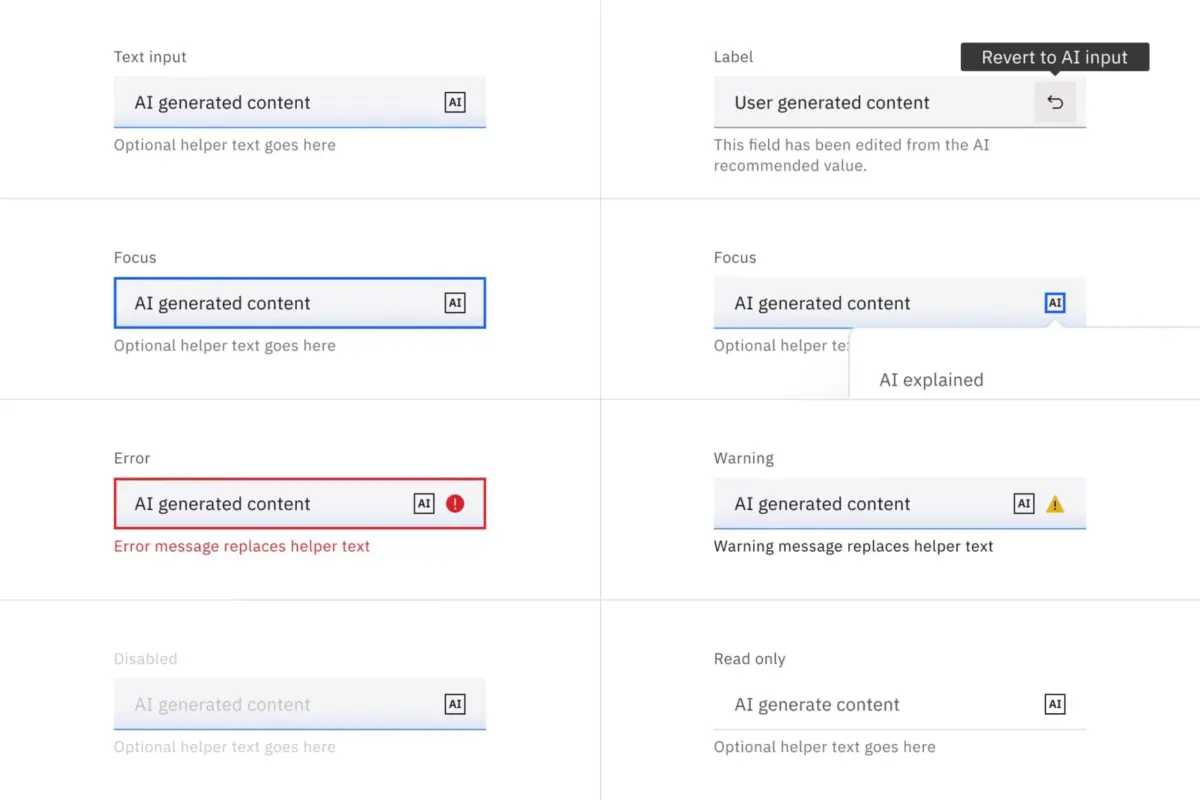
For years, the design community has relied on universal iconography—most notably the "sparkle" or "magic wand" symbol ($star$ / ✨) — to denote the presence of artificial intelligence within a software interface. However, the European Commission’s newly published Code of Practice and official EU AI Icon Set indicate that sparkles are no longer legally sufficient.
The Ambiguity of Sparkles
Research from organizations like the Nielsen Norman Group highlights a major UX flaw: users frequently interpret the sparkle icon as a signal for an "AI-powered feature" (such as a smart autocomplete or writing assistant) rather than a clear disclosure that the specific piece of content in front of them was generated by machine intelligence.

Because the sparkle is vague, it fails to meet the legal test of being "clear and distinguishable." The EU guidelines explicitly state that utilizing an icon alone does not automatically establish legal compliance. Furthermore, disclaimers hidden away in fine print, buried in footers, or flashing for a fraction of a second violate both the letter and spirit of the law.
The Official EU AI Icon Set and Best Practices
The European Commission has introduced specific visual marks to standardize transparency. To achieve compliance, digital products should pair these official iconography standards with plain-text disclosures (e.g., “AI-generated”).
Crucially, these labels must persist across formats. If a user downloads an image, shares a document, or exports a report, the underlying AI metadata and visible disclosures must travel with the asset to prevent tampering or deceptive re-sharing downstream.

A Global Regulatory Pattern: It Isn’t Just the EU
While European regulations frequently dominate tech headlines, the push toward mandatory AI transparency is not an isolated phenomenon. It is part of a broader, synchronized global legislative wave:
- United States: State-level laws have rapidly emerged to regulate synthetic media, particularly targeting "deepfake" political advertising, synthetic human performers in entertainment, and deceptive consumer-facing chatbots.
- China: The Cyberspace Administration of China enforces strict provisions requiring deep synthesis service providers to explicitly label generated text, images, and audio with verifiable watermarks and visible tags.
- South Korea and Brazil: Both nations have advanced legislative proposals requiring distinct watermarking and labelling for commercial AI outputs to protect elections, intellectual property, and consumer trust.
This global convergence demonstrates that transparency is becoming the baseline requirement for operating an AI-driven business. Product teams shipping AI features must design flexible, scalable UI labelling systems that can adapt to multi-jurisdictional compliance requirements.
Future Outlook: Building Trust Through Transparency
As the August 2026 enforcement date approaches, organizations must view AI labelling not as a burdensome regulatory hurdle, but as an opportunity to build authentic user trust. The era of unchecked, opaque synthetic media is drawing to a close.

By designing clear, accessible, and user-centric interfaces that gracefully disclose AI involvement, companies can help users separate valuable technological assistance from deceptive "AI slop." Ultimately, transparency benefits everyone: it protects consumers, empowers creators, and establishes a sustainable foundation for the future of digital interaction.
Meet “Design Patterns For AI Interfaces”
Navigating the UX challenges of AI transparency requires specialized knowledge and practical frameworks. To help product designers and engineers master this domain, Vitaly Friedman has released Design Patterns For AI Interfaces—an in-depth video course featuring real-world examples from leading digital products, accompanied by live interactive training sessions.
Whether you are looking to design compliant AI labels, structure explainability panels, or streamline human-in-the-loop workflows, this course offers actionable patterns for modern UX professionals. Jump into a free video preview today and future-proof your product design strategy.
