

Executive Overview
In an achievement poised to reshape the architecture of next-generation optical communications and quantum computing, an international research coalition has successfully unraveled a decades-old scientific mystery regarding barium titanate (BTO). For over fifty years, the true optical properties of this advanced ferroelectric crystal remained elusive, clouded by contradictory data, complex internal geometries, and measurement limitations. Today, however, that veil of uncertainty has been lifted.
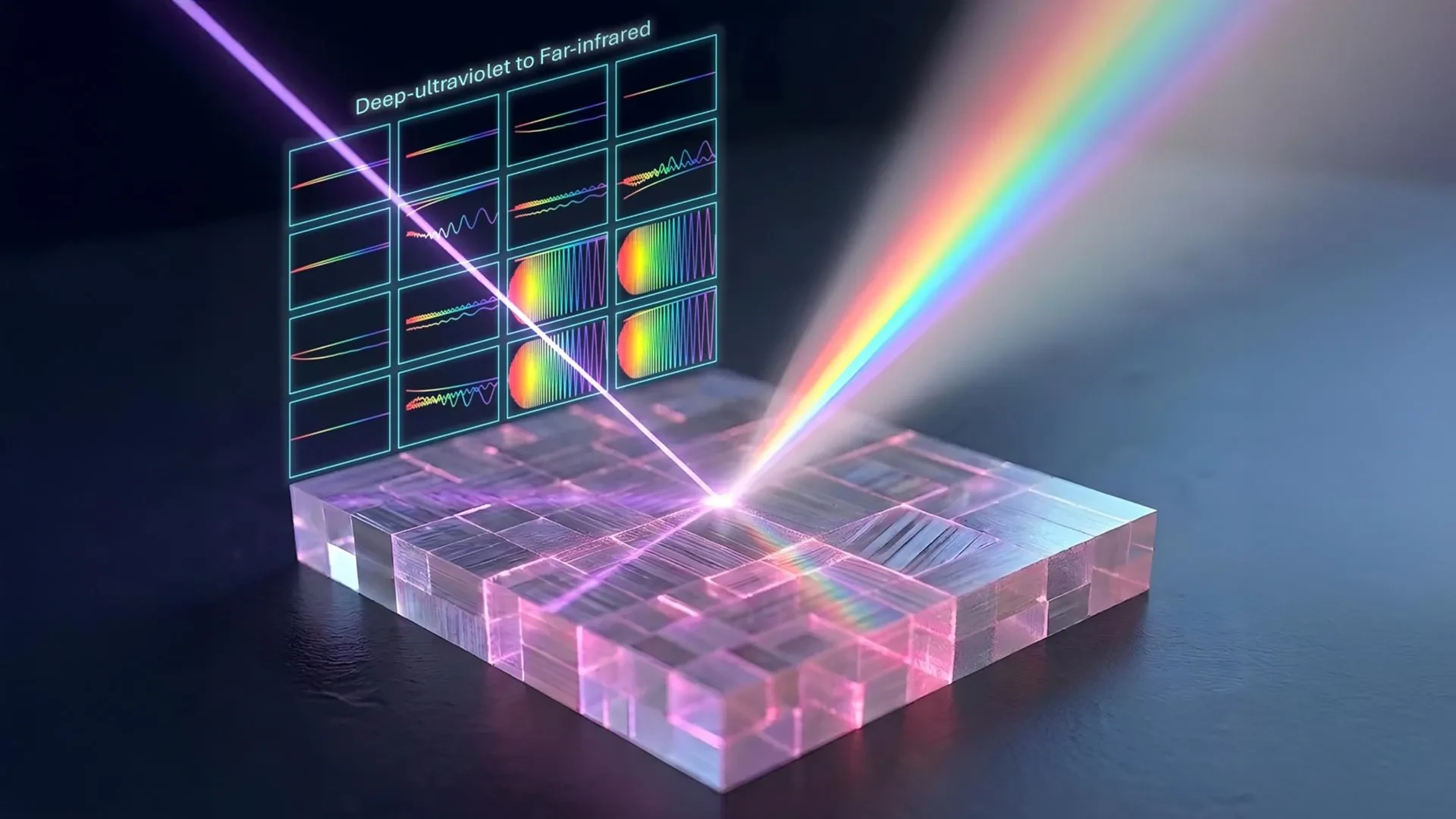
Led by Professor Min Seok Jang from the Korea Advanced Institute of Science and Technology (KAIST)—in close collaboration with Caltech’s Professor Harry A. Atwater, the Korea Research Institute of Standards and Science (KRISS), and U.S.-based analytical hardware leader J.A. Woollam Co.—the research team has mapped BTO’s interactions with light across an exceptionally broad spectrum. Ranging from the ultraviolet (UV) to the far-infrared, this newly established dataset resolves historical discrepancies in refractive index and extinction coefficient measurements.
The implications of this breakthrough are profound. Modern telecommunications rely heavily on the efficient conversion of electronic data into optical signals that travel along fiber-optic cables and microscopic waveguides. Barium titanate has long been prized for its exceptionally strong electro-optic response—driven by the Pockels effect—which allows its refractive properties to be dramatically altered via applied electrical voltages. This makes it an ideal candidate for high-speed optical modulators, the gatekeepers of modern data networks.
Yet, without precise, reliable metrics governing how light traverses and is absorbed by BTO, engineers have had to navigate a costly trial-and-error design process, hampered by signal attenuation and unpredictable domain scattering. By deploying state-of-the-art Mueller matrix spectroscopic ellipsometry and leveraging meticulously uniform single-crystal samples, the research team has provided the global photonics industry with an authoritative blueprint. Published on October 20, 2026, in the prestigious journal ACS Photonics, this breakthrough promises to slash the prototyping cycles of advanced optical components, clear the path for ultra-fast data transmission systems, and accelerate the realization of scalable quantum photonic circuits.
Detailed Chronology: Overcoming a Decades-Old Optical Mystery
The journey to decoding barium titanate’s optical profile is a testament to persistent international scientific collaboration, spanning decades of frustration followed by a technological convergence that finally cracked the puzzle.
The Historical Bottleneck
Since the mid-20th century, materials scientists recognized that barium titanate possessed extraordinary ferroelectric and electro-optic capabilities. In theory, BTO-based modulators could operate at speeds and efficiencies far surpassing conventional silicon photonics. However, a major experimental roadblock consistently frustrated researchers: whenever measurements were taken of bulk or thin-film BTO samples, the resulting data varied wildly from lab to lab.
The root cause of these discrepancies lay deep within the crystal’s microscopic architecture. BTO naturally forms internal boundaries known as domains—microscopic regions where the spontaneous polarization vector of the crystal points in different directions. Because these adjacent domains interact with polarized light in drastically different ways, illuminating a standard multi-domain crystal yielded a convoluted, averaged response. Light scattering, birefringence variations, and polarization mixing conspired to obscure the material’s true, intrinsic optical constants. Consequently, engineers lacked a dependable standard for refractive index ($n$) and extinction coefficient ($k$), stalling the commercial translation of BTO into robust optical circuits.
The Breakthrough Collaboration
Recognizing that traditional characterization tools were hitting a wall, Professor Min Seok Jang’s laboratory at KAIST joined forces with world-class theoreticians and experimentalists. The coalition included Professor Harry A. Atwater’s renowned group at the California Institute of Technology (Caltech), metrologists at the Korea Research Institute of Standards and Science (KRISS), and thin-film optical characterization experts at J.A. Woollam Co.
The turning point in the research timeline arrived when the team abandoned the approach of measuring chaotic, multi-domain samples. Instead, they engineered and procured specialized single-crystal samples featuring highly consistent, uniform domain orientations. By isolating single-domain states, the researchers effectively eliminated the "noise" introduced by domain walls, laying bare the material’s fundamental optical physics.
Advanced Characterization via Spectroscopic Ellipsometry
To extract precise measurements from these refined samples, the team deployed Mueller matrix spectroscopic ellipsometry—a sophisticated, non-destructive optical technique. Unlike standard reflection or transmission tests, Mueller matrix ellipsometry measures the complete polarization transformation matrix of light interacting with a material. This yields a wealth of directional and phase-sensitive data.
The experimental sweep was breathtaking in its scale. The researchers probed BTO samples across an electromagnetic spectrum stretching from 190 nanometers in the deep ultraviolet to 40 micrometers in the far-infrared. Because a material’s electronic and vibrational interactions with light shift drastically across such vast frequency ranges, the team partitioned the spectrum into three distinct operational regions. They applied specialized analytical models to each zone, mapping how both the refractive index and absorption profiles depend dynamically on light wavelength and crystallographic orientation.
Decoding Ultra-Low Absorption and Multi-Domain Behavior
One of the crowning achievements of this experimental campaign occurred in the mid-infrared window (spanning wavelengths from 2 to 10 micrometers), where BTO behaves as a nearly transparent medium. By pairing high-resolution ellipsometry with direct transmission measurements, the team detected remarkably low optical absorption. They quantified extinction coefficients on the order of $10^-5$, providing hard numerical proof of BTO’s exceptional optical clarity in this range.
Furthermore, the team did not stop at single-domain crystals. Recognizing that practical engineering applications often involve films with complex domain structures, they developed a predictive mathematical model. By factoring in the spatial proportions and orientation vectors of various domains within a given crystal, this model can accurately calculate the composite material’s macro-scale optical response. This bridges the gap between idealized single-crystal physics and real-world manufacturing tolerances.
Supporting Context & Metrics: The Science of Barium Titanate
To fully appreciate the magnitude of the KAIST-led study, one must examine the physical parameters that dictate optical communication efficiency and understand why barium titanate occupies such a vital niche in advanced material science.
Fundamental Optical Metrics: Refractive Index and Extinction Coefficient
In optical engineering, device design relies fundamentally on two interdependent parameters:
- The Refractive Index ($n$): This metric defines how much the speed of light is reduced when passing through a medium. In waveguide design, spatial variations in the refractive index are what trap and guide light along microscopic channels—much like fiber-optic claddings guide light down a glass fiber. Without an accurate, wavelength-dependent refractive index for BTO, engineers cannot calculate mode profiles, confinement factors, or bending radii for integrated photonic circuits.
- The Extinction Coefficient ($k$): This parameter quantifies how strongly a material absorbs light at specific wavelengths, directly determining signal attenuation (loss). In high-speed data transmission, even fractional decibel losses accumulate rapidly across large chip layouts, necessitating energy-intensive optical amplification. Knowing BTO’s extinction coefficient down to the $10^-5$ level in the 2–10 $mu m$ band enables designers to model photon survival rates with unprecedented accuracy.
The Pockels Effect and Electro-Optic Modulation
Barium titanate’s structural claim to fame is its massive linear electro-optic coefficient, rooted in the Pockels effect. When an external electric field is applied across a BTO crystal, its atomic lattice shifts subtly, altering its polarizability and, consequently, its refractive index.
In practical systems, this phenomenon is harnessed in optical modulators. As data streams arrive as electrical impulses at server farms or telecommunication hubs, modulators use these electrical voltages to phase- or amplitude-modulate continuous-wave laser beams, translating electrical data into optical streams. Because BTO exhibits an electro-optic response significantly stronger than traditional materials like lithium niobate or silicon-integrated modulators, it allows for shorter device lengths, lower drive voltages, and dramatically faster switching speeds.
Official Statements and Institutional Perspectives
The collaborative nature of this research was underscored by statements from key institutional leaders and primary investigators who steered the project to fruition.
On November 8, KAIST—under the leadership of President Choongsik Bae—formally announced the breakthrough, highlighting its cross-disciplinary significance. Professor Min Seok Jang of KAIST’s School of Electrical Engineering, who served as the corresponding author alongside Caltech’s Professor Harry A. Atwater, articulated the core impact of the study:
"This study reveals the optical response of barium titanate, which had long remained unclear, and provides a reliable reference for how the material interacts with light."
Jang further emphasized how the findings translate directly to industrial applications, noting that the newly mapped optical constants will directly underpin the engineering of high-capacity communication hardware:
"These insights can contribute directly to the development of optical communication devices capable of transmitting data faster while substantially reducing light loss. Furthermore, this improved understanding of BTO will serve as a foundational pillar for quantum photonic technologies, where the ultra-precise manipulation of individual light quanta is absolute."
Dr. Nina Hong of J.A. Woollam Co., serving as co-first author alongside KAIST Ph.D. candidate Jiwon Kang, played a pivotal role in refining the ellipsometric models. The seamless synergy between KAIST’s advanced material synthesis, Caltech’s theoretical frameworks, KRISS’s metrological rigor, and Woollam’s analytical instrumentation exemplifies the power of global scientific cooperation.
Future Outlook: Transforming Data Transmission and Quantum Architectures
The publication of this foundational dataset in ACS Photonics marks not an endpoint, but a starting line for a new era of photonic engineering. By removing the guesswork from BTO-based device manufacturing, the research opens several transformative technological frontiers.
1. Streamlining Photonic Integrated Circuit (PIC) Design
In the semiconductor industry, silicon photonics has emerged as the leading paradigm for packing optical components onto microchips. However, silicon lacks a native Pockels effect, forcing engineers to adopt complex hybrid integration schemes. BTO can be integrated onto silicon platforms to supply the necessary electro-optic muscle.
Armed with KAIST’s precise refractive index and extinction coefficient databases, photonic engineers can now simulate entire chip layouts using advanced CAD software. They can accurately predict modal propagation, optimize waveguide dimensions, and calculate thermal-optical interactions prior to tape-out. This predictive capability promises to drastically reduce the number of costly prototyping iterations, accelerating time-to-market for high-speed transceivers used in hyperscale data centers.
2. Scaling High-Speed Telecom and Datacom Networks
As global data consumption surges—driven by artificial intelligence, cloud computing, and streaming media—traditional copper interconnects and standard silicon modulators face fundamental bandwidth and thermal bottlenecks. BTO-based electro-optic modulators operating at lower voltages and higher modulation frequencies offer a viable escape route. By minimizing signal loss across chip-scale interconnects, these materials will help sustain the exponential scaling of global telecommunication bandwidth.
3. Powering the Quantum Photonics Revolution
Perhaps the most exciting long-term horizon lies in quantum information processing (QIP). Quantum computers and secure quantum communication networks rely heavily on the generation, manipulation, and routing of single photons or entangled photon pairs. Achieving these feats requires materials that can manipulate light fields with sub-wavelength precision and near-zero parasitic absorption.
Because BTO allows for intense light confinement and dynamic phase control, the accurate characterization of its far-infrared and ultraviolet optical properties paves the way for advanced nonlinear optical devices. These include integrated quantum light sources, frequency converters, and electro-optic switches designed to route delicate quantum states without decoherence.
Conclusion
The decades-long enigma of barium titanate’s optical behavior has finally been solved. Through the meticulous application of Mueller matrix spectroscopic ellipsometry, single-crystal isolation, and cross-disciplinary international partnership, the research coalition led by KAIST and Caltech has provided the photonics community with an authoritative, high-precision reference standard.
By defining BTO’s refractive index, resolving its extinction coefficients down to $10^-5$ across the mid-infrared spectrum, and establishing a predictive model for multi-domain crystals, this study bridges the gap between fundamental solid-state physics and industrial-scale manufacturing. As engineers begin integrating these verified metrics into commercial design pipelines, the world moves one step closer to ultra-fast, ultra-low-loss optical communications and the realization of scalable quantum technologies.
