

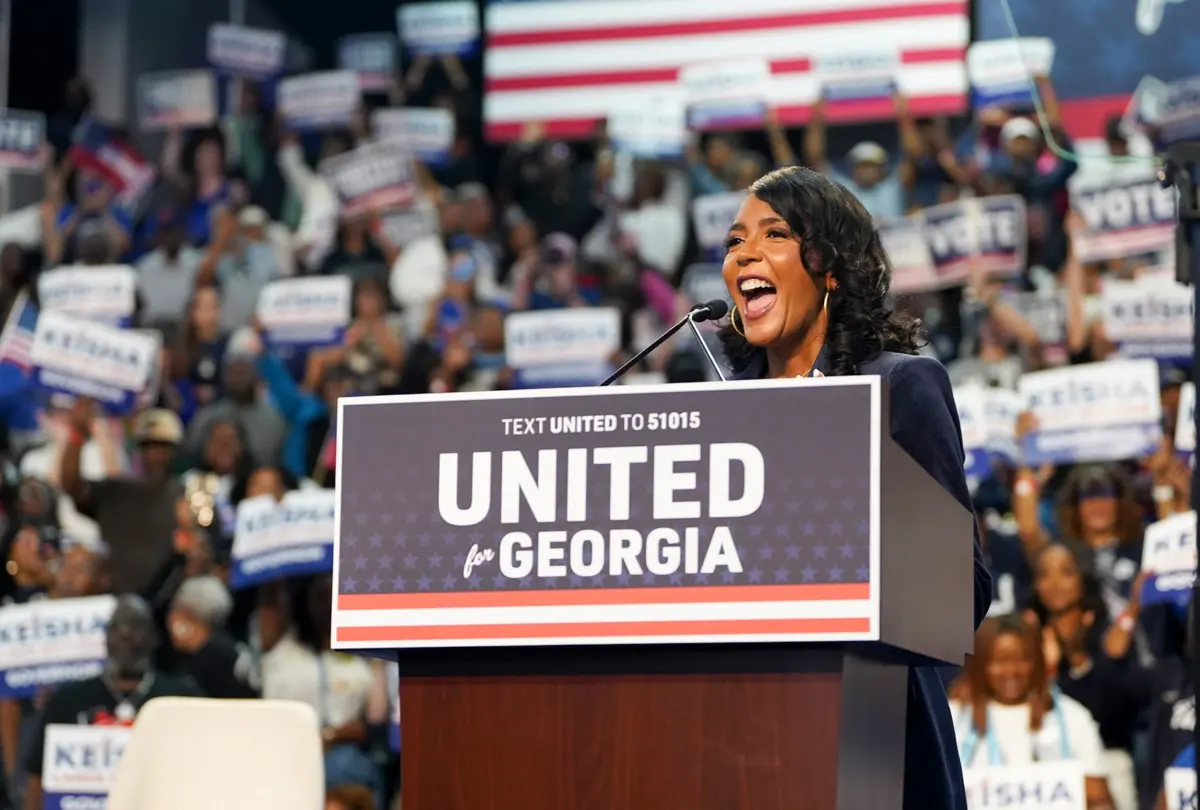
ATLANTA — In a political earthquake that reverberated across the American South, Democrat Keisha Lance Bottoms secured a historic victory in Georgia’s fiercely contested gubernatorial election on Tuesday night, November 3, 2026. Defeating Republican billionaire Rick Jackson, Bottoms achieved a milestone that has eluded politicians for centuries: she was elected as the first Black female governor in the history of the United States.
The high-stakes contest also effectively shattered a 24-year Republican monopoly on the Peach State’s highest executive office, marking the first time a Democrat has claimed the governor’s mansion since Roy Barnes won election in 1998.
The dramatic conclusion to this multi-million-dollar showdown signals a profound evolution in Georgia’s political identity, solidifying its status as the nation’s premier political battleground. Bottoms’ triumph, paired with Senator Jon Ossoff’s successful reelection bid the same night, underscores a shifting demographic and ideological tide in a state long defined by conservative dominance.
Executive Overview: A Watershed Moment in American Politics
The gubernatorial race to succeed term-limited Republican Governor Brian Kemp was never going to be ordinary. For eight years, Kemp steered Georgia through rapid economic expansion, corporate relocations, and intense national scrutiny following the contentious 2020 and 2024 presidential cycles. With Kemp stepping aside, the political floodgates opened, inviting a race defined by a clash of starkly contrasting visions, astronomical campaign spending, and historic implications.
Keisha Lance Bottoms—a former Mayor of Atlanta and senior adviser to President Joe Biden—ran a disciplined, grassroots-driven campaign centered on working-class concerns: expanding healthcare access under the Affordable Care Act, shoring up public education funding, and mitigating the crippling effects of the rising cost of living on Georgia families.
Opposing her was Rick Jackson, a self-made healthcare executive and political newcomer who stepped into the arena with a staggering personal war chest. Jackson poured upwards of $200 million of his own fortune into his campaign, transforming the race into one of the most expensive self-funded gubernatorial bids in American history. Jackson’s campaign relied heavily on the narrative that his private-sector acumen was precisely what was needed to streamline state government, slash taxes, and curtail public spending.
Despite Jackson’s unprecedented financial saturation of the airwaves, digital platforms, and mailboxes, Georgia voters ultimately rejected the billionaire’s business-first pitch in favor of Bottoms’ extensive public service resume and message of inclusive economic growth. When the dust settled on November 3, Bottoms did not merely win an election; she etched her name into the history books.
Detailed Chronology: The Road to the Governor’s Mansion
The trajectory of the 2026 Georgia gubernatorial race was shaped over years of demographic shifts, shifting party alignments, and high-profile political positioning.
The Primary Phase and Clearing the Field
Following Governor Brian Kemp’s announcement that he would not seek a third consecutive term, both major political parties braced for intense primary battles. Keisha Lance Bottoms, whose national profile had risen significantly following her tenure as Atlanta’s mayor during the social justice protests of 2020 and her subsequent role in the Biden-Harris administration, emerged early on as the consensus heavyweight for the Democratic nomination. Leveraging her deep roots in local governance and national network connections, Bottoms consolidated party support quickly, avoiding a bruising intra-party civil war.
On the Republican side, the primary was a chaotic and crowded affair characterized by traditional conservative orthodoxy colliding with populist fervor. Out of the fray emerged Rick Jackson. Armed with a nearly bottomless personal bank account, Jackson bypassed traditional donor networks, positioning himself as an independent-minded outsider untethered to typical political special interests.
The General Election and the Billionaire’s Blitz
Once the matchups were finalized, the general election transformed into a masterclass in modern political warfare. Rick Jackson’s strategy relied on saturating Georgia media markets with advertisements designed to paint Bottoms as a tax-and-spend career politician, while promoting his own credentials as a job creator and fiscal conservative. By injecting more than $200 million of his personal wealth into the race, Jackson sought to define Bottoms before her campaign could define him.
Bottoms’ campaign, however, countered with a sophisticated grassroots mobilization effort, targeting suburban women, minority voters, and urban centers with relentless door-to-door canvassing and community-focused messaging. Rather than attempting to match Jackson dollar-for-dollar on television, Bottoms leaned into retail politics, framing the election as a clear choice between an elite billionaire attempting to buy the statehouse and a proven public servant dedicated to protecting everyday Georgians.
Debates became critical turning points. While Jackson frequently struggled to articulate specific policy proposals beyond broad-stroke tax cuts, Bottoms demonstrated deep command of state budgetary mechanics, infrastructure needs, and social services. Her poise under pressure reassured undecided moderates and energized the progressive base.
Election Night and the Historic Breakthrough
As precincts reported results on the evening of November 3, 2026, early returns showed a nail-biting margin before suburban shifts decisively broke in favor of the Democrats. By late evening, major networks projected Keisha Lance Bottoms as the winner.
The victory celebration in downtown Atlanta was electric. Supporters wept, danced, and waved state and national flags as the realization set in: Georgia had not only elected a Democratic governor for the first time in nearly three decades, but it had also shattered the ultimate political glass ceiling by elevating a Black woman to the highest executive office in the state—and the nation.
Supporting Context & Metrics: Breaking Down the Numbers
To fully grasp the magnitude of Keisha Lance Bottoms’ victory, one must examine the broader political and financial metrics that defined the 2026 cycle.
Financial Footprint
Rick Jackson’s expenditure of over $200 million places his campaign in rare, historic company. Self-funded gubernatorial bids of this magnitude are exceedingly rare, typically seen only in massive states like California, New York, or Illinois. Jackson’s capital allowed his campaign to build an omnipresent advertising infrastructure.
However, political analysts noted diminishing returns on Jackson’s final tens of millions of dollars, as voters grew fatigued by the sheer volume of negative messaging. Bottoms’ campaign, operating on a fraction of Jackson’s budget, proved that deeply embedded community trust, high voter turnout operations, and clear, empathetic messaging could successfully combat an unprecedented financial tsunami.
The Evolution of the Georgia Electorate
Georgia’s transformation from a reliably "red" southern stronghold into the nation’s premier swing state has been one of the most significant political narratives of the 21st century.
- 2002: Sonny Perdue defeated Democratic incumbent Roy Barnes, initiating a 24-year Republican lock on the governor’s mansion.
- 2020: Joe Biden narrowly carried Georgia in the presidential election, signaling a seismic shift driven by rapid suburban growth around Atlanta, an influx of educated out-of-state transplants, and high mobilization among Black voters.
- 2021–2022: Democrats Jon Ossoff and Raphael Warnock secured historic U.S. Senate victories, proving that 2020 was no fluke.
- 2024: The state temporarily reverted to the Republican column in the presidential contest, demonstrating the fiercely competitive, purple nature of the electorate.
- 2026: Bottoms captures the governorship while Senator Jon Ossoff handily wins reelection, confirming that Georgia voters are fully willing to split tickets and evaluate candidates on their individual merits, while maintaining a clear appetite for Democratic executive leadership.
Official Statements and Reactions
The historic nature of the election prompted an outpouring of reactions from political figures across the ideological spectrum, civic leaders, and national icons.
In her victory speech before a roaring crowd in Atlanta, Governor-elect Keisha Lance Bottoms emphasized unity and the weight of her historic mandate:
"Tonight, the people of Georgia have sent a resounding message to the entire nation. We have proven that the promise of America—and the promise of our great state—belongs to everyone, regardless of where you started in life, what you look like, or who you love. This victory is not mine alone; it belongs to every ancestor who prayed for this day, every organizer who walked these streets in the sweltering heat, and every voter who believed that our best days are still ahead of us."
Outgoing Republican Governor Brian Kemp released a gracious statement acknowledging the results and wishing his successor well in managing the state’s future:
"Serving the people of Georgia as governor has been the honor of a lifetime. While the outcome of this election is not what our party hoped for, the strength of our state institutions and our booming economy endure. I congratulate Mayor Bottoms on her historic victory and pledge a smooth, cooperative transition of power for the good of all Georgians."
National Democratic leaders, including President Joe Biden and prominent congressional figures, hailed the result as a monumental milestone. Former colleagues praised Bottoms’ resilience, pointing to her steady leadership during times of profound civil unrest and public health crises in Atlanta as proof of her executive readiness for the statehouse.
Future Outlook: What Bottoms’ Victory Means for Georgia
As Keisha Lance Bottoms prepares to take the oath of office, her administration will inherit a complex set of governance challenges and extraordinary opportunities.
Legislative Realities
While Bottoms secured a landmark personal and party victory, she will face a state legislature where Republicans retain significant influence. Navigating a divided or narrowly aligned General Assembly will require deft bipartisan negotiation. Bottoms has signaled her willingness to work across the aisle on shared priorities, such as workforce development, infrastructure modernization, and regional economic competitiveness.
Core Policy Objectives
Governance under Governor Bottoms is expected to pivot sharply away from the conservative priorities of the Kemp administration:
- Healthcare Expansion: Bottoms has made expanding healthcare access—specifically tackling rural hospital closures and pushing for comprehensive coverage solutions—a central pillar of her platform.
- Education Investment: Drawing on her background as a product of public schools and a local leader, her administration is expected to prioritize increased teacher pay, enhanced early childhood education, and modernized school infrastructure.
- Cost of Living and Economic Equity: With inflation and housing affordability squeezing working families, Bottoms will be under intense pressure to implement targeted relief measures while sustaining Georgia’s reputation as a top destination for corporate investment.
A New Chapter for the South
Beyond policy, Keisha Lance Bottoms’ occupancy of the Georgia governor’s mansion fundamentally alters the political landscape of the American South. By breaking the 24-year Republican hold on the office and shattering a multi-century racial and gender barrier, Bottoms steps onto the national stage as a transformative figure. As Georgia continues to serve as the ultimate political laboratory for the nation, all eyes will be on Atlanta to see how this historic administration reshapes the future of the Peach State.
