

Executive Overview
In the shadowy, highly counterintuitive realm of quantum physics, researchers have long hunted for elusive material states capable of revolutionizing how we process information. Recently, an international team of 38 scientists spanning 19 esteemed research institutions announced a breakthrough that may finally bridge the gap between theoretical quantum mechanics and practical, next-generation device engineering.
By closely examining europium silicide (EuSi)—a chemically straightforward, stoichiometric metallic compound—physicists have uncovered compelling, rigorous evidence of a rare and exotic phenomenon known as p-wave magnetism.
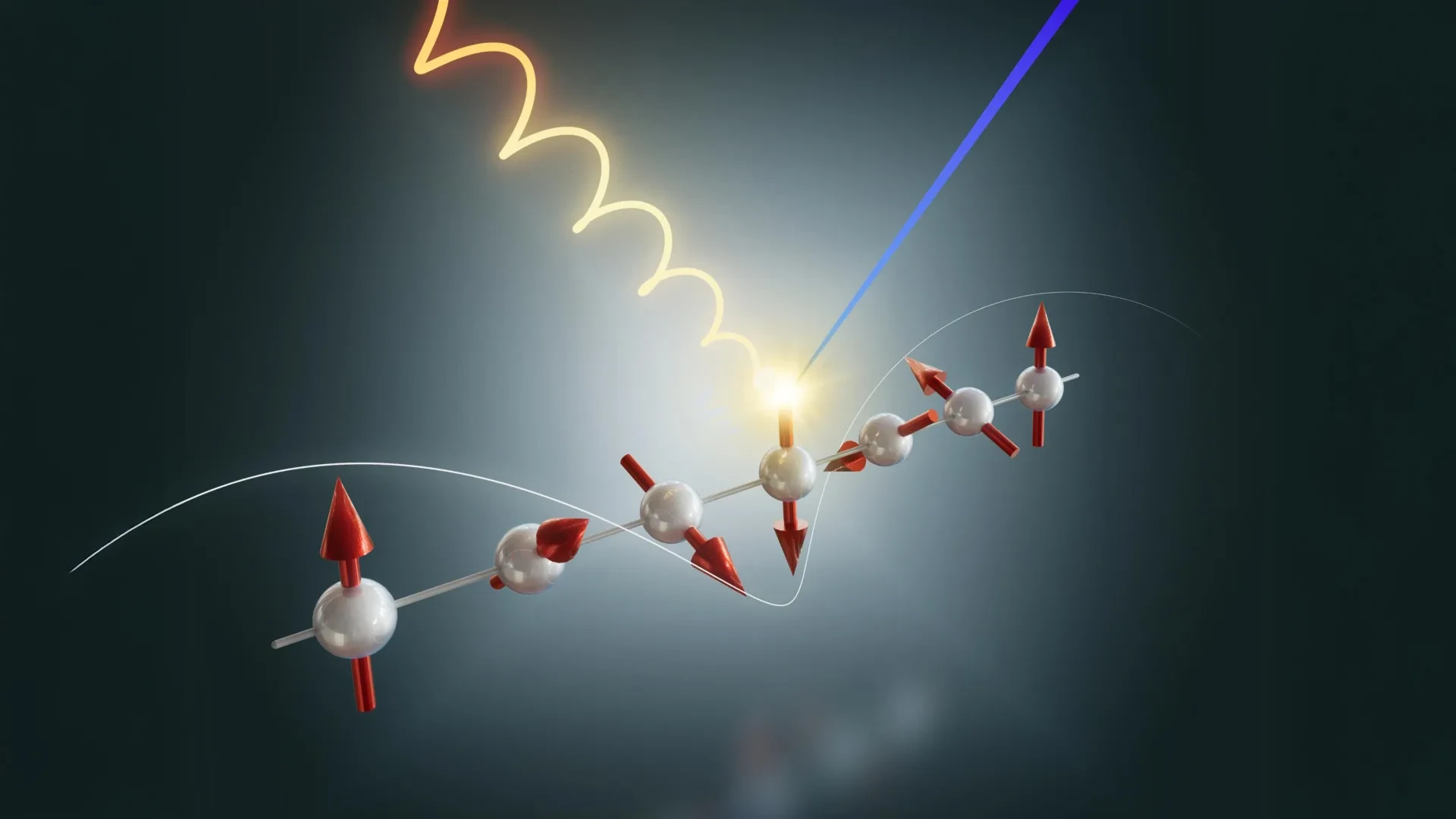
Unlike standard bar magnets or refrigerator magnets, which rely on ferromagnetism to project a unified, external magnetic field, EuSi behaves in a radically counterintuitive fashion. At cryogenic temperatures ranging from roughly 33 to 62 kelvin (approximately −400 to −348 degrees Fahrenheit), the individual magnetic moments of the material’s europium atoms spontaneously organize into an intricate, repeating spiral pattern.
Because the opposing orientations of these magnetic moments precisely balance one another out across the spiral structure, the bulk material produces no net magnetization. To the casual observer, it appears entirely non-magnetic.
Beneath this macroscopic silence, however, lies a microscopic tempest. The hidden spiral arrangement profoundly reshapes the material’s electronic structure, coupling an electron’s direction of travel directly to its quantum spin. This relationship—formally designated as an odd-parity spin texture—suggests a promising pathway toward controlling electronic properties without the need for external magnetic fields.
Because EuSi is a relatively simple metallic compound that yields high-quality single crystals, it instantly transforms from an obscure laboratory curiosity into a premier experimental platform. This breakthrough holds profound implications for the future of spintronics, quantum computing architectures, and the ongoing quest to understand unconventional superconductivity.
Detailed Chronology: Unraveling the Enigma of EuSi
The discovery of p-wave magnetism in europium silicide is the culmination of a multi-year investigative journey that highlights the painstaking nature of modern solid-state physics.
Phase I: Crystal Growth and Initial Observations (Circa 2021–2022)
The research began roughly three years ago at the Max Planck Institute for Chemical Physics of Solids (MPI CPfS) in Dresden, Germany. The foundational breakthrough occurred when Dr. Erjian Cheng successfully synthesized and grew ultra-high-quality single crystals of EuSi. Without these pristine samples, the subtle electronic signatures hidden within the material would have remained undetectable against background lattice defects or chemical impurities.
When Dr. Cheng and his colleagues first deployed photoemission techniques—which probe the energy levels and momentum states of electrons inside a solid—they noticed an immediate anomaly. The magnetic arrangement of the atoms exerted an exceptionally strong, disproportionate influence on the electronic band structure, which dictates how electrons navigate the material and conduct electricity.
"When we first measured the electronic structure of EuSi, we were surprised by the exceptionally large effect of magnetism on the electrons," notes Dr. Cheng. "That observation led us to investigate whether this simple compound could host a much more unusual magnetic state."
Phase II: Global Collaboration and Advanced Spectroscopy (2022–2024)
Recognizing the monumental implications of these initial scans, the Dresden team spearheaded an expansive international collaboration. Ultimately, 38 scientists from 19 premier institutions—including ShanghaiTech University, the Hong Kong University of Science and Technology, the Max Planck Institute for the Physics of Complex Systems, and Oak Ridge National Laboratory—pooled their expertise and specialized equipment.
To confirm whether EuSi truly exhibited the predicted p-wave magnetic state, the consortium deployed a triple-pronged experimental strategy:
- Neutron Diffraction: Researchers utilized neutron scattering facilities to map the exact spatial arrangement of atoms and magnetic moments within the crystal lattice. This confirmed that the europium magnetic moments formed the precise spiral structure required for p-wave symmetry.
- Angle-Resolved Photoemission Spectroscopy (ARPES): This method allowed scientists to map the electronic band structure with high momentum resolution, revealing magnetically driven energy separations exceeding 100 millielectronvolts—a clear indicator of a profound magnetic footprint.
- Spin-Resolved Photoemission Spectroscopy: Providing the most decisive evidence of the project, this advanced technique enabled the team to examine electron spin polarization directly. They observed that the sign of the spin polarization reversed across successive magnetic Brillouin zones, exactly matching theoretical predictions for an odd-parity spin texture.
Phase III: Mapping Magnetic Chirality (Recent Developments)
Most recently, the team uncovered an additional layer of complexity regarding the material’s chirality, or handedness. Although the underlying crystal structure of EuSi is centrosymmetric (meaning its atomic arrangement remains unchanged when inverted through a central point), the magnetic spiral can twist in either of two opposite directions.
Using high-resolution magnetic force microscopy and spatially resolved photoemission spectroscopy, the researchers identified microscopic domains—measuring roughly ten micrometers across (about one-tenth the thickness of a human hair)—characterized by opposing chiral orientations. By probing these domains with circularly polarized light, the team proved that the direction in which the magnetic structure twists is fundamentally linked to the material’s macroscopic electronic behavior.
Supporting Context & Metrics
To appreciate the significance of this discovery, it is helpful to examine the underlying physics, operational parameters, and structural metrics that define EuSi.
Defining P-Wave Magnetism and Odd-Parity Spin Texture
In conventional ferromagnets (like iron or nickel), electron spins align parallel to one another, generating a net magnetic field. In antiferromagnets, adjacent spins point in opposite directions, also canceling net fields, but typically without the complex momentum-dependent coupling seen here.
In the proposed p-wave magnetic state of EuSi:
- Momentum-Spin Coupling: Electrons traveling in opposite directions possess opposite spin polarizations. Reversing an electron’s momentum ($mathbfk$) reverses its spin polarization ($mathbfs$), creating an odd-parity spin texture.
- Symmetry-Driven Origin: While many materials exhibit spin-dependent energy splitting via spin-orbit coupling (where an electron’s relativistic motion interacts with its spin), the unusual spin structure in EuSi arises primarily from collective interactions between localized magnetic moments and the specific spatial symmetry of their spiral arrangement.
Operational Parameters of EuSi
| Parameter | Measurement / Characteristic | Significance |
|---|---|---|
| Chemical Composition | Stoichiometric Europium Silicide (EuSi) | High chemical simplicity and fixed elemental ratios allow for clean, reproducible single-crystal growth. |
| Magnetic Transition Window | 33 to 62 kelvin (−400°F to −348°F) | The temperature range wherein the europium atoms self-organize into the repeating spiral magnetic pattern. |
| Net Magnetization | Zero (Null bulk magnetic field) | Individual magnetic moments balance across the spiral, eliminating stray magnetic fields while retaining internal electronic asymmetry. |
| magnetically Driven Energy Splitting | Exceeding 100 millielectronvolts (meV) | Demonstrates an unusually powerful feedback loop between magnetic order and electron band structure. |
| Chiral Domain Size | ~10 micrometers (~1/10th human hair thickness) | Spatial scale of opposing left- and right-twisted magnetic spiral domains identified via magnetic force microscopy. |
Official Statements from Leading Researchers
The discovery has generated considerable excitement within the global condensed matter physics community, underscoring how material serendipity can upend long-standing theoretical assumptions.
Prof. Claudia Felser, Director at the Max Planck Institute for Chemical Physics of Solids in Dresden, emphasized the broader philosophical and technological implications of the findings:
"What makes EuSi particularly exciting is that an unconventional electronic spin structure emerges from the magnetic order of a chemically simple metal," stated Prof. Felser.
"This demonstrates how the discovery of new materials can reveal entirely new electronic phenomena. EuSi now gives us an experimental platform to investigate how magnetic symmetry and chirality can be used to control electronic properties, with potential implications for future spintronics and unconventional superconductivity."
Echoing these sentiments, Dr. Erjian Cheng highlighted the collaborative rigor required to translate a anomalous laboratory measurement into a validated quantum phenomenon:
"When we first measured the electronic structure of EuSi, we were surprised by the exceptionally large effect of magnetism on the electrons," Cheng reflected.
"That observation led us to investigate whether this simple compound could host a much more unusual magnetic state. The combination of crystal growth, neutron scattering, and spin-resolved spectroscopy now provides compelling evidence for p-wave magnetism."
Future Outlook: Implications for Quantum Technology and Spintronics
While the identification of p-wave magnetism in europium silicide marks a monumental scientific milestone, researchers are quick to note that the discovery represents a beginning rather than an endpoint. EuSi does not currently perform quantum computing tasks or operate as a commercial spintronic device; rather, it provides the long-sought-after experimental playground required to test decades of theoretical predictions.
1. Advancing Spintronic Architectures
Traditional electronics rely exclusively on manipulating the electrical charge of electrons. Spintronics (spin-transport electronics), by contrast, harnesses both charge and quantum spin to process, transport, and store data.
Because EuSi exhibits a direct link between electron momentum and spin polarization without requiring an external magnetic field, metallic p-wave magnets could eventually inspire novel circuitry where spin-polarized currents flow with minimal energy loss, paving the way for ultra-dense, non-volatile memory and logic gates.
2. Unconventional Superconductivity
Another tantalizing avenue of research involves exploring whether magnetic spirals with odd-parity spin textures can mediate unconventional superconductivity. In conventional superconductors, electrons pair up into Cooper pairs driven by lattice vibrations (phonons). In exotic magnetic systems, spin fluctuations can occasionally foster alternative pairing mechanisms, potentially yielding superconducting states that operate at higher temperatures or possess unique topological properties.
3. Redesigning Materials Discovery
Perhaps the most immediate impact of the EuSi breakthrough is philosophical. For decades, researchers searching for exotic quantum states focused heavily on complex insulators or delicate heterostructures that were notoriously difficult to synthesize and analyze.
EuSi proves that profoundly complex quantum phenomena can hide inside remarkably simple, stoichiometric metallic compounds. By demonstrating that macroscopic magnetic silence can conceal microscopic electronic sophistication, this study challenges material scientists to re-examine known binary and ternary compounds through the lens of magnetic symmetry, chirality, and momentum-resolved spin textures.
As laboratories worldwide begin utilizing EuSi to probe the limits of quantum electron behavior, we stand on the precipice of a new era in materials science—one where the invisible twists of atomic spirals may ultimately shape the architecture of future quantum technologies.
