

Executive Overview
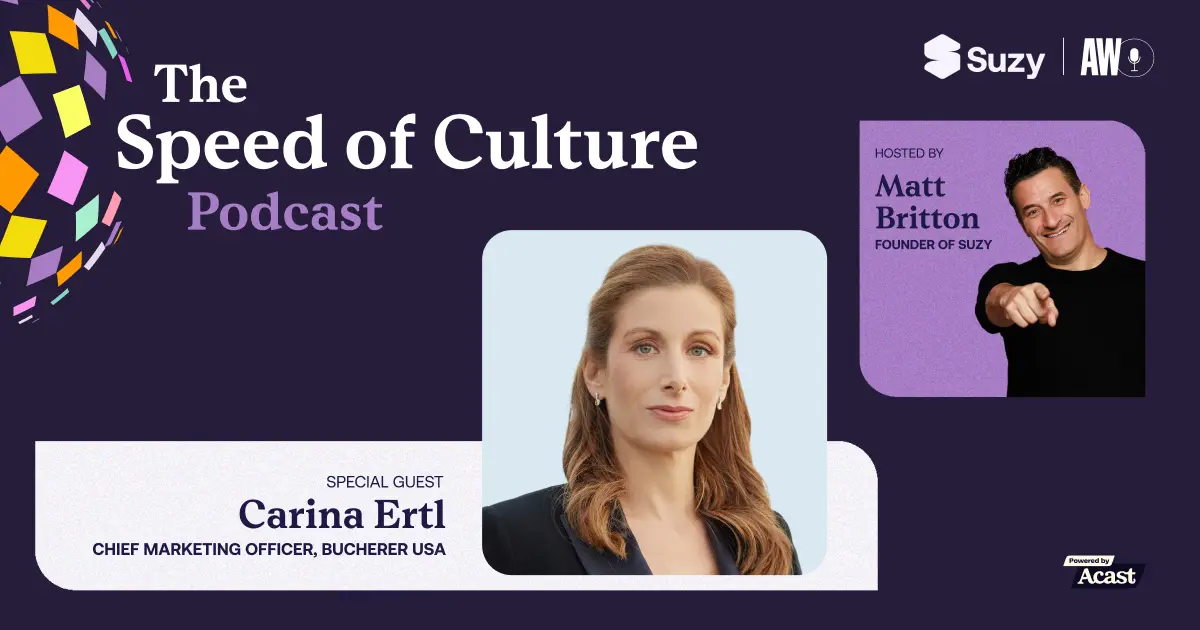
In the modern commercial landscape, nearly every consumer product is anchored by a fundamental premise of utility: it solves a problem, fulfills a need, or optimizes a process. Yet, the upper echelon of the luxury market operates entirely outside this paradigm. As Carina Ertl, Chief Marketing Officer at Bucherer USA, recently observed on The Speed of Culture podcast hosted by Matt Britton, “No one needs a mechanical watch, but then again, luxury is not a category built on need.”
This single declaration cuts to the heart of a fascinating marketing paradox. When utility is removed from the equation, how do heritage brands construct and sustain value? The answer, according to Ertl, lies in a sophisticated ecosystem where the physical object is merely a vessel. The true value of a luxury timepiece or high-end piece of jewelry is forged from an intangible portfolio of scarcity, generational craftsmanship, individual identity, personal memory, exclusive access, and the communal identity conferred upon its owner.
As a historic Swiss retailer whose lineage dates back to 1888, Bucherer navigates a rapidly shifting terrain that bridges centuries-old physical retail traditions with frictionless modern ecommerce. Under Ertl’s marketing leadership—informed by a rich career spanning private equity, entrepreneurship, and nearly a decade at Swarovski—the brand has adapted to the digital age without sacrificing the aura of exclusivity that defines high horology.
In her conversation with Matt Britton, Ertl unpacks the shifting realities of modern luxury marketing. The discussion explores why the category frequently inverts traditional microeconomic demand curves, how experiential retail outlives the point of sale, why niche curators consistently outperform macro-influencers, and why the proliferation of artificial intelligence makes uniquely human taste an invaluable competitive moat. This report delves deep into those insights, offering a comprehensive look at the strategies shaping the future of high-end retail.
Detailed Chronology: The Evolution of Bucherer’s Modern Marketing Playbook
To understand how a 135-year-old luxury purveyor approaches contemporary consumer engagement, one must trace the evolution of its marketing framework. Ertl’s tenure at Bucherer USA represents a critical convergence of heritage preservation and radical adaptability.
Reversing the Economic Paradigm: Managing Hyper-Demand
In traditional retail and consumer packaged goods, the primary marketing objective is demand generation—using advertising, discounting, and promotional incentives to stimulate consumer appetite. In the upper tiers of luxury watchmaking, however, the economic engine runs in reverse.
“Luxury marketing is art and science, with perhaps a little more art than science,” Ertl explains. Unlike categories plagued by oversupply, premier watch brands frequently encounter the inverse dilemma: too much consumer demand for a critically finite supply. This scarcity shock changes the traditional marketing playbook completely.
When manufacturing a single mechanical movement can take months or even years, driving mass awareness becomes counterproductive. Instead, the modern luxury marketer’s primary directive is to protect and elevate desirability while deepening the narrative framework surrounding the product. Scarcity is not merely a supply chain bottleneck; it is the fundamental currency of emotional value.
Elevating the Secondary Market: The Certified Pre-Owned Revolution
For decades, traditional luxury houses viewed the secondary market with apprehension, if not outright hostility. Resale was often associated with gray-market uncertainty, lack of authenticity, and a dilution of brand equity. However, the explosive growth of the pre-owned luxury sector forced a strategic pivot across the industry.
Ertl draws a sharp, non-negotiable distinction between generic resale platforms and rigorous Certified Pre-Owned (CPO) programs. In an era where sophisticated counterfeits threaten consumer trust, absolute authentication is paramount.
By instituting rigorous CPO standards, retailers like Bucherer do more than simply offer peace of mind. They unlock the rich history, provenance, and storytelling embedded within vintage and pre-owned pieces. Certification transforms the secondary market from a secondary thought into an immersive, desirable luxury experience in its own right, granting clients access to discontinued masterpieces while reinforcing absolute brand trust.
Expanding the Definition of the "Product"
In a transactional commodity economy, the customer journey is linear: awareness, consideration, conversion, and fulfillment. In Ertl’s strategic vision for Bucherer, this linear model is obsolete.
Between the initial discovery of a product and the final point of sale lies the true substance of the luxury experience. Ertl argues that the interstitial space—the boutique atmosphere, the horological expertise shared by specialists, the curation of community events, and the validation of personal identity—is actually the product itself.
When a client purchases a high-end timepiece, they are buying entry into a lifelong relationship. By prioritizing community and belonging over isolated sales metrics, Bucherer transforms transactions into enduring client partnerships that span generations.
Supporting Context & Metrics: The Pillars of Modern Luxury Strategy
To operationalize these philosophies, modern luxury marketers must navigate an increasingly complex media and technological landscape. Ertl’s insights highlight several critical metrics and shifting dynamics defining the sector today.
The Micro-Curator vs. Macro-Influencer Paradigm
For years, digital marketing strategies across all retail sectors were dominated by the pursuit of raw reach. Brands chased macro-influencers boasting millions of followers, operating under the assumption that top-of-funnel visibility automatically translated to brand equity.
In the luxury watch segment, this approach frequently falls flat. Ertl highlights that some of Bucherer’s most successful partnerships leverage passionate curators rather than mass-market influencers.
| Metric / Focus Area | Macro-Influencer Approach | Curator / Specialist Approach |
|---|---|---|
| Primary Objective | Broad reach, top-of-funnel awareness | Deep category authority, high engagement |
| Audience Profile | Broad, heterogeneous, passive | Niche, highly informed, active collectors |
| Credibility Factor | Commercial endorsement | Earned expertise and genuine passion |
| Conversion Quality | Low intent, high volume | High intent, long-term loyalty |
As Ertl notes, a smaller voice with deep category knowledge and an intensely engaged community of enthusiasts carries vastly more credibility than broad, unearned reach. For luxury marketers, authentic passion and horological authority will always outperform follower counts.
Artificial Intelligence and the Supremacy of Human Taste
As generative artificial intelligence tools flood the market with automated content, personalized recommendations, and algorithmic design variations, brands face a new homogenization risk. Ertl expresses enthusiasm for AI as an operational productivity and process optimization tool, but she draws a firm boundary where automation threatens to replace genuine cultural judgment.
In the luxury sector, formulas can be easily replicated. Any brand can utilize AI to analyze trends, draft copy, or optimize ad spend. Therefore, true differentiation requires:
- Uncompromising Taste: The ability to discern elegance from mere noise.
- Creative Execution: Crafting narratives that resonate on an emotional level.
- Cultural Fluency: A deep, intuitive understanding of shifting subcultures and global zeitgeists.
As generative tools make generic ideas cheaper and faster to produce, distinctly human taste and creative vision become exponentially more valuable.
Official Statements & Industry Perspectives
Reflecting on her expansive career—which includes foundational roles in private equity, entrepreneurial ventures, and a nearly ten-year tenure scaling operations at Swarovski—Carina Ertl brings a holistic, cross-disciplinary perspective to the executive suite at Bucherer USA. Her leadership ethos rejects dogmatic adherence to legacy playbooks in favor of continuous learning and cultural curiosity.
"No one needs a mechanical watch, but then again, luxury is not a category built on need. And that is exactly what makes the marketing challenge interesting. The value comes from everything surrounding the object: scarcity, craftsmanship, identity, memory, access, and the community someone enters by owning it."
— Carina Ertl, Chief Marketing Officer, Bucherer USA
Expounding on the psychological architecture of luxury consumption, Ertl emphasizes that modern marketing leaders must look beyond immediate sales conversions. The resilience of a heritage brand depends on its ability to cultivate long-term emotional resonance.
"Luxury marketing is art and science, with perhaps a little more art than science… When anyone can copy a formula, the differentiators are taste, creativity, execution, and knowing what is happening in culture and subculture."
— Carina Ertl
These perspectives underscore a vital truth for contemporary brand stewards: while consumer touchpoints and digital platforms will continue to evolve at breakneck speed, the foundational drivers of luxury—trust, human connection, and impeccable taste—remain immutable.
Future Outlook: Navigating the Next Era of Luxury Retail
As the luxury retail sector looks toward the horizon, the convergence of shifting consumer demographics, digital acceleration, and technological disruption presents both profound challenges and unprecedented opportunities.
The Enduring Currency of Curiosity
Reflecting on her career path—which has traversed digital transformation initiatives, multi-market retail expansions, and executive leadership roles—Ertl offers sage advice to the next generation of marketing leaders: adaptability is the ultimate competitive advantage.
No academic institution or professional certification can prepare an executive for every technological shift or macroeconomic pivot they will encounter over a multi-decade career. Instead, the single most durable professional asset is relentless curiosity. Ertl encourages marketers to actively seek out unfamiliar projects, master the broader mechanics of the businesses they serve, and remain fundamentally willing to evolve as their professional responsibilities transform around them.
Summary of Strategic Imperatives for Luxury Brands
Looking forward, brands operating in the high-end watch and jewelry sectors must internalize several key strategic imperatives to sustain market leadership:
- Protect and Cultivate Scarcity: Resist the temptation to over-scale production. Maintain the mystique of exclusivity by ensuring that demand consistently outpaces supply.
- Institutionalize Trust in Resale: Embrace Certified Pre-Owned programs not merely as revenue drivers, but as essential mechanisms for authentication, historical storytelling, and consumer reassurance.
- Monetize the Interstitial Experience: Shift organizational focus from the transactional point of sale to the holistic customer journey—building communities, fostering belonging, and honoring personal identity.
- Prioritize Authentic Authority: Pivot away from vanity metrics and macro-influencer reach, investing instead in passionate curators and subject-matter experts who command genuine respect within niche communities.
- Leverage AI While Elevating Human Taste: Utilize artificial intelligence for operational efficiency and data processing, but double down on human creativity, cultural fluency, and taste as the ultimate brand differentiators.
By adhering to these principles, luxury brands can successfully navigate the complexities of the modern marketplace—proving that even in an era dominated by automation and algorithms, the deeply human art of storytelling and desire will always command the highest value.
