

Executive Overview
Amazon Web Services (AWS), long the undisputed heavyweight champion of the cloud computing infrastructure market, is undergoing a profound and historic brand metamorphosis. For nearly two decades, the AWS value proposition was laser-focused on a distinct, highly technical demographic: software developers, systems architects, and DevOps engineers. Its messaging relied heavily on arcane architectural diagrams, serverless scalability metrics, latency reduction benchmarks, and granular cost-per-gigabyte pricing models.
Today, however, the enterprise technology landscape is shifting beneath our feet. Driven by the generative artificial intelligence boom, the democratization of software development through low-code/no-code platforms, and the ascent of autonomous AI agents as workplace participants, AWS is casting a much wider net.
In an exclusive revelation, AWS leadership confirmed a sweeping strategic pivot designed to capture the hearts, minds—and desktop monitors—of a broader cohort of everyday knowledge workers. This paradigm shift was dramatically illustrated by a recent, highly unconventional marketing campaign for AWS Quick, the company’s flagship AI-centered workspace tool. Breaking traditional advertising molds, the campaign featured a dual-layer media strategy: striking visual elements tailored for human eyes, undergirded by programmatic, machine-readable text specifically engineered for AI agents to ingest, interpret, and act upon.
This imaginative approach to audience expansion is far more than a creative marketing experiment. It represents the vanguard of a multi-pronged corporate strategy aimed at driving AWS toward an ambitious, trillion-dollar horizon. Under the leadership of CEO Matt Garman, AWS has publicly stated its audacious goal: scaling the cloud division into a $1 trillion annual revenue business within the next five to ten years. To achieve this astronomical valuation, AWS must transcend its traditional silos, moving past the server rack and the terminal window to become an indispensable utility for every digital worker on the planet—human and artificial alike.
Detailed Chronology: The Evolution of AWS Marketing and Strategy
To understand the magnitude of the current pivot, one must trace the chronological arc of Amazon Web Services from an internal utility project to a global enterprise behemoth.
Phase 1: The Developer-First Genesis (2006–2015)
When AWS launched in 2006, it solved a critical friction point for developers: the agonizingly slow procurement cycles required to spin up physical servers. By allowing engineers to provision compute and storage with a credit card and an API call, AWS captured the developer imagination.
- The Marketing Playbook: Bottom-up adoption. AWS marketed directly to the engineers building the applications. Ads emphasized raw power, elasticity, and control. Conventions like AWS re:Invent were technical bootcamps, not high-level strategic keynotes.
- The Result: AWS built an insurmountable lead in Infrastructure-as-a-Service (IaaS), capturing over 30% of the global cloud market.
Phase 2: Enterprise Land-Grab and C-Suite Selling (2016–2022)
As cloud computing matured, AWS realized that developer-led adoption alone could not capture the entire enterprise wallet. The company needed to win over Chief Information Officers (CIOs) and Chief Technology Officers (CTOs).
- The Marketing Playbook: Security, compliance, migration modernization, and total cost of ownership (TCO). AWS learned to speak the language of corporate governance, enterprise-grade SLAs, and boardrooms, establishing massive enterprise sales forces.
- The Result: AWS solidified its dominance among Fortune 500 corporations, powering everything from Netflix to financial institutions, cementing multi-billion-dollar enterprise agreements.
Phase 3: The Generative AI Era and the Convergence of Human-AI Audiences (2023–Present)
The launch of advanced foundational models, exemplified by Amazon Bedrock and the infusion of generative AI across the AWS product ecosystem, fundamentally altered the end-user profile. Suddenly, cloud capabilities were no longer mediated exclusively by professional developers. Business analysts, human resources professionals, legal teams, and marketers began interacting directly with AI workspaces.
- The Marketing Playbook: The introduction of AWS Quick and the historic dual-audience advertising campaign. Recognizing that AI agents are now active researchers and decision-makers within enterprise environments, AWS began crafting multi-modal campaigns that appeal to biological stakeholders and algorithmic consumers simultaneously.
- The Visual-AI Hybrid Campaign: In late 2024 and early 2025, AWS rolled out innovative ad placements featuring creative imagery designed to capture human attention while embedding machine-readable code blocks and semantic tags optimized for web-scraping AI agents. When an AI assistant summarizes the web or helps a knowledge worker research productivity suites, it directly consumes the AWS value proposition.
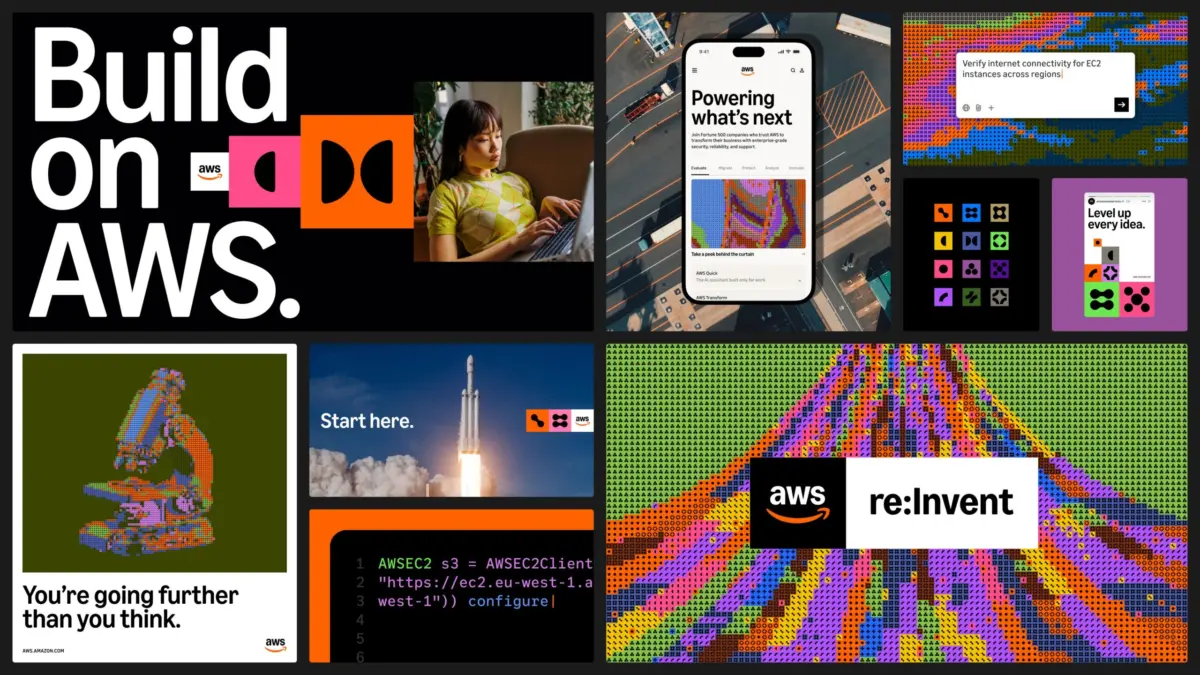
Concurrently, AWS has begun rolling out a cohesive visual brand update. By aligning its core aesthetic and messaging more closely with its parent company, Amazon, AWS is shedding its hyper-niche, geek-centric skin in favor of a universally trusted, consumer-adjacent brand identity.
Supporting Context & Metrics: The Road to a $1 Trillion AWS
The imperative driving this brand overhaul is purely mathematical. Reaching a $1 trillion revenue run-rate requires unlocking massive new Total Addressable Markets (TAM).
The Scale of the Ambition
When Matt Garman assumed the role of AWS CEO, he stepped into a business already operating at an astonishing scale. AWS recently crossed an annualized revenue run-rate well over $100 billion, serving as the most profitable engine within the broader Amazon corporate ecosystem. However, compounding growth at this scale requires geometric expansion.
[Current Run-Rate: ~$100B+] ──> [Target: $1 Trillion within 5–10 years]
          │
          ├─► Traditional Developer Base (Saturated / Steady Growth)
          └─► NEW TAM: Knowledge Workers + AI Agents (Exponential Expansion)
To bridge the gap from $100 billion to $1 trillion, AWS cannot rely solely on the traditional cloud infrastructure spend of software companies. It must capture the digital workspace productivity market—competing directly against enterprise software suites from Microsoft (Azure/Office 365/Copilot) and Google (Google Cloud/Workspace).
The Demographics of the Modern Enterprise
- The Shrinking Barrier to Entry: Generative AI tools allow non-technical employees to write code, build databases, and generate custom workflows using natural language.
- The Rise of the AI Agent: According to enterprise automation metrics, autonomous AI agents are increasingly responsible for software testing, data analysis, supply chain monitoring, and customer service triage. AWS recognizes that if an AI agent is performing the preliminary research and software selection, enterprise marketing must target the agent’s ingestion protocols as much as the human’s psychological triggers.
Official Statements and Insider Perspectives
The strategic pivot has been carefully choreographed by AWS leadership, emphasizing a transition from infrastructure provider to holistic workspace enabler. While portions of the corporate realignment are rolling out organically, industry insiders have shared critical insights regarding the shift.
"We are no longer just building primitives for the developers of tomorrow; we are building intelligent capabilities for every knowledge worker operating today," noted an internal AWS strategy document reviewed by industry analysts. "Our brand must reflect accessibility, intuitiveness, and seamless integration across every tier of the modern organization."
Addressing the groundbreaking campaign for AWS Quick, marketing executives noted that the integration of machine-readable text was a calculated step toward the future of media consumption.
"When your audience includes autonomous systems that synthesize web data on behalf of human executives, your creative execution cannot stop at visual aesthetics," a branding strategist close to the campaign explained. "We are communicating simultaneously with the creative right-brain of the human CMO and the analytical parser of the AI agent."
This sentiment echoes Matt Garman’s overarching vision: AWS must be as familiar, accessible, and intuitive to a financial analyst in Excel or an HR specialist reviewing resumes as it has traditionally been to a backend engineer managing Kubernetes clusters.
Future Outlook: What the Trillion-Dollar AWS Means for the Tech Ecosystem
As AWS executes its ambitious long-term strategy over the next decade, the ripple effects will reshape the broader enterprise technology and marketing landscapes.
1. The Redefinition of B2B Marketing
The AWS "dual-layer" advertising strategy marks the death of pure human-centric B2B marketing. As AI agents evolve from passive assistants to active enterprise procurement influencers, future B2B campaigns will increasingly feature:
- Dual-stream content architectures (visual/emotional for humans; structured semantic data/JSON-LD/machine-readable specs for AI agents).
- Optimization for Large Language Model (LLM) training sets and Retrieval-Augmented Generation (RAG) pipelines as prime real estate.
2. Intensifying Cloud Workspace Wars
By pushing aggressively into the workspace tool category with products like AWS Quick, Amazon is stepping onto turf traditionally dominated by Microsoft and Google.
- Microsoft leverages its ubiquitous Windows and Office footprint to drive Azure and Copilot adoption.
- Google leverages Gmail, Docs, and Android to anchor Google Workspace and Vertex AI.
- AWS is countering by leveraging its unmatched cloud reliability, security infrastructure, and deep developer ecosystem, now wrapped in consumer-grade simplicity designed for the masses.
3. Cultural and Brand Harmonization
By visually aligning AWS more closely with the parent Amazon brand, the company is betting that consumer trust will translate effortlessly into enterprise software confidence. For years, AWS maintained a distinct visual separation from the smiling arrow of Amazon.com. Bringing the cloud titan back into the corporate fold signals that cloud computing is no longer a specialized IT department function—it is the foundational infrastructure of modern commerce itself.
Conclusion
The transformation of AWS from a developer’s playground into a trillion-dollar ecosystem for knowledge workers and AI agents is a defining business narrative of the 2020s. By rethinking everything from creative ad campaigns to brand architecture, AWS is proving that even the most dominant technology giants must continually reinvent their identities to capture the future. As human workers and artificial agents increasingly share the modern digital workspace, AWS intends to be the invisible, indispensable infrastructure powering every single action they take.
