

Executive Overview
In the shadowy domains of theoretical astrophysics, few concepts are as tantalizing—or as conceptually elusive—as primordial black holes (PBHs). Hypothesized to have materialized in the first fleeting fractions of a second following the Big Bang, these ancient remnants of the cosmic dawn could hold the key to one of modern physics’ greatest enigmas: the identity of dark matter. Until recently, however, these hypothetical entities remained utterly undetectable, cloaked in the absolute silence of the deep cosmos.
Now, a groundbreaking study published in The Astrophysical Journal suggests that these subatomic heavyweights may not remain hidden forever. Researchers from the Massachusetts Institute of Technology (MIT), the Flatiron Institute, New York University, and Stanford University have unveiled a chilling theoretical scenario: some primordial black holes could become trapped inside ordinary stars, acting as cosmic parasites that gradually consume their hosts from within before obliterating them in a cataclysmic, seconds-long explosion.
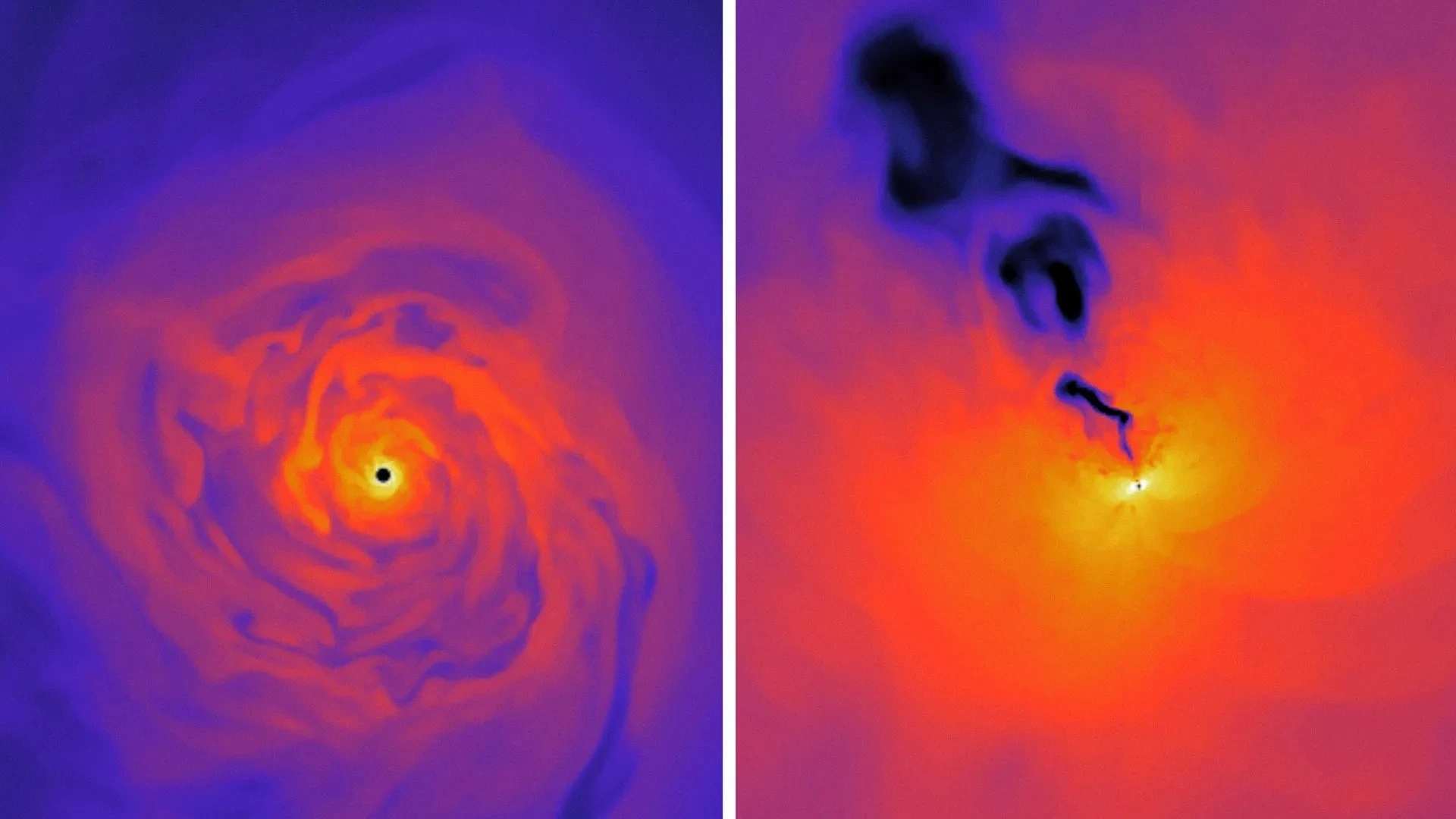
Led by Ore Gottlieb, an assistant professor of physics at MIT, the research team utilized advanced three-dimensional computer simulations to model the fate of a star harboring an asteroid-mass black hole. Their findings indicate that when specific criteria—such as stellar rotation—are met, the interaction culminates in a violent detonation. Crucially, this theoretical explosion would emit a distinct cocktail of blue light, ultraviolet radiation, X-rays, and gamma rays. This explosive signature could be captured by existing telescopes, providing astronomers with the long-sought observational proof required to confirm the existence of primordial black holes and map their distribution across the universe.
Detailed Chronology of a Stellar Demise
To comprehend how a microscopic entity can dismantle a gargantuan celestial body, researchers had to map out a precise, multi-stage cosmic chronology. The journey from a rogue black hole drifting through the void to the sudden death of a sun-like star spans millions of years, culminating in a violent, multi-stage apocalypse.
Phase 1: The Capture and Orbital Decay
In isolation, a single star passing through space lacks the gravitational muscle required to capture a fast-moving primordial black hole. As Gottlieb and his colleagues discovered through their numerical models, the black hole would simply streak past the star, indifferent to its gravitational well.
The dynamic shifts dramatically in multi-body star systems. When a companion star or a massive orbiting planet enters the gravitational equation, it alters the trajectory of the passing black hole just enough to allow the star to snare it. Once captured, the primordial black hole does not instantly plunge into the core. Instead, it enters an elliptical orbit, repeatedly plunging deep through the stellar interior.
With every pass, the black hole experiences friction as it rams through dense stellar plasma. This continuous drag bleeds kinetic energy from its orbit, shrinking the path over millennia. Though this orbital decay requires thousands to millions of years—a blink of an eye in cosmic terms—the black hole inexorably spirals inward until it settles deep within the stellar core.
Phase 2: Internal Consumption and Core Growth
Once anchored in the stellar core, the primordial black hole shifts from a transient visitor to an active predator. As ambient stellar gas is drawn inward by the black hole’s gravity, it accelerates, generating intense heat. In typical accretion scenarios, this outward thermal pressure can choke off the influx of fuel. However, the team’s relativistic and fluid-dynamic simulations revealed a different dynamic: the vast majority of the thermal energy generated by infalling gas is swallowed directly by the black hole itself, circumventing the choking effect.
Over the span of several million years, the internal black hole steadily feeds on the core material, devouring approximately 1 percent of the star’s total mass. For a stable star like our Sun, this internal parasite operates largely unnoticed on the surface, while secretly hollowing out the star’s central engine.
Phase 3: The Critical Threshold and Disk Formation
The ultimate fate of the host star hinges on a single variable: its rate of rotation. If the star spins slowly, gas continues to plunge directly into the black hole, leading to a quiet, prolonged consumption. However, if the star rotates with sufficient rapidity, the conservation of angular momentum changes everything.
Gas spiraling toward the black hole can no longer fall straight inward. Instead, it flattens out, forming a dense, rapidly spinning accretion disk around the black hole—which has by this point grown to several meters in diameter.
Phase 4: The Final Seconds and Cataclysmic Detonation
The moment the accretion disk forms, the countdown to destruction begins. The black hole, spinning furiously alongside its surrounding disk, twists the fabric of spacetime and intensifies the magnetic fields threading through the trapped matter.
These twisted magnetic fields act as a cosmic particle accelerator, channeling energy away from the disk and firing titanic electromagnetic jets straight out from the black hole’s poles. Within mere dozens of seconds, these powerful jets punch completely through the stellar mantle, tearing the star apart from the inside out in a brilliant, terminal flash.
Supporting Context & Metrics: The Physics of Primordial Relics
To evaluate the plausibility of this stellar destruction model, physicists must contextualize the nature of primordial black holes against our broader understanding of cosmology and particle physics.
The Legacy of the Big Bang and Hawking Radiation
Unlike stellar-mass black holes, which are born from the explosive death of massive stars (supernovae), primordial black holes are hypothesized to have been forged in the crucible of the early universe. During the first fraction of a second after the Big Bang, microscopic density fluctuations created regions of matter so concentrated that they collapsed under their own gravity.
Not all of these ancient black holes would have survived to the present day. According to theoretical work pioneered by physicist Stephen Hawking, black holes emit a subtle thermal glow known as Hawking radiation, causing them to lose mass over time. The smallest primordial black holes would have completely evaporated long ago.
However, heavier specimens—specifically those roughly the size of an atom yet packing the mass of an asteroid (equivalent to about one-millionth of the mass of Earth)—could easily have survived for 13.8 billion years. Finding these surviving relics remains one of the ultimate holy grails of modern astrophysics, as their existence would simultaneously validate inflation theory and solve the mystery of dark matter.
Modeling the Unseen: Multi-Disciplinary Simulations
To simulate the interaction between a subatomic black hole and a stellar interior, Gottlieb’s team had to construct complex models integrating several distinct branches of physics:
- General Relativity: To accurately compute extreme gravitational fields and spacetime warping near the black hole’s event horizon.
- Fluid Dynamics: To track the turbulent flow, pressure gradients, and hydrodynamic behavior of plasma within the star’s core.
- Stellar Evolution: To account for the changing chemical composition, density, and temperature profiles of the host star over millions of years.
- Particle Physics: To model energy dissipation, neutrino cooling, and electromagnetic interactions within the accretion disk and relativistic jets.
The Spectral Signature of Stellar Assassination
Should such an event occur, the resulting explosion will not resemble a standard supernova. Because the detonation is driven by an internal micro-quasar rather than standard nuclear fusion collapse, the output across the electromagnetic spectrum follows a unique chronological sequence:
- Initial Flash: A sharp, high-energy burst of gamma-rays and X-rays as the jets first breach the stellar surface.
- Intermediate Phase: An intense pulse of blue and ultraviolet optical light as the expanding stellar debris interacts with the radiation.
- Cooling Tail: A prolonged infrared and radio afterglow as the ejecta expands into the surrounding interstellar medium.
Official Statements and Expert Perspectives
The research has generated significant excitement within the theoretical physics community, offering a tangible framework to test hypotheses that were previously considered untestable.
Lead author Ore Gottlieb emphasized the definitive nature of the final phase transition during a presentation of the findings. "Once the disk forms, this is essentially a death sentence for the star," Gottlieb noted, underscoring the abruptness with which a stable stellar body can be dismantled once critical rotational thresholds are crossed.
Addressing the broader implications for observational astronomy, Gottlieb expressed cautious optimism regarding humanity’s capacity to detect these events. "There is hope for us to probe primordial black holes through interactions with stars," he stated. "We expect this to be visible, and it’s something we should look into." Detailing the expected electromagnetic trail, he added: "We would initially detect some X-rays and gamma rays, then over time optical and infrared emissions, and later on radio emissions. This is something we could potentially detect, if it’s not happening too far from us. It could be many galaxies away, not just in our backyard."
Furthermore, Gottlieb pointed out that identifying these anomalous explosions could serve as a diagnostic tool to differentiate natural stellar deaths from parasitic consumption. "For instance, if the star is a certain mass that is not supposed to explode, it must be something that is happening inside that is a sort of parasite that is consuming the star from the inside," he explained. "The broader impact is that we can now place constraints on primordial black holes, and their contributions to dark matter, using observations."
Alongside Gottlieb, the multidisciplinary research collective featured contributions from Matteo Cantiello of the Flatiron Institute, Cameron Norton and Matthew Kleban of New York University, and Ken Van Tilburg of Stanford University—a coalition whose combined expertise in stellar structure, cosmology, and high-energy astrophysics was vital to the study’s success.
Future Outlook: A New Frontier in Dark Matter Detection
While primordial black holes remain firmly in the realm of hypothesis, this study bridges the gap between abstract theoretical cosmology and empirical astronomy. By providing a concrete, observable signature—an anomalous blue-and-ultraviolet flash accompanied by high-energy gamma-rays from a star that should otherwise have enjoyed a peaceful retirement—the research gives observational teams a specific target to hunt.
Current and next-generation astronomical facilities, ranging from wide-field optical survey telescopes to high-energy space observatories, are uniquely positioned to scan the skies for these atypical transients. Even a null result—failing to detect such explosions across vast volumes of space—will yield valuable scientific data, allowing researchers to place strict upper limits on the abundance of primordial black holes and constraining their potential contribution to the universe’s dark matter inventory.
As scientists continue to refine their computer simulations and analyze archival survey data, the universe’s oldest secrets may finally be revealed not by looking into the quietest voids of space, but by watching for the sudden, violent death of unsuspecting stars hiding a primordial secret within.
