For the past several years, the technology sector has operated under a monolithic and largely unchallenged assumption: that humanity is collectively pining for more artificial intelligence. Corporate boardrooms, venture capital firms, and product development labs have evangelized an impending era of ubiquitous automation, treating "AI-powered" not merely as a feature set, but as a standalone value proposition. Tech leaders envision a world seamlessly augmented by intelligent workflows, generative text boxes embedded into every facet of digital existence, and autonomous agents acting as gatekeepers to daily life.
Yet, a glaring disconnect has emerged between boardroom ambitions and everyday reality. Recent deployment data and adoption metrics reveal a sobering truth: many enterprise AI features suffer from remarkably low user adoption and retention rates, despite demanding exorbitant delivery costs and introducing severe reputational risks.
Rather than ushering in an era of friction-free efficiency, the forced proliferation of generative and autonomous tools has often intensified the modern workload. Employees are left juggling yet another fragmented ecosystem of disconnected software, spending valuable hours chasing and correcting algorithmic hallucinations, and navigating a landscape marked by deep-seated anxiety and resistance to change.
This piece explores the core thesis that people do not inherently desire more AI; rather, they demand systems that work reliably, respect existing mental models, and quietly shoulder tedious burdens. By examining the shifting sentiment from "AI-first" to "AI-second" product design, we can understand why the future of technology belongs not to invasive digital boxes, but to ambient, supportive automation that ultimately preserves human agency and connection.
Detailed Chronology: The Evolution of the AI Adoption Gap
To understand how the technology industry reached this critical juncture of user fatigue and skepticism, it is necessary to retrace the trajectory of the artificial intelligence boom over the past decade.
Phase One: The Novelty and Promise (2018–2022)
In the early waves of mainstream machine learning integration, AI was predominantly deployed beneath the surface. It powered recommendation engines, optimized logistics networks, and streamlined backend data processing. Users interacted with these tools indirectly, reaping the benefits of personalization and speed without being forced to radically alter their established workflows. During this era, AI was largely viewed with cautious optimism; it was an invisible engine doing heavy lifting.
Phase Two: The Generative Tipping Point (2023–2024)
Following the widespread public release of advanced large language models and generative interfaces, the tech industry experienced a seismic shift. The prevailing philosophy rapidly mutated from ambient utility to aggressive foreground presence. Companies across every sector—from finance to consumer software—rushed to bolt chat interfaces, generative art modules, and predictive writing assistants onto legacy platforms.
The mandate from leadership was simple and sweeping: integrate AI everywhere, immediately. However, this rush often ignored fundamental principles of user experience (UX) and product-market fit. Features were introduced not because users demanded them, but because corporate survival in a hyper-competitive market seemed to dictate it.
Phase Three: The Productivity Paradox and User Resistance (2025–Present)
As these hastily deployed tools matured within enterprise and consumer environments, the cracks in the strategy widened into chasms. Far from reducing human effort, the introduction of uninvited, high-maintenance AI features began to extract a heavy operational toll.
Data from workplace productivity studies started painting an alarming picture: time spent managing electronic communication, sorting through generative output, and fixing algorithmic errors skyrocketed. Employees found themselves working longer hours—spanning weekends and evenings—not because they were achieving more, but because they were spending precious cognitive bandwidth managing the very tools designed to liberate them. The industry had officially entered the AI adoption gap, characterized by profound user skepticism, fatigue, and a growing insistence that technology adapt to humans, rather than the other way around.
Supporting Context & Metrics: The Cost of Forced Automation
The narrative that AI universally increases productivity has been challenged by mounting empirical evidence. Far from streamlining operations, the uncritical deployment of AI tools has frequently complicated the very workflows it sought to optimize.
The Metrics of Intensified Labor
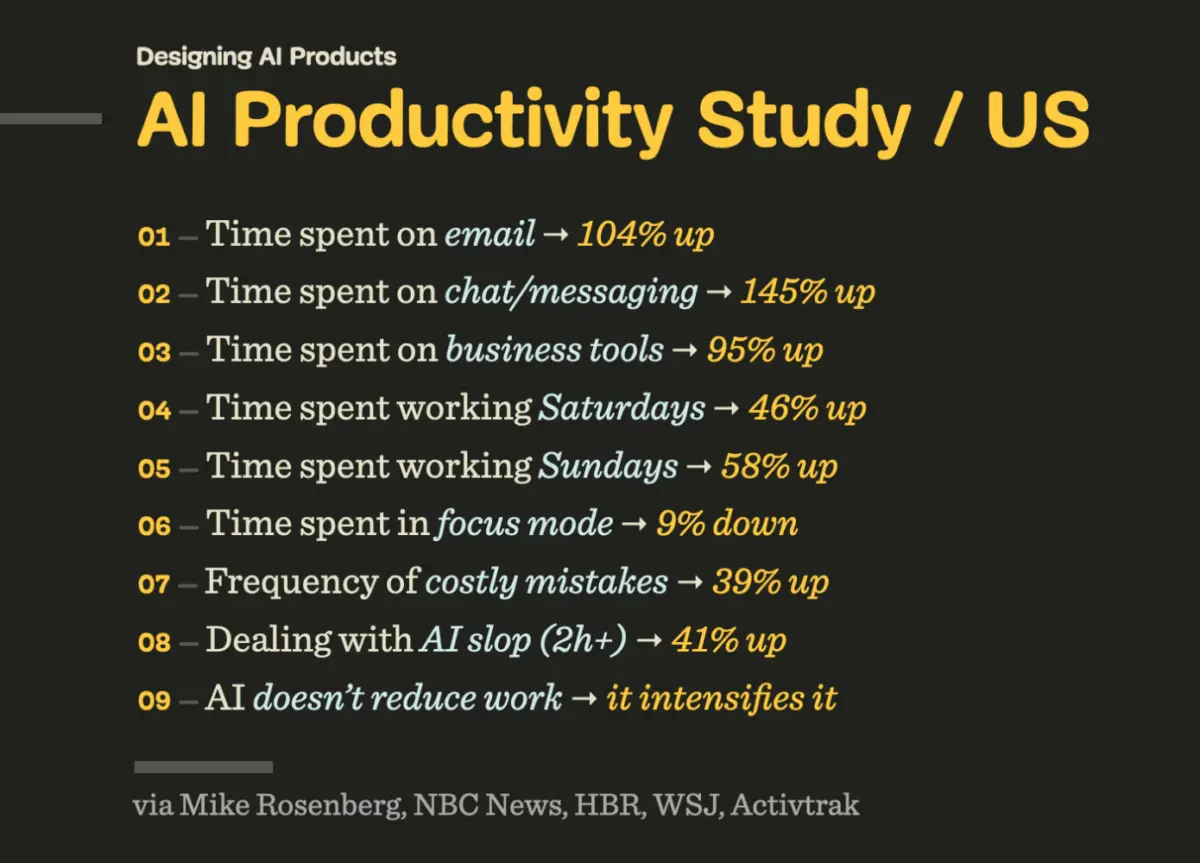
A comprehensive synthesis of recent productivity studies—drawing from industry tracking and workplace analytics—illustrates the hidden costs of modern AI integration:
Surge in Communication Overhead: Time dedicated to managing email has spiked by 104%, while chat and messaging tool usage has increased by 145%.
Expanded Work Hours: Weekend work has seen dramatic increases, with Saturday workloads rising by 46% and Sunday workloads jumping by 58%.
Erosion of Focus: Deep-work "focus modes" have decreased by 9%, supplanted by the constant demand to monitor, prompt, and correct automated outputs.
The Burden of "AI Slop": Dealing with low-quality, AI-generated text and redundant outputs has added 41% more friction to daily administrative tasks.
Escalating Errors: Rather than eliminating human mistakes, poorly integrated systems have contributed to a 39% rise in costly oversights as users struggle to verify automated claims.
These figures underscore a fundamental design flaw: treating AI as a universal value proposition rather than a specialized resource. As agile business strategist David Bland notes in his widely circulated annotations of the Business Model Canvas, artificial intelligence belongs firmly in the domain of Key Activities and Key Resources, not bolted onto the Value Proposition. AI is an operational enabler, not the foundational reason a customer purchases a product.
Furthermore, vulnerability mapping from institutions such as GovAI and the Brookings Institution highlights that while knowledge-worker roles (such as software developers and public relations specialists) face high exposure to automation, the true value of these professions lies in human intuition, taste, and strategic judgment. Automating the drudgery is a net positive; attempting to automate human judgment is a recipe for operational failure.
Official Statements and Industry Insights
The backlash against intrusive, mandatory artificial intelligence has found voice among prominent designers, thinkers, and enterprise leaders who are calling for a return to human-centric product development.
"I don’t want to read books written by AI. I don’t want to gaze upon paintings by AI. I don’t want AI to teach my children. I don’t want to have an AI therapist. I don’t want AI making my medical decisions. I want AI to do all the physical and mental labor that taxes me so I can read books written by humans and go to art galleries to engage with art made by humans. I want AI that makes my life easier rather than forces me to change myself."
— Bo Young Lee, Enterprise Leadership Expert and Advisor
This perspective encapsulates the profound emotional and psychological divide between what technologists want to sell and what society actually requires. When technology forces users to drastically alter their habits, adopt entirely new mental models, and constantly police algorithms for hallucinations, it ceases to be a tool and becomes a second job.
UX design veterans echo these sentiments, emphasizing that users do not evaluate software by comparing it to the fallibility of other human beings; they compare software features against other software features. If a traditional, deterministic feature works predictably and flawlessly every single time, a probabilistic AI feature that requires manual verification and error-checking will invariably be rejected, regardless of the marketing hype surrounding it.
Future Outlook: The Rise of the "AI-Second" Paradigm
As the initial hype cycle matures into pragmatic disillusionment, the trajectory of artificial intelligence design is undergoing a necessary course correction. The future does not belong to the "AI-first" enterprise—characterized by loud chat interfaces, uninvited agents roaming user accounts, and disruptive workflow overhauls. Instead, the market is pivoting toward an "AI-second" paradigm.
Principles of Sustainable AI Integration
Ambient and Humble Support: The most successful future applications of artificial intelligence will not demand center stage. They will operate quietly in the background, serving as subtle, calm utilities that handle repetitive, draining tasks without demanding user validation for every minor action.
Alignment with Existing Mental Models: Rather than forcing users to learn complex prompt engineering or adapt to erratic algorithmic behaviors, tools must integrate seamlessly into established workflows. AI must conform to how humans naturally think and make decisions.
Augmentation Over Replacement: The primary objective of automation must be the preservation of human agency and joy. By offloading the mental and physical labor that exhausts cognitive energy, technology can restore the space needed for deep, creative, and intrinsically rewarding human work.
Reliability as the Ultimate Feature: Branding an interface as "smart" or "AI-powered" is no longer a substitute for functional reliability. Predictability, speed, accessibility, and utility must remain non-negotiable baselines.
Ultimately, the goal of technological innovation should not be to engineer a world where humans spend more time managing machines. It should be to build systems efficient and invisible enough to give us more time to spend with one another.