

Executive Overview
Long before modern marine biology mapped the mysteries of the frozen north, the courts of Renaissance Europe were captivated by a legendary artifact: the unicorn horn. Valued far above its weight in gold, these spiral, ivory shafts were symbols of absolute power, incorruptibility, and divine right. Few knew their true origin. In the 17th century, Danish King Frederik III understood that these prized possessions did not come from mythical beasts of the forest, but from the frigid, ice-choked waters of the Arctic. The king’s successful maritime expeditions secured so many of these artifacts that he commissioned an entire coronation throne fashioned exclusively from them, cementing his political dominance across the continent.
Yet history’s most coveted "horn" was never a horn at all. It is a tooth—specifically, one of the most astonishing evolutionary adaptations in the natural world.
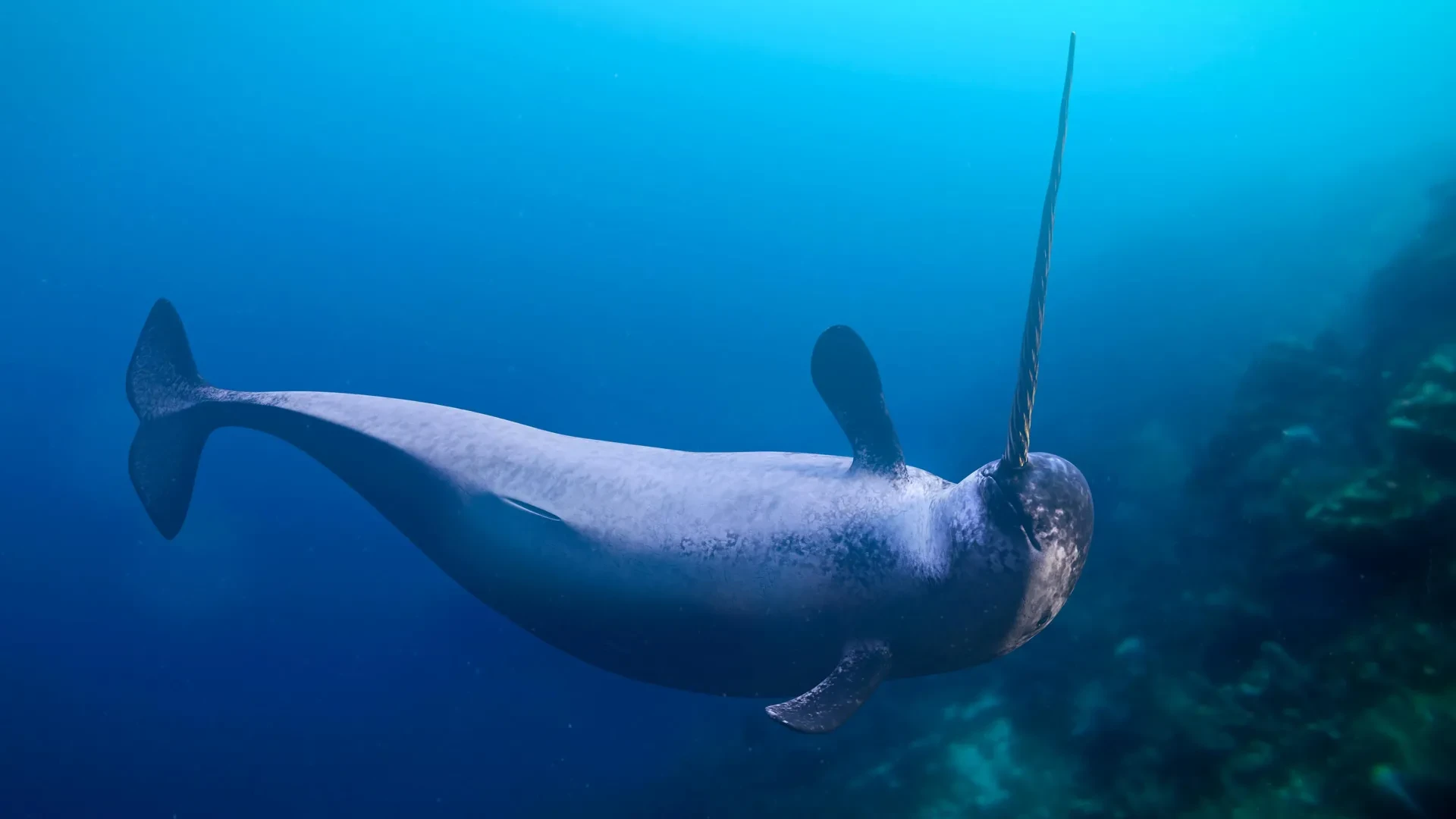
Today, the male narwhal (Monodon monoceros) continues to mesmerize scientists, not merely for its mythical status, but for the engineering marvel of its primary weapon and display organ. Growing up to two meters (6.6 feet) in length—equivalent to half the animal’s entire body length—the narwhal tusk breaks every rule of mammalian dental anatomy. Unlike elephant tusks, walrus tusks, or beaver incisors, which grow in gentle, sweeping curves, the narwhal’s upper left canine erupts through the lip to form a precise, counter-clockwise corkscrew.
For decades, the physical properties of this giant tooth have puzzled researchers. How does a structure so long and seemingly vulnerable withstand the immense hydrodynamic forces of the open ocean, the crushing pressure of Arctic depths, and the violent impacts of social combat?
An international, multidisciplinary team of researchers has finally answered this question by peering deeper than ever before. Utilizing state-of-the-art synchrotron X-ray facilities across Europe, scientists have uncovered the hidden architecture of the narwhal tusk. Their findings reveal that the tusk is a masterpiece of biological engineering, built like reinforced concrete and structured around two intertwined, opposing helices at the nanoscale. Published in Nature Communications, this breakthrough bridges the gap between atomic-level building blocks and the macro-scale majesty of the Arctic’s most iconic marine mammal.
Detailed Chronology: From Royal Obsession to Synchrotron Discovery
To understand how humanity unlocked the secrets of the narwhal tusk, one must trace a trajectory spanning centuries of exploration, evolving scientific paradigms, and cutting-edge technological innovation.
The Royal Era and Early Misconceptions
- The 17th Century: Danish King Frederik III leverages maritime expeditions to Greenland, acquiring scores of "unicorn horns" from local Inuit trade networks and whalers. Recognizing that the artifacts originate from marine mammals, the king uses them to build a legendary throne, elevating the Danish monarchy’s prestige across European courts.
- The 18th to 20th Centuries: Naturalists confirm that the "horn" is an elongated canine tooth unique to male narwhals (and occasionally rare females). However, theories regarding its function remain purely speculative, ranging from ice-breaking tools to breathing tubes and weapons of predation.
The Modern Scientific Awakening
- The 2000s–2010s: Marine biologists begin to understand the behavioral ecology of the narwhal. Observational studies challenge old assumptions, revealing that tusks are rarely used for feeding or breaking ice, but are heavily involved in sensory perception, mate selection, and playful "tusking" duels among males.
- The "Narwhal Tusks – A Tale with a Twist" Project: Funded by NordForsk and supported by the European Union’s Horizon 2020 program under the Marie Skłodowska-Curie actions, an elite consortium of scientists forms under the leadership of Professor Henrik Birkedal of Aarhus University, Denmark. The goal: decode the relationship between the tusk’s physical structure, its growth, and its environmental context.
The Breakthrough Imaging Campaign
- Mid-to-Late 2010s: The research team targets the microscopic structure of the tusk. To capture data across multiple length scales, they secure beamtime at three of Europe’s premier synchrotron radiation facilities:
- The Swiss Light Source (SLS) at the Paul Scherrer Institute (PSI) in Villigen, Switzerland.
- The MAX IV Laboratory in Lund, Sweden.
- The European Synchrotron Radiation Facility (ESRF) in Grenoble, France.
- The Tensor Tomography Phase: Lead author Adrian Rodriguez-Palomo—then a PhD student at Chalmers University of Technology in Sweden, later a postdoctoral researcher at Aarhus University—alongside PSI researcher Marianne Liebi and colleagues, subjects tusk samples to non-destructive tensor tomography. By rotating the tooth within ultra-powerful X-ray beams, they gather millions of scattering patterns.
- The "Eureka" Moment: Initial data analysis baffles the team. Standard mechanical assumptions predict that the visible macro-spiral should be immediately obvious in the orientation of the nanoscale collagen fibers. Instead, individual points yield flat, regular patterns.
- The Paradigm Shift: The researchers change their analytical framework. Rather than examining points in isolation, they map the directional relationships between neighboring points. By "connecting the dots," a hidden architectural blueprint emerges: the tusk is constructed from two opposing, intertwined helical structures.
Supporting Context & Metrics: The Anatomy of a Biological Masterpiece
To appreciate the significance of the synchrotron findings, one must examine the biological and physical parameters that govern the narwhal tusk.
Material Science: Nature’s Reinforced Concrete
At its core, the narwhal tusk is a composite material. In engineering, composites combine disparate materials to achieve performance metrics that neither component could manage alone. Reinforced concrete is the classic human analogue: cement and sand provide compressive strength, while an internal web of steel rebar resists tensile (pulling) forces and bending stress.
The narwhal tusk achieves a similar duality:
- Dentin Matrix: Forming the vast majority of the interior tooth, dentin is a mineralized tissue reinforced by an intricate mesh of microscopic collagen fibers.
- Cementum Sheath: A thin, outer layer of cementum—a material typically restricted to the roots of mammalian teeth—caps the exterior.
- The Mineral-Protein Balance: Extremely fine collagen fibers act as the "steel rebar," providing tensile elasticity, while tiny apatite mineral crystals supply hardness. This balance allows a tusk to flex significantly under hydrodynamic pressures without snapping.
| Structural Component | Material Type | Primary Function | Microscopic Orientation |
|---|---|---|---|
| Inner Dentin | Mineralized collagen composite | Compressive strength & flexibility | Right-handed helix (inner layers) |
| Outer Cementum | Specialized dental tissue | Surface protection & stress distribution | Left-handed helix (outer layer) |
| Overall Tusk | Modified upper left canine | Sensory reception, social display, combat | Visible macro-corkscrew (counter-clockwise) |
The Power of Synchrotron Radiation
Why were standard laboratory microscopes insufficient? The transition from the nanoscale (nanometers, or one-billionth of a meter) to the macroscale (meters) required equipment capable of probing deep inside dense ivory without destroying it.
Synchrotrons accelerate electrons to near-light-speed in massive storage rings, generating brilliant beams of X-rays millions of times brighter than standard medical equipment. When these high-energy X-rays strike the ordered nanostructures of the tusk, they scatter in distinct, geometric patterns. By compiling millions of these scattering vectors via tensor tomography, scientists reconstructed a three-dimensional map of mineralized collagen orientation across the entire volume of the tooth.
The Arctic Archive: Teeth as Climate Recorders
Beyond structural mechanics, the narwhal tusk serves as a biological time capsule. Because narwhals live up to 70 years—and occasionally approach a century of life—their tusks grow continuously throughout their existence, laying down annual growth layers analogous to the rings of a tree.
As part of the broader NordForsk initiative, researchers are analyzing these incremental layers to reconstruct historical Arctic conditions. Variations in chemical composition within the tusk layers record shifts in sea ice extent, water temperature, and dietary availability, turning the narwhal into an independent archivist of historical climate change in the polar north.
Official Statements and Expert Perspectives
The publication of the study in Nature Communications generated widespread commentary within the international scientific community, highlighting the interdisciplinary nature of modern biomimetics.
"Like bones or other teeth in the animal kingdom, the narwhal tusk is a complex composite material whose structure extends from tiny nanoscale building blocks to the visible form of the entire tooth," explains Marianne Liebi, researcher at the Paul Scherrer Institute (PSI) and co-author of the study.
Emphasizing the mechanical demands placed on the animal, Liebi adds: "The narwhal tusk, too, must be both hard and flexible. Only then can it withstand the strong hydrodynamic forces that swimming generates."
Reflecting on the analytical hurdles the team faced before uncovering the dual-helix structure, Liebi recalls:
"That puzzled us quite a bit. Earlier mechanical experiments had indicated that the tusk’s characteristic twist should be reflected in the orientation of its collagen fibers and mineral crystals. But instead of a helix, all we saw was a regular pattern."
Lead author Adrian Rodriguez-Palomo, whose work spanned Chalmers University of Technology and Aarhus University, describes the turning point in the data analysis:
"When we compared how these points were oriented relative to each other, a directional trend began to appear. All we had to do then was connect the dots—as in a children’s paint-by-numbers kit—and suddenly the structure became visible: two intertwined spirals."
Project leader Professor Henrik Birkedal of Aarhus University underscores the broader ecological and chronological value of the research:
"During a lifespan that can approach a century, a male narwhal effectively builds its own environmental archive within its remarkable spiral tooth. By reading these layers, we unlock not only the physical mechanics of a legendary evolutionary adaptation but also a high-resolution history of the Arctic environment."
Future Outlook: Biomimetics and Arctic Conservation
The decoding of the narwhal tusk’s nanoscale architecture marks the end of a centuries-old mystery, but it opens an expansive new chapter in both materials science and environmental monitoring.
Implications for Biomimetic Engineering
Human engineers are constantly searching for structural solutions that reconcile conflicting physical demands—such as high strength paired with extreme fracture toughness. Traditional composite materials often fail catastrophically when cracks propagate along uniform interfaces.
The narwhal tusk’s dual-helical arrangement—where the outer cementum spirals counter to the inner dentin—offers a masterclass in stress dissipation. Much like braided rope or advanced aerospace composites, the opposing helices arrest crack propagation and distribute torsional loads evenly across the length of the shaft. Materials scientists are already drawing inspiration from these findings to design next-generation carbon-composite shafts, drive axles, and structural pilings that mimic the narwhal’s natural resistance to twisting forces.
Environmental Monitoring in a Changing Climate
As the Arctic experiences unprecedented climatic shifts, understanding the historical baseline of the polar ecosystem is more critical than ever. The ongoing analysis of narwhal tusk growth layers by Birkedal’s team provides an unprecedented biological proxy for historical oceanographic data. By extracting chemical signatures from decades-old tusk layers, researchers can reconstruct local food web dynamics and water temperature fluctuations across the 20th and 21st centuries.
Conservation in the Anthropocene
Ultimately, the narwhal remains an ambassador for the fragile cryosphere it inhabits. Threatened by industrial encroachment, retreating sea ice, and changing marine traffic routes, these remarkable cetaceans face mounting anthropogenic pressures. By elevating our scientific appreciation of the narwhal from a purveyor of mythical "unicorn horns" to a sophisticated architect of nanoscale composites and an archivist of Arctic history, researchers hope to galvanize broader support for the conservation of high-latitude marine ecosystems.
The legendary unicorn horn of Danish kings was never a myth; it was a marvel of evolution, refined over millions of years of Arctic survival. Today, thanks to advanced synchrotron imaging and collaborative international science, its true brilliance is finally coming to light.
