


Executive Overview
In the rapidly evolving landscape of digital product design, user experience (UX) research remains the North Star for product teams striving to build intuitive, engaging, and high-converting applications. Yet, traditional user research methodologies frequently overlook one of the most critical and rapidly growing segments of the population: individuals with cognitive disabilities and neurodivergence.
In the summer of 2024, a groundbreaking exploratory study was launched to determine the true value of incorporating testers with cognitive disabilities into standard accessibility and usability testing. Spearheaded by experts in innovation and accessibility—including research leaders at Fable in collaboration with the University of California, Irvine—the study set out to test a fundamental hypothesis: Do participants with cognitive disabilities uncover significantly more usability insights than general population (gen pop) participants?
The findings, finalized and analyzed across multiple AI-prototyped web platforms, were definitive. Participants with cognitive disabilities identified 1.8 times more usability issues and made 1.8 times more actionable suggestions than their general population counterparts.
This deep dive examines the methodology, data analysis, qualitative observations, and profound business implications of cognitive inclusion in UX research. It reveals how designing for cognitive accessibility is not merely an ethical obligation or a compliance box-check, but a strategic engine for uncovering critical cognitive load issues that benefit every single user, ultimately protecting revenue, improving customer retention, and future-proofing digital products.
Detailed Chronology: From Pilot Study to Empirical Research
The path to this comprehensive study began long before the user sessions commenced. Recognizing a critical gap in digital accessibility testing, industry leaders sought to establish rigorous, repeatable frameworks for engaging with testers who experience challenges regarding memory, focus, and learning.
Phase 1: Foundation and Pilot Testing
In mid-2024, a specialized working group was formed to investigate best practices for accessibility testing involving cognitive disabilities—an umbrella term covering conditions that affect how the brain processes information. According to the Centers for Disease Control and Prevention (CDC), cognitive disabilities represent the most prevalent disability category in the United States at 13.9%, a figure corroborated by Yale studies showing rapid upward trends.
To prepare for large-scale evaluation, researchers established four core operational goals:
- Recruitment & Screening: Developing a nuanced screener to identify individuals who self-identified with challenges in memory, focus, and learning.
- Literature Review: Reviewing existing published studies on cognitive testers to extract industry best practices.
- Iterative Pilot Testing: Testing these practices with an initial cohort of 25 testers, fine-tuning the methodology iteratively.
- Tool Creation: Developing a formalized guide for running user interviews with cognitive testers, alongside a survey designed to quantify their digital product experiences.
Following the success of this pilot, researchers noticed that cognitive testers naturally unearthed a staggering depth of usability insights. This observation sparked the formal comparative study.
Phase 2: Experimental Design and Website Prototyping
To empirically test the hypothesis, researchers partnered with the University of California, Irvine (collaborating with Syed Fatiul Huq and Fable researchers Pranav Pidathala, Ali Brown, and Michael Fagan).
Using an AI prototyping tool, the team engineered three distinct websites, each featuring vastly different user goals, visual designs, and core functionalities:

- Strong Snacks: A clean, bright, brutalist-style website featuring three-ingredient high-protein recipes, blog posts, and category filters.
- Turning Pages: A moody, dark, classic-themed online bookstore featuring extensive genre filters, an innovative "book swiping" feature to build preference profiles, custom lists, and a full shopping cart and checkout flow.
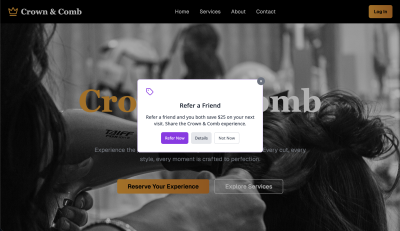
- Crown & Comb: A bold, clean, black-and-white hair salon website with selective bursts of color, designed intentionally to be complex with a challenging VIP program, service packages, and an online appointment/consultation booking system.
Phase 3: Execution of User Sessions
The study deployed a unified screener evaluating memory, focus, and learning, dividing participants into two matched cohorts: self-identified cognitive participants and general population participants.
Across the board, 30 user interviews (10 per website, split evenly 5/5 between cognitive and gen pop participants) were conducted. Each participant completed all designated tasks for a specific website during a moderated online interview. Concurrently, all participants completed the Accessible Usability Scale (AUS)—a validated, Creative Commons-licensed 10-question survey evaluating the usability of digital interfaces on a scale from 0 to 100.
Supporting Context & Metrics: Data Analysis and Findings
To ensure absolute consistency, all study recordings and transcripts were reviewed by a single lead researcher. Every instance where a participant raised a concern, asked a question about functionality, experienced a roadblock, or missed a task element was logged as an "issue." Furthermore, every user-generated recommendation for improvement was counted.
Quantitative Breakdown Across Platforms
The quantitative results confirmed the initial hypothesis: cognitive participants systematically outperformed gen pop participants in identifying systemic friction points. Across all three websites, cognitive participants surfaced 197 usability issues (compared to 113 by gen pop) and generated 93 suggestions (compared to 54 by gen pop).
1. Strong Snacks (Simple Design & Low Complexity)
- Gen Pop: Total Issues = 32 | Average Issues = 6.4 | Total Suggestions = 13 | Average AUS = 90.5
- Cognitive Participants: Total Issues = 49 | Average Issues = 9.8 | Total Suggestions = 24 | Average AUS = 76.8
- Insight: Even on a minimalist site, cognitive participants found 3.4 more issues on average, demonstrating that basic layout choices can introduce subtle cognitive hurdles.
2. Turning Pages (Complex E-Commerce & Heavy Functionality)
- Gen Pop: Total Issues = 55 | Average Issues = 11.0 | Total Suggestions = 26 | Average AUS = 78.0
- Cognitive Participants: Total Issues = 86 | Average Issues = 17.0 | Total Suggestions = 42 | Average AUS = 60.8
- Insight: Featuring multiple tasks and diverse features, this platform generated the highest volume of issues. Cognitive participants found 6 more issues on average and scored the experience 17.2 points lower.
3. Crown & Comb (Intentional Complexity & Booking Flow)
- Gen Pop: Total Issues = 26 | Average Issues = 5.0 | Total Suggestions = 15 | Average AUS = 49.5
- Cognitive Participants: Total Issues = 62 | Average Issues = 12.0 | Total Suggestions = 27 | Average AUS = 63.8
- Insight: Designed to be deliberately difficult (particularly the bridal package task), this site revealed a fascinating paradox: cognitive participants rated the overall experience 14.3 points higher than gen pop users, likely because unpredictable interactions weighed less heavily on their overall perception than structured guidance elsewhere.
Issue Categories: Where Friction Happens
When categorized, issues mapped heavily into specific design domains. Cognitive participants surfaced significantly more issues within:

- Content: Clarity, readability, and information architecture.
- Buttons and Links: Affordances, predictability, and interactive feedback.
- Icons and Visual Elements: Ambiguous symbolism and visual clutter.
- Media: Animations and video elements that destabilize focus.
Official Statements and Qualitative Insights
The qualitative depth harvested from cognitive sessions highlights how poor design impacts not just task completion, but human well-being.
When examining the lowest-scoring evaluations for the complex salon site (Crown & Comb), the disparity in user expression is striking:
Gen Pop Participant Quote:
"As soon as you have a name of a treatment and a little explanation and like the duration and the price, as soon as you click onto that, it should be that you can interact with that service straight away. And I feel like if you’re seeing a service repeated on a page multiple times and you’re still not able to select it, it’s really, really frustrating. This feels not particularly engaging."Cognitive Participant Quote:
"For example, like, the mental energy aspect of it, like, sometimes there’s, like, okay, cookies, and then ads, pop-ups, or maybe the website or service has too many options to look through, and maybe I just want something that I already know. I have to go through a lot of stuff. It makes me, like, feel drained and less able to focus."
While the general population participant expressed annoyance at broken affordances, the cognitive participant articulated a profound depletion of mental energy. This distinction illustrates the precise threshold where standard usability defects transform into absolute accessibility barriers.
Industry feedback echoes this sentiment. As noted by a UX Manager at Bell Media:
"2 sessions with cognitive users feel like 200 because of the volume of insights we get."
Future Outlook: Why Cognitive Inclusion is Imperative
As demographic shifts reshape global populations, the urgency for cognitive-first UX design will only accelerate. Projections from the U.S. Census Bureau indicate that the percentage of Americans aged 65 and older will rise from 17% to 25% by 2060. As populations age, cognitive decline—coupled with neurodiversity—becomes a universal human experience.
Key Takeaways for Product Teams
- Cognitive Load is Universal: Designing for users with memory, focus, and learning challenges eliminates cognitive friction that quietly degrades the experience for all users, including stressed, distracted, or aging customers.
- An Accessible On-Ramp: While testing with screen reader and assistive technology users remains vital, cognitive accessibility provides an approachable entry point for teams transitioning into comprehensive inclusive research.
- Protecting Business Outcomes: Ambiguity in e-commerce purchase flows or booking mechanisms directly impacts revenue. Clear content, predictable button behaviors, and streamlined navigation safeguard customer retention and brand loyalty.
Cognitive inclusion in UX research is no longer an optional luxury or a secondary consideration. It is a proven, high-efficiency methodology that empowers product teams to craft simpler flows, deliver clearer content, and build digital ecosystems that truly work for everyone.
