

Executive Overview
The long-simmering tensions between major broadcast networks and federal regulatory bodies reached a boiling point on Tuesday when ABC filed a high-stakes lawsuit against the Federal Communications Commission (FCC) in the U.S. District Court for the District of Columbia. The legal challenge marks a dramatic escalation in an ongoing conflict over broadcast licenses, editorial discretion, and allegations of unconstitutional government retaliation.
At the heart of the litigation is ABC’s assertion that the FCC is weaponizing its regulatory authority to penalize the network for news coverage and commentary critical of the Donald Trump administration. Describing the government’s actions as "an extraordinary assault on free speech," the network’s legal filing argues that the FCC’s recent enforcement maneuvers are designed to punish editorial decisions that run counter to the administration’s political narrative. ABC contends that this pattern of regulatory pressure violates the First Amendment, transforming the neutral administration of public airwaves into a mechanism for partisan censorship.
The dispute was triggered by a controversial FCC order issued in late April, which abruptly upended standard regulatory timelines by forcing eight ABC-owned and operated (O&O) television stations to file early broadcast license renewals. While the commission initially justified the directive as part of an ongoing inquiry into potential violations of the 1934 Communications Act and prohibitions on unlawful discrimination—tied to a year-long federal probe into parent company Disney’s Diversity, Equity, and Inclusion (DEI) practices—ABC and media analysts point to a direct correlation between the regulatory crackdown and a series of sharp criticisms leveled by network hosts against top administration officials.
This comprehensive report examines the multifaceted dimensions of the lawsuit, detailing the chronology of events leading up to the legal filing, the constitutional arguments presented by ABC, the regulatory and political context surrounding the dispute, the official responses from both parties, and the profound implications this case holds for the future of American broadcast journalism and media regulation.
Detailed Chronology of the Dispute
To understand the gravity of Tuesday’s lawsuit, one must trace the rapid acceleration of events that transformed a standard regulatory oversight process into a constitutional showdown between corporate media and the federal government.
The Spark: Late-Night Controversy and On-Air Commentary
The friction between the Trump administration and ABC intensified significantly following high-profile public spats involving network programming. The scrutiny intensified after late-night comedian Jimmy Kimmel delivered a monologue featuring a controversial joke directed at First Lady Melania Trump. The quip drew immediate and fierce condemnation from administration allies, sparking renewed calls from conservative circles for regulatory retaliation against the network’s parent company, The Walt Disney Company.
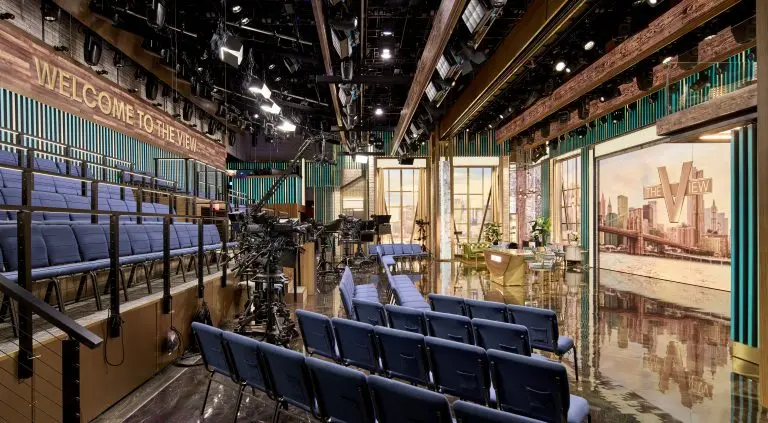
Concurrently, daytime programming on ABC faced intense political blowback. Co-hosts of the long-running talk show The View drew the direct ire of the White House after launching sharp criticisms against government officials who visited the "Alligator Alcatraz" ICE detention facility in Florida. Furthermore, the program’s hosts publicly questioned the executive branch’s reach, arguing that President Trump was overstepping his constitutional authority by proceeding with the construction of a new White House ballroom.
These segments did not go unnoticed by the administration. In a striking escalation of political messaging, the White House established a dedicated "media offenders" webpage specifically spotlighting the co-hosts of The View for their commentary on immigration policy and executive branch expenditures.
The FCC’s April Directive: Early License Renewals
Against this backdrop of heightened political animus, the FCC issued a sweeping directive in late April. The order commanded eight ABC-owned and operated television stations to file early broadcast license renewals. Under standard regulatory schedules, these licenses were not slated for renewal until sometime in 2028. However, the FCC’s new order accelerated this deadline to May 28, 2026.
The directive impacted vital O&O stations situated in some of the nation’s most lucrative and influential media markets, including:
- New York (WABC-TV)
- Los Angeles (KABC-TV)
- Chicago (WLS-TV)
- Philadelphia (WPVI-TV)
- Houston (KTRK-TV)
- San Francisco (KGO-TV)
- Raleigh-Durham (WTVD)
- Fresno (KFSG)
In its initial announcement, the FCC stated that the expedited renewals were necessary as the stations were under active investigation for possible violations of the 1934 Communications Act and the "agency’s prohibition on lawful discrimination." Behind the scenes, sources reported that the inquiry was ostensibly linked to a sprawling federal investigation into Disney’s internal corporate DEI practices. However, media watchdogs and legal experts immediately questioned the timing, noting the uncanny synchronization between the FCC’s actions and the administration’s public grievances regarding ABC’s editorial output.
The Legal Fallout: ABC Files in D.C. District Court
Faced with what it characterizes as an existential threat to its journalistic independence, ABC exhausted its preliminary administrative pathways and turned to the federal judiciary. On Tuesday, the network filed its landmark lawsuit in the U.S. District Court for the District of Columbia.
In its legal complaint, ABC pulled no punches, declaring that "government censorship is deeply un-American." The network argued that the FCC’s demand for early license renewal applications was not rooted in legitimate administrative oversight, but rather served a punitive purpose. ABC asserted that the commission intends either to hold predetermined hearings to deny the license applications outright or to subject the network to years of exhausting, onerous litigation and regulatory uncertainty—effectively achieving the same chilling effect on protected speech.
Supporting Context & Metrics: The Chilling Effect on Free Speech
The core of ABC’s legal argument relies heavily on the doctrine of the "chilling effect"—the phenomenon where individuals or institutions self-censor out of fear of government reprisal. In its court filing, the network provided concrete examples of how the FCC’s regulatory pressure has already altered its operational and editorial decisions.
Self-Censorship in Political Coverage
Most alarmingly, ABC disclosed that the looming threat of non-renewal has forced the network to fundamentally alter its booking and editorial strategies for political programming. Specifically, the network admitted that since the FCC’s investigations and early renewal mandates began, producers of The View have intentionally refrained from featuring any political candidates on the program.
The network explained that it can no longer invite candidates without first conducting an exhaustive risk assessment of the potential consequences. This evaluation includes weighing whether hosting a specific candidate might provoke further retaliatory scrutiny from the commission, potentially cited as a pretext for denying the renewal of essential broadcast licenses during the impending proceedings. This self-imposed restriction strikes at the heart of public discourse, depriving viewers of diverse political perspectives during election cycles simply because a broadcaster fears the wrath of a federal regulatory agency.
Regulatory Metrics and Precedent
The relationship between the FCC and broadcast licensees is governed by the public interest standard enshrined in the Communications Act of 1934. Historically, broadcast licenses are granted for fixed terms—traditionally eight years—during which stations operate with a presumption of renewal, provided they have served the public interest without major statutory violations.
Accelerating renewals by two years for an entire cohort of major-market O&O stations is an extraordinarily rare regulatory maneuver. Standard FCC enforcement actions involving license scrutiny typically follow documented technical violations, severe indecency infractions, or adjudicated antitrust breaches. Deploying the licensing apparatus in response to corporate DEI policies or editorial commentary represents a radical departure from historical regulatory norms, prompting widespread concern across the legal and journalistic communities.
Furthermore, the financial and operational stakes quantified in the lawsuit are immense. ABC’s O&O stations reach tens of millions of households across major metropolitan areas, generating substantial advertising revenue and serving as primary conduits for local news, emergency broadcasting, and syndicated entertainment. Threatening the operational viability of these stations places billions of dollars in corporate assets at risk, creating a powerful economic lever for government coercion.
Official Statements and Legal Arguments
The public discourse surrounding the lawsuit has been characterized by starkly contrasting narratives, with ABC framing the battle as a defense of constitutional liberties and the FCC countering that the network is attempting to evade accountability for unlawful corporate practices.
ABC’s Legal Position
In its federal complaint, ABC’s legal counsel emphasized the foundational role of the First Amendment in American democracy, arguing that the government cannot use the licensing power of the public airwaves to punish media organizations for unfavorable coverage.
"Government censorship is deeply un-American," the lawsuit states. "The FCC’s demand for early renewal applications reveals its intent to either hold a hearing to deny the applications or simply to subject Plaintiffs to months—and likely years—of onerous litigation and regulatory uncertainty. Either way, the agency succeeds at continuing to punish Plaintiffs for editorial decisions and news coverage of the Donald Trump administration it does not like."
ABC further articulated that judicial intervention is the only remaining remedy to halt what it describes as an "extraordinary assault on free speech." The network maintains that allowing the FCC’s actions to stand unchecked would establish a dangerous precedent, granting federal regulators unchecked power to intimidate any broadcast licensee that dares to question executive power or broadcast critical commentary.
The FCC’s Counter-Response
In a sharp and unyielding counter-statement released shortly after the lawsuit was filed, the FCC defended its actions and launched a blistering attack against ABC’s parent company, Disney.
The commission asserted that Disney is "obviously very concerned" over the ongoing federal investigation into the media conglomerate’s alleged illegal DEI discrimination practices. According to the FCC, this corporate anxiety is the true driving force behind what the agency labeled an "ongoing campaign of disinformation as well as their decision to ask a court to stop the FCC from further pursuing matters."
The FCC maintains that its regulatory inquiries are entirely separate from editorial content, asserting that the agency has a statutory duty to investigate potential violations of federal law and civil rights prohibitions, regardless of the corporate entity involved. By framing the lawsuit as a diversionary tactic by a media giant attempting to shield itself from civil rights and employment investigations, the commission seeks to legitimize its procedural oversight.
Future Outlook: Implications for Media, Law, and Politics
As this high-profile legal battle moves to the U.S. District Court for the District of Columbia, the ramifications of the case extend far beyond the corporate boardrooms of Disney and the offices of the federal government. The litigation promises to shape the legal landscape of media regulation and constitutional law for years to come.
Key Legal Questions for the Courts
Federal judges will be forced to untangle complex questions at the intersection of administrative law and constitutional rights:
- Motivatory Intent: Can a plaintiff successfully enjoin an administrative agency by proving that facially neutral regulatory actions (such as early license renewals) were actually motivated by unconstitutional viewpoint discrimination and political retaliation?
- The Boundaries of Regulatory Discretion: To what extent can the FCC utilize its broad oversight powers under the Communications Act when concurrent political friction exists between the regulated entity and the sitting administration?
- Standing and Ripeness: Will the court rule that ABC’s claims are ripe for judicial review at this stage, or will the judiciary require the network to exhaust the administrative renewal hearings before intervening?
Broader Implications for Journalism
For the broader media industry, the lawsuit serves as a critical test case. In an era of intense political polarization, the relationship between government regulators and news organizations has grown increasingly fraught. If the courts permit the FCC’s early renewal mandate to proceed under the current circumstances, media executives warn that a chilling effect could settle over broadcast networks nationwide. Broadcasters might increasingly shy away from aggressive investigative journalism, political satire, and critical commentary regarding executive branch policies to protect their multi-million-dollar broadcast licenses.
Conversely, if the federal court rules in favor of ABC, it could establish a robust judicial shield protecting media organizations from executive overreach and administrative weaponization, reaffirming the absolute primacy of the First Amendment over regulatory intimidation.
As the litigation unfolds in Washington, D.C., media analysts, legal scholars, and industry leaders will be watching closely. The ultimate resolution of ABC v. FCC will not only determine the fate of eight major-market television stations, but will also help define the boundaries of press freedom and government accountability in modern American democracy.