

Executive Overview
In the contemporary landscape of Hollywood celebrity culture, where personal brands are meticulously manicured and every career move is calculated for maximum commercial yield, Oscar-nominee Andrew Garfield continues to carve out a refreshingly idiosyncratic path. Best known for his emotionally charged, high-stakes dramatic performances in films like The Social Network, Tick, Tick… Boom!, and Hacksaw Ridge, the 42-year-old actor has recently pulled back the curtain on a side project that defies conventional Hollywood vanity.
During an exclusive interview with E! News correspondent Will Marfuggi, Garfield revealed that he is leading a clandestine band dedicated entirely to performing covers of songs from the 1976 classic musical Bugsy Malone. Dubbed The Shangles—a self-described collective of middle-aged men reimagining gangster-themed children’s gangster musicals—the endeavor is decidedly uncommercial. According to Garfield, it is a pure, unadulterated passion project driven by camaraderie and a desire to play music without the suffocating pressures of the modern entertainment machine.
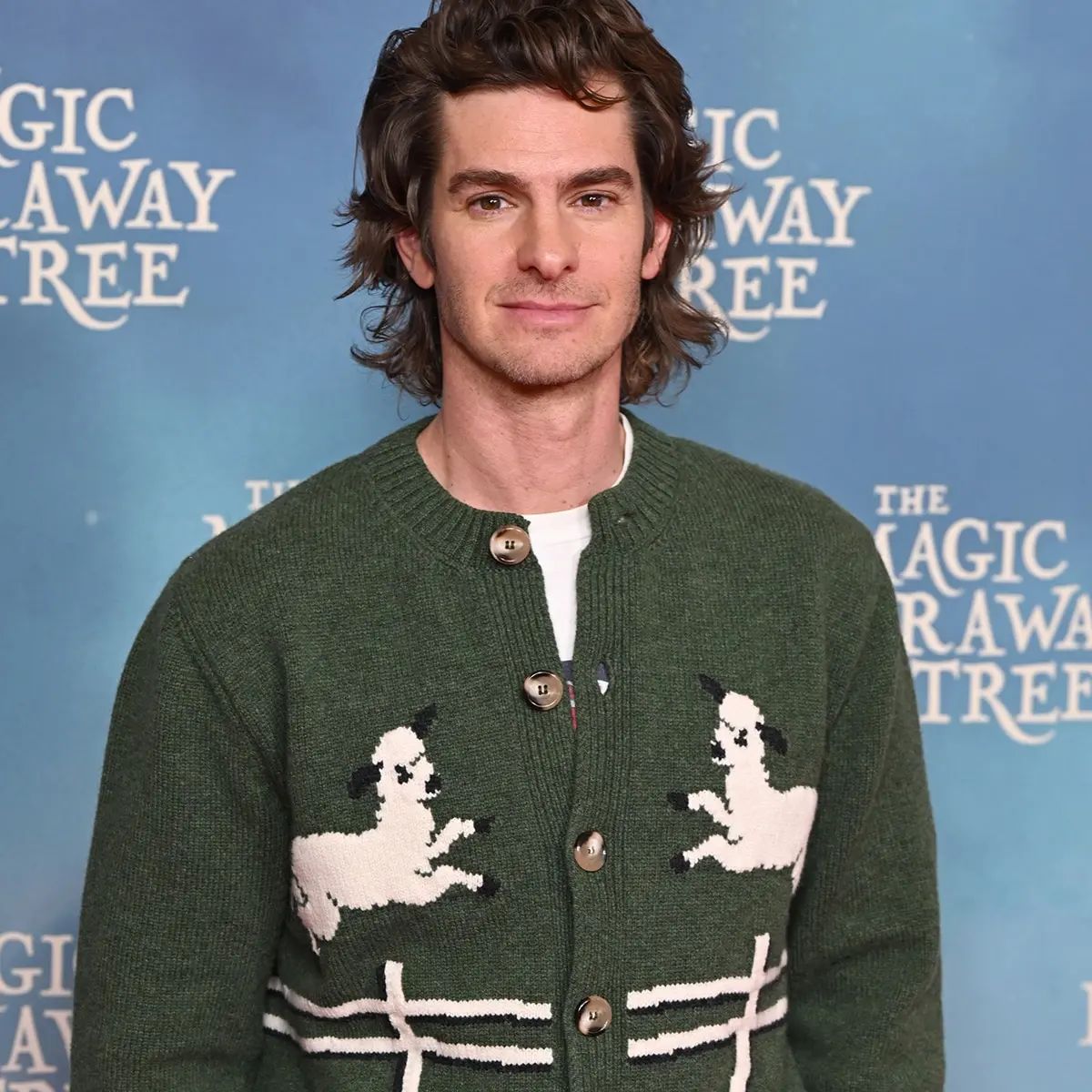
This craving for unscripted joy and playful escapism seamlessly mirrors Garfield’s motivation for joining his latest silver-screen project, The Magic Faraway Tree, scheduled to hit theaters on August 21. Starring alongside Claire Foy and Nicola Coughlan, Garfield has embraced a role that allows him to step away from the hyper-digitalized, attention-economy landscape of the 21st century. In an age where smartphone screens and algorithms dominate human consciousness, Garfield’s recent artistic choices—both musical and cinematic—serve as a manifesto for creative liberation, urging both himself and his audience to log off, look at the tree bark, and remember how to play.
Detailed Chronology: From Broadway Melodies to Underground Gangster Parodies
Garfield’s journey into unexpected musical territories is not entirely out of left field, though the specific execution of The Shangles certainly stretches the boundaries of conventional celebrity side projects. To understand the genesis of this middle-aged musical collective, one must trace the trajectory of Garfield’s vocal and theatrical evolution over the past several years.
The Musical Awakening: Tick, Tick… Boom! (2021)
For years, Garfield’s public-facing persona was strictly rooted in dramatic theater and blockbuster action cinema. However, the paradigm shifted dramatically in 2021 when he took on the role of the late, visionary musical theater composer Jonathan Larson in Lin-Manuel Miranda’s directorial debut, Tick, Tick… Boom!.
To prepare for the demanding role, Garfield—who had never sung professionally in a musical capacity—underwent intensive vocal training. His raw, kinetic, and emotionally resonant performance earned him widespread critical acclaim and a second Academy Award nomination for Best Actor. More importantly, the grueling yet transformative process unlocked a latent passion for music that extended far beyond the soundstages of Netflix.
The Birth of The Shangles
While Tick, Tick… Boom! showcased Garfield’s capability to handle Broadway-caliber belting, it appears to have laid the psychological groundwork for lower-stakes, high-fun musical exploration. Enter The Shangles.
Formed in relative obscurity, the band represents the antithesis of the stadium-tour vanity projects frequently launched by aging film stars. Instead of releasing original pop-rock singles designed for streaming optimization, Garfield and his compatriots chose Alan Parker’s 1976 cult classic musical Bugsy Malone—a gangster comedy uniquely performed entirely by a child cast wielding custard pies instead of tommy guns.
"I do have a band, we do Bugsy Malone covers," Garfield revealed exclusively to E! News. "Look out for The Shangles. Look out for a group of middle-aged guys doing Bugsy Malone covers."
Navigating the Future of the Band
Despite possessing grand ambitions, Garfield remains tight-lipped about the exact trajectory of The Shangles. When probed by Marfuggi about whether fans can expect a sudden tour or an album drop, the actor maintained a superstitious caution, noting that the group is still testing the waters.
"We have some plans. We have some big plans," he mused, before quickly checking himself. "But I can’t really say it until it’s official—I don’t want to jinx it."
Crucially, Garfield emphasized that financial profit or chart dominance plays zero role in the band’s existence. "We aren’t in it for any kind of commercial kind of success," he explained. "It’s more of a passion project."
Supporting Context & Metrics: Escaping the Digital Panopticon
To fully contextualize Andrew Garfield’s pivot toward whimsical musical covers and nostalgic fantasy cinema, one must examine the broader cultural moment in which these projects exist. Modern Hollywood operates within an increasingly consolidated ecosystem driven by metrics, algorithmic content delivery, and audience fragmentation. Yet, paradoxically, the human beings working inside this machine are experiencing acute digital fatigue.
The Attention Economy and Digital Saturation
Garfield’s commentary during the press junket for The Magic Faraway Tree touched upon a profound sociological reality: the erosion of human attention spans and the commodification of leisure time by technological behemoths.
"We’ve all been so captured and taken over by these amazing technological developments in our culture and our society right now," Garfield observed. "They do suck a lot of our time away from us."
This sentiment is backed by extensive cultural metrics. According to data from digital analytics firms such as DataReportal and Nielsen, the average adult in developed nations spends upwards of six to seven hours a day interacting with digital screens, social media platforms, and streaming applications. This perpetual connectivity has given rise to widespread cultural phenomena like "brain rot," digital burnout, and an epidemic of loneliness.
The Antidote: Tactile Reality and Fantasy Fulfillment
For Garfield, countering this hyper-connected exhaustion requires a conscious return to tactile, physical experiences—themes that heavily influenced his decision to board The Magic Faraway Tree, an adaptation of Enid Blyton’s beloved children’s fantasy series.
"A big part of the draw of doing the film is that it was an opportunity to play and be silly and not take things seriously," he shared. "It’s like fantasy fulfillment."
The actor elaborated on how the script rewired his daily perspective, instilling a renewed appreciation for the natural world over the virtual one:
"I need this essence in my life. I need more excuse to go into woods and to look at the tree bark and the ants crawling up the tree, and to get lost in the magnificence of nature and the magic of it."
By aligning his career choices with projects that demand playfulness—whether singing vintage children’s gangster songs with middle-aged friends or wandering through mythical forests on screen—Garfield is effectively practicing a form of professional self-care.
Official Statements & Industry Reactions
The revelation of The Shangles and Garfield’s philosophical approach to his craft have generated significant chatter across entertainment media and social platforms. Industry insiders and fellow creatives have responded warmly to the actor’s unabashed embrace of unpolished joy.
The E! News Exclusive
The initial disclosure, captured on camera by E! News journalist Will Marfuggi, highlighted Garfield’s self-deprecating humor. By labeling his band as "a group of middle-aged guys," Garfield actively deflates the pristine, untouchable image often cultivated by A-list movie stars.
Entertainment analysts point out that this authenticity is precisely what cements Garfield’s enduring popularity. In an era where audiences frequently reject inauthentic PR training, Garfield’s willingness to discuss bizarre, low-stakes hobbies like Bugsy Malone cover bands humanizes him, bridging the gap between icon and everyday music fan.
The Ensemble of The Magic Faraway Tree
Garfield’s co-stars in The Magic Faraway Tree—a high-profile fantasy adaptation boasting a powerhouse British cast including Claire Foy and Nicola Coughlan—have similarly echoed sentiments regarding the healing power of imaginative storytelling. While the film industry often prioritizes grim, gritty reboots and dark prestige television, this ensemble project aims to restore whimsical, family-friendly wonder to the cinematic marketplace when it opens on August 21.
Future Outlook: A Slate of Blockbusters and Passion Projects
As the entertainment calendar rolls toward the latter half of 2026, Andrew Garfield’s career trajectory sits at a fascinating intersection of massive commercial cinema and eccentric personal endeavors. While The Magic Faraway Tree promises to deliver fantastical escapism this August, the broader theatrical landscape is bracing for an unprecedented wave of high-profile releases.
The 2026 Theatrical Landscape
The late-summer and autumn box office is stacked with heavy hitters that span every conceivable genre. From nostalgic franchise revivals like Focker-In-Law (starring Ben Stiller, Robert De Niro, and Ariana Grande) and Jumanji: Open World, to massive sci-fi epics like Ridley Scott’s The Dog Stars and the culmination of Denis Villeneuve’s monumental trilogy with Dune: Part Three, audiences are spoiled for choice.
Furthermore, literary adaptations and dark thrillers are dominating the autumn slate. Colleen Hoover’s psychological thriller Verity (starring Anne Hathaway and Dakota Johnson) and Aaron Sorkin’s corporate exposé The Social Reckoning (starring Jeremy Strong and Jeremy Allen White) promise intense dramatic engagement.
Where Does Garfield and The Shangles Fit In?
Amid this corporate-backed cinematic onslaught, the humble existence of The Shangles stands out as a defiant act of artistic freedom. Whether or not the band ever steps out of the rehearsal room to grace an actual stage remains to be seen. However, the mere fact that an Academy Award nominee spends his downtime shouting 1970s gangster-musical lyrics with his peers proves that Garfield remains grounded in the simple, joyful mechanics of play.
As fans await official word on whether The Shangles’ "big plans" materialize into a public performance, the underlying message from Andrew Garfield remains clear: art does not always need to be monetized, optimized, or algorithmically targeted to be valuable. Sometimes, the best projects are the ones born out of pure friendship, silly nostalgia, and a shared love for the absurd.