For the past several years, the global technology sector has operated under a monolithic, unquestioned assumption: that humanity’s greatest aspiration is to infuse every waking moment, workflow, and consumer product with artificial intelligence. Tech giants, venture capitalists, and corporate boardrooms alike have championed a relentless march toward "AI-first" futures, treating the mere inclusion of the acronym as an automatic value proposition.
Yet, a profound disconnect has emerged between executive suites and the realities of daily life. Beneath the glossy marketing campaigns and trillion-dollar market valuations lies a quiet, growing resistance. The truth is stark: most people do not want more AI—at least not in the intrusive, disruptive, and poorly thought-out manner envisioned by industry leaders.
Empirical data reflects this hesitation. Across industries, high-cost AI features suffer from notoriously low adoption rates and poor user retention. Far from revolutionizing work for the better, poorly implemented generative models often intensify workloads, introducing complex layers of error-checking, hallucination management, and fragmented system-hopping. Rather than sparking unbridled excitement, the uninvited proliferation of AI frequently triggers anxiety, change resistance, and a deep-seated fear of technological displacement.
This investigative piece explores why the current "AI-first" paradigm is missing the mark, what users actually require from modern software, and why the future of technology belongs not to invasive automation, but to the quiet, supportive principles of "AI-second" design.
Detailed Chronology: The Rise of the "AI-First" Delusion
The Genesis of the Mandate (2022–2023)
The modern generative AI boom, catalyzed by the widespread availability of advanced large language models, created an unprecedented panic across the corporate landscape. Fearing obsolescence, companies rushed to retrofit legacy systems with generative capabilities. Product roadmaps were rewritten overnight. Corporate strategy shifted from solving specific human problems to a frantic race of checkbox integration: How do we add an AI chatbot here? How do we embed a machine learning copilot there?
During this initial phase, velocity eclipsed utility. Leadership teams assumed that because generative models possessed astonishing raw capabilities, users would naturally invent ways to incorporate them into their daily routines. "Powered by AI" was treated as a self-explanatory endorsement of excellence, bypassing the rigorous foundational product discovery processes that traditional software development required.
The Integration Backlash and Reality Check (2024–2025)
As the dust settled, the initial euphoria gave way to operational fatigue. Organizations discovered that bolting AI onto fragmented architectures did not fix systemic organizational issues. Instead, it exposed them.
Data quality deficiencies, political silos, and years of technical debt were suddenly amplified. Because AI tools were introduced as separate, disjointed applications, workers found themselves leaping between an even greater number of fragmented systems. Instead of reducing workloads, enterprise AI tools frequently generated more administrative friction—forcing employees to spend valuable hours verifying outputs, correcting subtle hallucinations, and dealing with what corporate analysts began labeling "AI slop."
Simultaneously, consumer markets began pushing back against forced automation. From automated customer service hurdles that trap users in endless loops to uninspired AI-generated media, the public started expressing fatigue toward technology that felt manufactured, distant, and stripped of genuine human touch.
Supporting Context & Metrics: The Human and Economic Toll
The friction of the current AI wave is not merely anecdotal; it is heavily documented by productivity studies and workforce analytics.
The Productivity Paradox
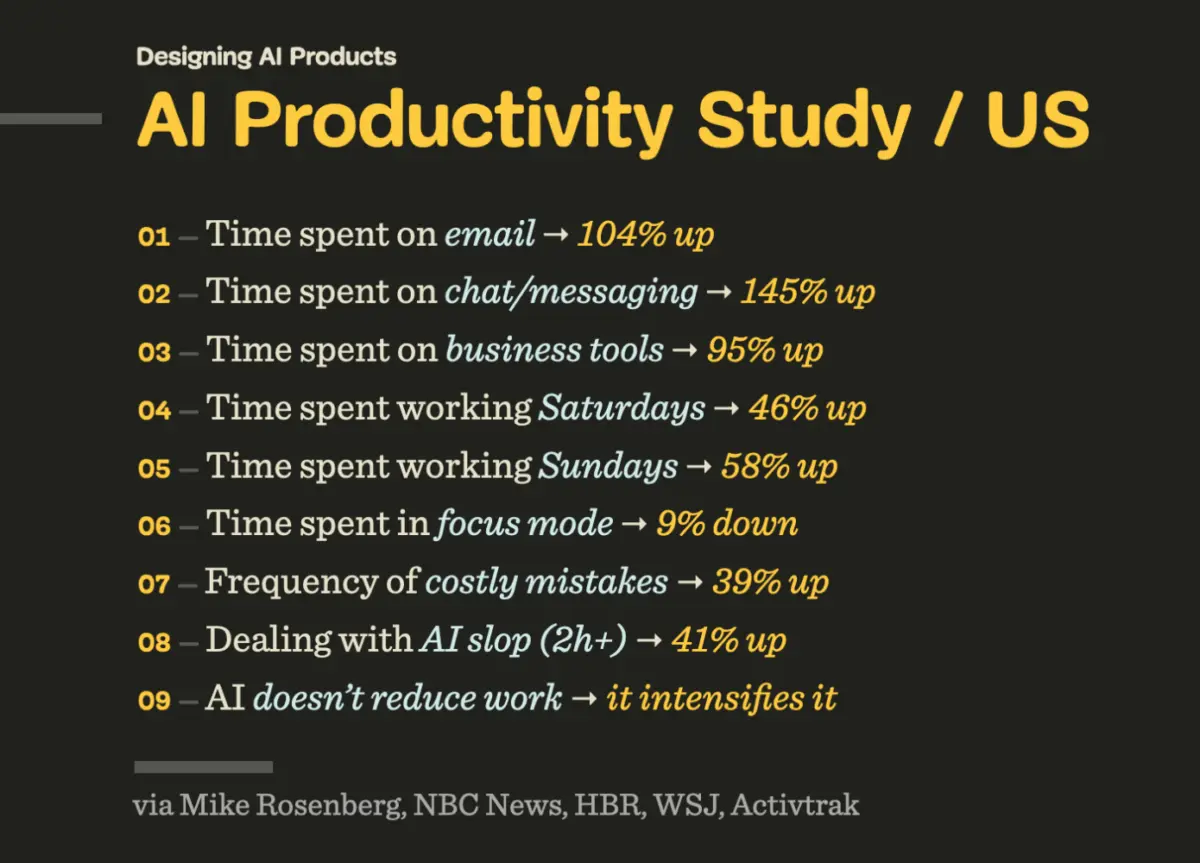
Recent multi-industry workplace analyses—drawing on data from platforms like ActivTrak, alongside reporting from major business publications—illustrate a sobering trend: AI does not reduce work; it intensifies it.
Key metrics from recent US productivity studies reveal a paradoxical strain on the modern workforce:
Email time: Up 104% as professionals manage heavier correspondence volumes generated by automated workflows.
Chat and messaging: Up 145%.
Business tools utilization: Up 95%.
Weekend burnout: Working Saturdays has increased by 46%, and Sundays by 58%.
Focus mode: Down 9%, crushed by constant context-switching.
Error management: Costly mistakes and the time spent dealing with "AI slop" have climbed by 39% and 41% respectively.
The Value Proposition Fallacy
As business strategist David Bland illustrates in his seminal work on the Business Model Canvas, artificial intelligence does not belong in the "Value Propositions" box. AI is a tool of execution—it belongs squarely within Key Activities and Key Resources.
When companies attempt to sell AI as the value proposition itself ("Buy our product because it has AI"), they fundamentally misunderstand consumer psychology. People do not compare software to abstract technological milestones; they compare feature to feature. If a traditional, deterministic feature works reliably every single time, while an AI-powered alternative introduces unpredictability and hallucinations, the user will reject the AI variant without hesitation.
Official Statements and Expert Perspectives
The pushback against hyper-aggressive AI adoption is finding a voice among prominent technologists, designers, and organizational thinkers who advocate for a more measured, human-centric approach.
"I don’t want to read books written by AI. I don’t want to gaze upon paintings by AI. I don’t want AI to teach my children. I don’t want to have an AI therapist. I don’t want AI making my medical decisions. I want AI to do all the physical and mental labor that taxes me so I can read books written by humans and go to art galleries to engage with art made by humans. I want AI that makes my life easier rather than forces me to change myself."
— Bo Young Lee, Enterprise Inclusion and Leadership Strategist
Lee’s sentiment captures the core dichotomy of modern technological anxiety. Humanity does not crave synthetic companionship, robotic art, or automated decision-making engines that encroach upon sacred interpersonal domains. People want relief from drudgery, not an artificial replacement for human culture.
UX design authority Vitaly Friedman echoes this sentiment through the lens of interface architecture. In his ongoing pedagogical work on designing intuitive software, Friedman emphasizes that technology must align with established human mental models rather than forcing users to adapt to erratic machine workflows:
"People don’t change much. And after all these years, they still want features that are fast, accessible, reliable, predictable, and useful—every single time. Ideally, not the ones that replace their entire workflow, but that augment their way of working, taking over the most mundane, annoying, and boring tasks that they find no pleasure in."
What People Actually Need: The Rise of "AI-Second" Design
To build sustainable, high-adoption technology, product creators must pivot away from the frantic pursuit of "AI-first" marketing and embrace a philosophy of "AI-second" design.
1. Focus on Burden Reduction, Not Workflow Replacement
Automation succeeds when it eliminates tasks that humans fundamentally despise—data entry formatting, routine scheduling checks, and repetitive sorting. It fails when it attempts to replace creative intuition, strategic judgment, and emotional nuance.
Jobs heavily exposed to automation—such as software development, public relations, and administrative coordination—still retain core components that require human taste and perspective. By absorbing the tedious, mentally exhausting overhead of these professions while leaving the creative core untouched, AI can genuinely enhance job satisfaction.
2. Ambient, Humble, and Calm Integration
The most successful technological interventions are often the least obtrusive. Users do not yearn to speak continuously into a magical chat box or manage a chaotic "swarm" of autonomous agent programs roaming through their financial accounts.
Instead, they need ambient, humble tools that operate quietly in the background. Whether a feature relies on machine learning or deterministic algorithms matters little to the end-user; what matters is that it functions predictably, respects their existing workflows, and requires zero emotional or cognitive overhead to manage.
Future Outlook: Reclaiming the Human Element
As we look toward the horizon of software development and digital product design, the industry stands at a critical crossroads. Continuing down the path of unbridled, feature-stuffing AI risks deepening user fatigue, driving up support liabilities, and eroding customer trust.
The antidote to this fatigue is a return to empathetic design. By acknowledging that people ultimately value human connection, predictable reliability, and mental peace over technological novelty, developers can build tools that serve humanity rather than subjugate it.
The ultimate goal of artificial intelligence should never be to turn humans into managers of machines. It should be to shoulder the heavy, unrewarding burdens of daily labor—giving us back the time, energy, and headspace required to do what we have always loved best: spend time with one another.