


In the realm of digital user experience (UX) research, a long-standing oversight has quietly persisted: the underrepresentation of individuals with cognitive disabilities. While accessibility testing has historically prioritized visual, auditory, and motor impairments, cognitive accessibility—which encompasses memory, focus, processing speed, and learning—frequently takes a back seat.
To challenge this paradigm, a groundbreaking exploratory user research study was conducted in the summer of 2024. Spearheaded by a working group of expert researchers and led by Fable’s VP of Innovation, the study sought to determine whether participants with cognitive disabilities uncover deeper, more abundant usability insights than general population (gen pop) participants.
The findings were definitive. Across three distinct, AI-generated test websites, participants with cognitive disabilities identified 1.8 times more usability issues and offered 1.8 times more actionable suggestions than their general population counterparts. This comprehensive study reveals that incorporating cognitive inclusion into UX methodologies is not merely an ethical imperative for digital accessibility, but a powerful catalyst for uncovering cognitive load bottlenecks that ultimately degrade the digital experience for everyone.
Detailed Chronology: From Pilot Study to Empirical Validation
The journey toward validating cognitive usability insights began with a structured framework designed to establish best practices for working directly with neurodivergent testers and individuals facing cognitive challenges.
Phase 1: Establishing the Framework (Summer 2024)
As the co-chair of an expert accessibility working group at Fable, the initiative kicked off with four core goals: identifying recruitment strategies, fine-tuning interview techniques, developing quantitative survey tools, and documenting foundational insights.
To recruit effectively, the team built a specialized screener targeting individuals who self-identified as having challenges with memory, focus, and learning. After a comprehensive review of existing literature on cognitive testing, the team executed a pilot study with 25 initial testers. Iterative refinement led to the creation of robust interview guides and the integration of the Accessible Usability Scale (AUS)—a free, Creative Commons-licensed 10-question survey designed to quantify digital product experiences.
Phase 2: Designing the Cognitive Usability Study
Following the pilot, the team formed a partnership with the University of California, Irvine, collaborating with Syed Fatiul Huq and Fable researchers Pranav Pidathala, Ali Brown, and Michael Fagan. The objective was to test the hypothesis that cognitive testers unearth significantly more usability insights than general population users.
Using an AI prototyping tool, the researchers generated three websites with entirely different goals, designs, and task structures:
- Strong Snacks: A minimalist, brutalist, high-protein recipe site focused on category filtering and newsletter sign-ups.
- Turning Pages: A moody, content-dense digital bookstore featuring complex features like a book-matching swiping tool, multi-layered genre filters, and a shopping cart workflow.
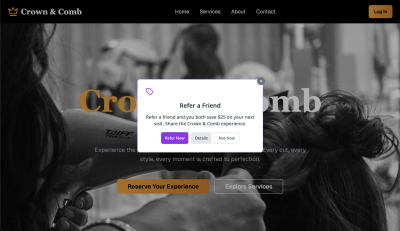
- Crown & Comb: A high-end salon website characterized by a bold, clean black-and-white aesthetic, designed intentionally with high friction points, particularly in booking complex bridal packages.
Phase 3: Execution and Data Collection
Using a uniform screener focusing on memory, focus, and learning, 30 user interviews were conducted (10 per website), perfectly split between 15 cognitive participants and 15 general population participants. Each participant tackled a complete set of tasks for one website during a moderated online session. Following the interviews, every participant completed the AUS survey.
Data analysis involved meticulously reviewing recordings and transcripts to log every question, confusion point, missed task requirement, and explicit design suggestion. To maintain absolute methodological consistency, a single evaluator coded all issues and suggestions.
Supporting Context & Metrics
Cognitive disability is an expansive umbrella term covering any condition that affects how individuals process information, typically impacting memory, concentration, and learning. According to the Centers for Disease Control and Prevention (CDC), cognitive disabilities represent the most prevalent disability category in the United States, affecting roughly 13.9% of the population, with recent studies from Yale pointing toward a rapidly growing demographic.
Furthermore, demographic shifts guarantee that cognitive challenges will only become more universal. The U.S. Census Bureau projects that the percentage of Americans aged 65 and older will jump from 17% to 25% by 2060. As the population ages, cognitive load management will transition from a niche accessibility consideration to a mainstream design requirement.

Quantitative Breakdown: Website Performance and AUS Scores
The empirical data gathered across the three sites highlights a stark contrast in how cognitive versus general population groups interact with digital interfaces.
- Strong Snacks (Simple Design): As the most straightforward site, it yielded the lowest overall issues and highest median AUS scores. However, cognitive participants still flagged an average of 3.4 more issues and made 2.2 more suggestions, scoring the overall experience 13.7 points lower than gen pop participants.
- Turning Pages (Complex Functionality): Boasting the highest functional density and four distinct tasks, this site generated the maximum overall issues. Cognitive participants found 6 more issues and made 3.2 more suggestions on average, rating the experience 17.2 points lower than the gen pop cohort.
- Crown & Comb (Intentional Friction): Designed to test extreme complexity—particularly Task 3 (finding a bridal package)—this site provoked an unexpected twist. Cognitive participants found 7 more issues on average, yet rated the overall experience 14.3 points higher than general population participants. Qualitative analysis suggests that general population users experienced acute frustration and disengagement, whereas cognitive participants encountered systemic barriers that deeply drained their mental energy.
Summary Table: Issue Volume by Category
| Issue Category | Strong Snacks (Gen Pop) | Strong Snacks (Cognitive) | Turning Pages (Gen Pop) | Turning Pages (Cognitive) | Crown & Comb (Gen Pop) | Crown & Comb (Cognitive) |
|---|---|---|---|---|---|---|
| Content | 11 | 22 | 11 | 30 | 23 | 36 |
| Navigation | 18 | 22 | 25 | 17 | 2 | 7 |
| Buttons & Links | 0 | 5 | 7 | 20 | 3 | 0 |
| Icons / Visual Elements | 3 | 16 | 2 | 3 | 4 | 23 |
| Media (Video/Anim.) | 0 | 2 | 0 | 1 | 0 | 0 |
Overall, participants with cognitive accessibility needs identified a staggering 197 usability issues compared to just 113 among general population participants, while contributing 93 design suggestions compared to 54.
Official Statements and Qualitative Insights
The qualitative differences in how participants described their friction points underscore the deep emotional and psychological toll of poor UX design.
A general population participant reviewing the frustrating booking process on Crown & Comb remarked:
"As soon as you have a name of a treatment and a little explanation and like the duration and the price, as soon as you click onto that, it should be that you can interact with that service straight away… This feels not particularly engaging."
In contrast, a cognitive participant reviewing the same interface articulated a far deeper systemic exhaustion:

"For example, like, the mental energy aspect of it… sometimes there’s, like, okay, cookies, and then ads, pop-ups, or maybe the website or service has too many options to look through… It makes me, like, feel drained and less able to focus."
Industry leaders have begun recognizing the disproportionate value of these findings. As noted by a UX Manager at Bell Media:
"2 sessions with cognitive users feel like 200 because of the volume of insights we get."
Rather than simply muddling through confusing layouts—as general population users often tend to do—cognitive participants illuminate the exact friction points where poor design transforms from a minor annoyance into an impenetrable accessibility barrier.
Future Outlook: The Strategic Necessity of Cognitive Inclusion
The implications of this research extend far beyond compliance or specialized accessibility audits. Designing for cognitive inclusion directly tackles core UX principles: reducing cognitive load, clarifying content hierarchy, and ensuring predictable interaction patterns.
When digital products are optimized for users with cognitive disabilities, the downstream beneficiaries include aging populations, multilingual users, individuals experiencing temporary stress or fatigue, and distracted mobile users. Neglecting cognitive inclusion risks alienating a rapidly growing demographic and hemorrhaging customer loyalty through high friction checkout and navigation flows.
As organizations look toward the future of inclusive design, cognitive accessibility should serve as the primary on-ramp into broader accessibility research. By mastering the fundamentals of clarity, predictability, and cognitive ease, UX teams build a resilient research foundation that makes subsequent work with screen readers, screen magnifiers, and alternative navigation tools remarkably more approachable.
Ultimately, cognitive inclusion in UX research is no longer optional. It is the definitive roadmap for building more efficient research practices, crafting simpler user journeys, and shipping superior digital products for everyone.