

Executive Overview
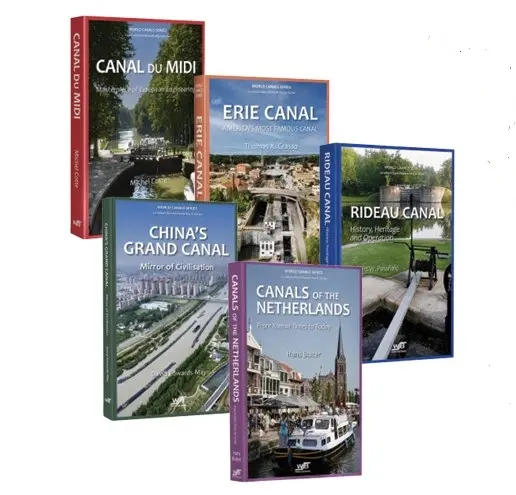
In an unprecedented cross-border publishing endeavor, Phoenix Science Press (China) and Waterway Books (UK) have jointly released a landmark seven-volume book series dedicated to the world’s most historically significant and technologically transformative inland waterways. Published simultaneously in English and Chinese, this authoritative collection offers an exhaustive re-examination of seven pivotal canal systems: France’s Canal du Midi, Canada’s Rideau Canal, the United States’ Erie Canal, the complex canal network of the Netherlands, China’s Grand Canal, Great Britain’s Grand Union Canal, and Belgium’s Canal du Centre.
Written by an international panel of leading historians, civil engineers, and waterway specialists, the series arrive at a moment of global renaissance for inland navigation. Once viewed primarily through the lens of industrial archaeology, artificial waterways are increasingly recognized by urban planners, environmental policymakers, and transport strategists as vital infrastructure for the twenty-first century.
The publication addresses a profound shift in global perspectives that accelerated following the 2014 designation of China’s Grand Canal as a UNESCO World Heritage site. That milestone ignited widespread international interest in the historical evolution, hydraulic mechanics, and economic legacies of artificial channels. Beyond their historical roles as engines of commerce and tools of statecraft, these waterways are being re-evaluated for their contemporary utility: as low-carbon freight corridors, civil engineering blueprints for water management amidst climate change, and vital blue-green urban spaces that foster ecological resilience and public well-being.
Sponsored by Phoenix Publishing and Media Inc., this multi-volume initiative represents one of the most comprehensive research and dual-language publishing projects ever undertaken in the domain of industrial heritage and civil engineering history.
Detailed Chronology: The Evolution of Global Waterway Engineering
To understand the scope of this new literary collection, one must examine the chronological milestones of canal construction across continents—a timeline marked by political ambition, groundbreaking technical innovations, and dramatic economic transformations.
+---------------------------------------------------------------------------------------------------+
|                                 HISTORICAL CANAL EVOLUTION                                        |
+-----------------------+-----------------------+-------------------------+-------------------------+
| 5th Century BCE - 1293|      1666 - 1681      |       1817 - 1825       |      1826 - 1832        |
|  China's Grand Canal  |     Canal du Midi     |       Erie Canal        |      Rideau Canal       |
| 3,200 km artificial   | 240 km engineering    | 584 km catalyst for US  | Geopolitical military   |
| navigation network.   | masterpiece in France.| economic expansion.     | bypass in North America.|
+-----------------------+-----------------------+-------------------------+-------------------------+
Antiquity to the Imperial Dynasties: The 2,500-Year Legacy of China’s Grand Canal
The timeline of large-scale canal construction begins in ancient China. As detailed by David Edwards-May in China’s Grand Canal: Mirror of Civilisation, the earliest sections of the Grand Canal trace back to the 5th century BCE during the Spring and Autumn period. However, it was during the Sui Dynasty (581–618 CE) that these disparate channels were synthesized into a unified national arterial network.
Stretching over 3,200 kilometers from Beijing in the north to Zhejiang province in the south, the Grand Canal stands as the longest artificial waterway in human history. For centuries, it functioned as the political and economic spine of Imperial China, facilitating the Caoyun (tribute grain transport system) that fed northern capitals and sustained vast standing armies. The canal’s construction required pioneering developments in hydraulic engineering, including early forms of pound locks invented by Chhai Qiao in 984 CE, centuries before similar technology appeared in Western Europe. The system remains a dynamic, living asset, continuously updated and extended southward as part of modern China’s national water transfer and logistics grid.
The Baroque Conquest of Geography: The Canal du Midi
In Europe, the modern era of canal construction was inaugurated in the late 17th century under the reign of King Louis XIV. In Canal Du Midi: Masterpiece of European Engineering, author Michel Cotte delivers a rigorous account of the political maneuvers and engineering genius behind the 240-kilometer channel connecting the Atlantic Ocean to the Mediterranean Sea.
Constructed between 1666 and 1681 under the visionary leadership of entrepreneur Pierre-Paul Riquet, the Canal du Midi solved a geographic puzzle that had defied the Roman Empire: crossing the Continental Divide of Southern France. Riquet’s masterstroke was the creation of a sophisticated feeder system anchored by the St. Ferréol reservoir—the largest artificial lake of its era. Inscribed as a UNESCO World Heritage site in 1996, the Canal du Midi established structural templates for artificial water supply, summit-level locks, and integrated landscape architecture that influenced European civil engineering for generations.
The Industrial Catalyst: The Erie Canal and North American Expansion
The 19th century witnessed the geopolitical deployment of canals as engines of nation-building, nowhere more visibly than in the United States. Published to coincide with the bicentennial era of the waterway’s construction and completion, Thomas X. Grasso’s Erie Canal: America’s Most Famous Canal charts the creation of the 584-kilometer waterway that reshaped the economic geography of North America.
Authorized in 1817 and completed in 1825, the Erie Canal pierced the Appalachian mountain barrier, linking the Atlantic seaboard at New York City directly to the Great Lakes basin. Built largely by self-taught engineers and immigrant laborers, the canal drastically reduced freight transportation costs between the Eastern seaboard and the Western frontier by over 90 percent. Grasso’s analysis emphasizes how the engineering solutions forged along the Mohawk Valley and the Niagara Escarpment catalyzed the rise of New York as the world’s preeminent financial metropolis and set off an epochal wave of American industrial growth.
European Industrial Backbone: Netherlands, Britain, and Belgium
Simultaneously, Western Europe was expanding its own networks to power the Industrial Revolution:
- The Netherlands: In Canals of the Netherlands, Hans Buiter traces the hydraulic evolution of a nation where canal building was an existential necessity for land reclamation, flood control, and trade. From Roman military channels to the modern polder networks and heavy-tonnage industrial arteries, Buiter documents the spatial planning and hydraulic mechanics of over a dozen vital Dutch canals.
- Great Britain: The Grand Union Canal volume examines the core of England’s narrowboat network, which linked London to the industrial Midlands, serving as the primary logistics artery for coal, iron, and manufactured goods during the height of the British Industrial Revolution.
- Belgium: The Canal du Centre volume explores Belgium’s industrial corridor, celebrated for its extraordinary hydraulic boat lifts—monumental late 19th-century engineering feats designed to bypass steep topography without consuming excessive water reserves.
Geopolitical Defense: The Rideau Canal
Completing the series’ historical sweep is the exploration of Canada’s Rideau Canal. Built between 1826 and 1832 in the wake of the War of 1812, this 202-kilometer waterway was engineered by Lieutenant-Colonel John By as a secure, strategic military supply route between Montreal and Kingston, bypassing the vulnerable St. Lawrence River border with the United States. Featuring slack-water navigation technology and massive stone masonry locks, it remains the oldest continuously operated canal system in North America.
Supporting Context & Metrics: Environmental, Technical, and Economic Dimensions
The new seven-volume series moves beyond narrative history to provide comparative technical data and economic metrics, emphasizing why these historic structures remain deeply relevant to contemporary infrastructure management.
Comparative Technical & Architectural Metrics
| Canal Network | Country | Total Length (km) | Key Historical Era | Primary Technical Innovation / Significance | UNESCO Status |
|---|---|---|---|---|---|
| Grand Canal | China | 3,200+ | 5th C. BCE – Present | First industrial-scale pound locks; imperial tribute logistics network | Inscribed 2014 |
| Canal du Midi | France | 240 | 1666–1681 | Complex summit-level supply reservoir (Bassin de St. Ferréol) | Inscribed 1996 |
| Erie Canal | United States | 584 | 1817–1825 | Longest continuous lock-and-channel system of the 19th-century Americas | National Heritage Area |
| Dutch Canals | Netherlands | Integrated National Grid | Roman Era – Modern | Dual-purpose infrastructure (polder drainage & deep-water transport) | Partial (Amsterdam Rings) |
| Rideau Canal | Canada | 202 | 1826–1832 | Pioneer of North American slack-water navigation & defensive masonry engineering | Inscribed 2007 |
| Grand Union Canal | Great Britain | 220 (Main line) | 1793–1930s | Narrow-gauge inland industrial logistics; multi-lock flight systems | Unlisted (Local Conservation) |
| Canal du Centre | Belgium | 21 | 1882–1917 | Historic hydraulic lift locks capable of overcoming severe elevation changes | Inscribed 1998 |
Environmental Impact and the Decarbonization Mandate
Modern transport planners are re-evaluating inland waterways as critical infrastructure for meeting global carbon-neutrality targets. The metrics surrounding modal transport efficiency strongly favor water-based freight:
FREIGHT EFFICIENCY COMPARISON
(Ton-Kilometers of Cargo Moved Per Liter of Fuel)

Inland Water Barges : [==================================================] ~250–400 t-km
Rail Freight        : [==============================                        ] ~150–200 t-km
Road Trucking       : [========                                              ] ~30–50 t-km
By shifting dry and liquid bulk freight from highway trucking to inland waterways, nations can achieve reductions in greenhouse gas emissions ranging between 60% and 80% per ton-kilometer, while significantly reducing road congestion and highway maintenance expenditures.
Socio-Urban Values and Public Health Economics
The series highlights the spatial evolution of canals from industrial conduits to urban ecological assets. Modern metropolitan centers are investing heavily in urban water-space remediation. Waterways serve as:
- Urban Heat Island Buffers: Linear water corridors reduce ambient summer temperatures in dense concrete environments by 1.5°C to 3.0°C.
- Linear Recreational Parks: Towpaths converted into non-motorized transport routes support urban cycling, walking, and eco-tourism.
- Mental Health Infrastructure: Exposure to managed blue-green urban spaces yields measurable reductions in urban stress indicators, creating significant public health cost savings.
Official Statements and Editorial Insights
The publication of this series represents a major achievement in cross-cultural academic collaboration. Leaders involved in the project emphasized both the historical depth and modern relevance of the books.
Reflecting on the overarching vision behind the dual-language project, Xu Hai, Editor-in-Chief of Phoenix Publishing and Media Inc., underscored the nuanced motivations behind global canal projects:
"How canals served the Industrial Revolution is a significant part of the story of the canals in England and Belgium, while geopolitical factors weighed heavily in the emergence of projects such as the Canal du Midi and the Rideau Canal.
This series provides new insights that show the many nuances of motivation in human enterprises, and between private profit and public good. This is perhaps the first time such a huge undertaking in compiling, writing, and production has been done in tandem for both Chinese and English editions. The plan is to expand the collection to include other famous canals that have played a role in shaping a country or region."
The editorial team emphasized that compiling these works required deep archival research across multiple languages, bridging the gap between Western civil engineering literature and Eastern historical scholarship. By offering identical text and high-resolution technical diagrams in both English and Chinese, the publishers aim to create a global baseline for future research in industrial heritage and spatial planning.
Future Outlook: Modern Revitalization and Series Expansion
The launch of these seven volumes marks the initial phase of a broader long-term initiative. As global infrastructure investments pivot toward sustainable development, the lessons embedded in historical canal systems offer key operational frameworks for contemporary engineers and urban planners.
Emerging Infrastructure Trends in Inland Waterways
- Multi-Purpose Canal Design: Modern canal projects are being engineered to simultaneously manage commercial navigation, inter-basin water transfers during droughts, flood control during extreme weather events, and renewable energy generation through inline micro-hydroelectric turbines and floating solar arrays.
- Autonomous and Zero-Emission Navigation: Navigational authorities across Europe and East Asia are testing autonomous electric barges designed to navigate narrow canal profiles, resurrecting historic urban waterways for quiet, zero-emission inner-city freight distribution.
- Heritage-Driven Urban Regeneration: Industrial waterfronts along canals like the Grand Union in London, the Erie in Upstate New York, and the Grand Canal in Jiangsu Province are becoming primary hubs for commercial, residential, and cultural redevelopment.
Planned Expansion of the Book Series
Following the commercial and academic rollout of the initial seven titles—available globally through waterwaybooks.com, inlandwaterwayinternational.org, and edwardsmay.eu—Phoenix Science Press and Waterway Books are preparing subsequent volumes.
Future installments will examine strategic international maritime corridors, such as the Suez and Panama Canals, alongside historic inland networks including Germany’s Kiel Canal, the Danube-Main-Danube canal system, and Greece’s Corinth Canal. Through this ongoing documentation, the series solidifies its role as the definitive modern record of humanity’s long-standing endeavor to reshape geography through artificial waterways.