

Executive Overview
In an era defined by hyper-accelerated digital cycles and fleeting internet moments, contemporary marketers face a perilous paradox: move at the speed of culture, or risk becoming obsolete. Yet, chasing every ephemeral trend, emerging platform, and viral conversation often leads to brand fragmentation. When a company tries to be everything to everyone across an endless landscape of social media currents, its core identity inevitably dilutes.
The central challenge facing modern brand stewardship is not participation, but discernment. How do marketing leaders separate passing digital fads from genuine, structural shifts in consumer behavior? More importantly, how do they engage with the new without abandoning the timeless DNA that built their equity in the first place?
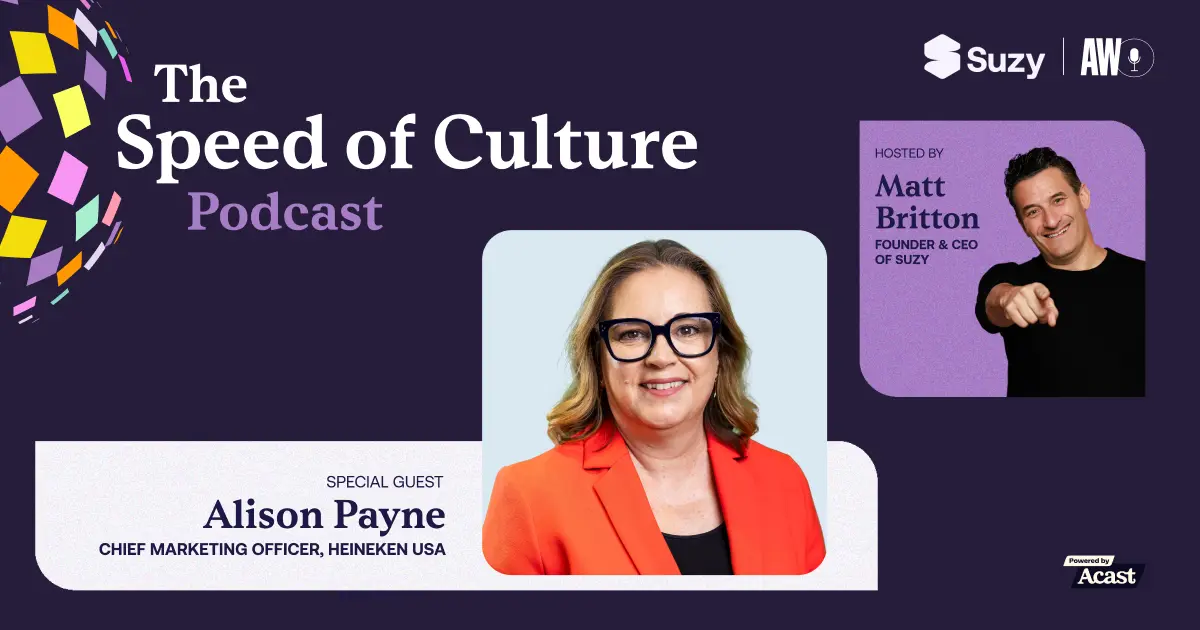
These vital questions take center stage in a recent episode of The Speed of Culture podcast, hosted by Matt Britton. Guest Alison Payne, Chief Marketing Officer of Heineken USA, steps into the spotlight to offer a masterclass in modern brand architecture. Overseeing a powerhouse portfolio that includes flagship Heineken and Dos Equis, Payne brings decades of cross-category experience—spanning iconic consumer brands like Guinness, Smirnoff, Lay’s, Doritos, and Special K—to the discussion.
Payne and Britton dissect the delicate balancing act required to honor a brand’s foundational purpose while innovating across experiential marketing, deeply rooted fandoms, artificial intelligence, and the booming non-alcoholic beverage category. For Heineken, that unchanging North Star is deceptively simple yet profoundly challenging to execute: the brand exists to make social moments better.
This deep-dive feature explores the core takeaways from their conversation, examining how disciplined strategy, rigorous creative protection, and an understanding of modern moderation are shaping the future of one of the world’s most recognizable beverage giants.
Detailed Chronology: Key Insights from the Conversation
1. Staying Relevant Without Losing the Brand ([00:38])
The temptation for legacy brands in a fast-moving media ecosystem is to pivot endlessly toward whatever is currently trending. Payne pushes back against this reactive approach, arguing that responding to culture should never be mistaken for chasing every shiny object.
Instead, Payne advocates for a disciplined filtering mechanism. When a new consumer behavior, digital platform, or cultural conversation emerges, marketing teams must ask a foundational question: Does this genuinely fit what the brand already stands for?
For Heineken, cultural relevance does not mean reinventing the brand’s identity for every new generation. Rather, it means evolving the occasions and places where socializing happens while fiercely protecting the underlying idea of bringing people together over good times. By anchoring innovation to core brand equity, a company can stay modern without suffering from identity whiplash.
2. Moving Beyond Badge Sponsorships to Holistic Consumer Journeys ([05:20])
For decades, experiential marketing was largely transactional—a brand bought logo placement at a stadium, slapped its name across a festival banner, and called it a day. Payne describes a radical shift away from this outdated "badge sponsorship" model toward end-to-end consumer journeys.
Taking premier cultural and sporting properties like Coachella and the US Open as examples, Payne details how Heineken maps out engagement across three distinct phases: before, during, and after the event.
- Before: Building anticipation and driving digital conversation leading up to the live experience.
- During: Delivering immersive, value-add activations on-site that enhance the consumer’s live experience rather than interrupting it.
- After: Extending the shelf life of the event through post-event social conversation, exclusive collectibles, and shared memories.
By treating experiential properties as continuous journeys rather than static billboards, marketers unlock significantly more touchpoints and narrative depth.
3. Fandom as an Engine for Social Connection ([10:59])
Heineken’s ongoing platform, "Fans Have More Friends," is built on a powerful human insight: shared passion acts as an immediate social lubricant, giving strangers an instant reason to connect.
During the podcast, Payne explains how fandom dissolves social barriers. Whether supporters are cheering for Arsenal at a packed local pub or rallying behind their national team during an international tournament, the collective emotional investment creates instant community.
For brands, the strategic takeaway is clear: the goal is not to awkwardly insert the product into the center of a fan community, but rather to facilitate and enrich the ways fans experience that connection together. When a brand empowers communities to bond over what they love, it becomes an welcomed facilitator of joy rather than an intrusive advertiser.
4. Navigating Artificial Intelligence: Acceleration vs. Authenticity ([15:08])
As generative AI transforms every corner of the corporate world, marketing departments are scrambling to integrate machine learning into their workflows. Heineken is no exception, but Payne draws a firm, unyielding line between acceleration and authenticity.
On the operational side, AI is proving invaluable for Heineken’s teams. It helps simulate creative concepts, test ideas rapidly with target consumer focus groups, synthesize massive datasets, and strip away burdensome administrative friction.
However, when it comes to consumer-facing execution, Payne maintains a strict boundary. For a brand built entirely around real-world human connection and genuine social experiences, manufacturing fake human moments via AI would be fundamentally hypocritical. Technology should be used to clear the path for human creativity, never to replace the raw, authentic interactions that define the brand’s soul.
5. The Rise of Moderation as a Modern Social Behavior ([21:32])
Perhaps one of the most significant shifts in the modern beverage landscape is the rapid mainstreaming of moderation. Today’s consumers—particularly younger demographics—are increasingly intentional about their alcohol consumption, looking for ways to maintain social stamina without necessarily consuming alcohol all night long.
Payne highlights two emerging consumer behaviors driving this evolution:
- "Zebra Striping": The practice of alternating between alcoholic and non-alcoholic beverages over the course of a single evening.
- "Social Marathoning": The desire to remain actively engaged in long, multi-hour social occasions while staying completely in control.
Products like Heineken 0.0 have become vital tools for modern consumers, offering a way to seamlessly shift what is in their glass without ever having to step outside the social moment. Moderation is no longer viewed as a limitation; it is embraced as a sophisticated choice that prolongs the fun.
6. The Art of Saying ‘No’ ([30:01])
One of the most profound lessons in Payne’s executive career is deceptively simple: strategy is defined just as much by what a brand refuses to do as what it chooses to pursue.
In complex, multi-layered organizations, marketers are constantly bombarded with endless opportunities, external cultural conversations, and internal pet projects. Without strict strategic discipline, marketing budgets and brand identities scatter in a dozen different directions.
Payne emphasizes the necessity of killing weak ideas early in the pipeline. Furthermore, she underscores the critical duty of senior leaders to protect strong creative work from being "watered down" through endless layers of corporate consensus and compromise. True creative excellence requires courage, and courage often sounds like the word "no."
Supporting Context & Metrics: The Modern Marketing Landscape
To fully appreciate the weight of Alison Payne’s insights, it is vital to examine the macro-economic and cultural landscape in which Heineken USA operates. The contemporary beverage-alcohol sector is undergoing a massive structural transformation, driven by changing demographics, digital saturation, and evolving health consciousness.
The Non-Alcoholic Boom
According to recent industry market research from IWSR Drinks Market Analysis, the non-alcoholic and low-alcoholic beer category has experienced explosive double-digit growth globally. In the United States alone, non-alcoholic beer sales have surged as consumers prioritize wellness, mindfulness, and professional productivity without sacrificing their desire to participate in social rituals.
Heineken 0.0 has positioned itself at the vanguard of this movement. By capturing the market share of consumers who want to participate in "social marathoning," Heineken has successfully decoupled its brand equity from alcohol volume alone, tying it instead to the broader, more resilient concept of sociability.
The Experiential Imperative
Data from Event Marketer and the Event Marketing Institute indicates that over 77% of consumers say participating in live brand experiences makes them more likely to purchase a product. Furthermore, 91% report having more positive feelings about brands that invest in memorable live events. Payne’s strategy of extending activations across the "before, during, and after" lifecycle capitalizes directly on this consumer preference for immersive, memory-driven brand interactions.
Official Statements & Industry Perspectives
Reflecting on the overarching philosophies shared during her conversation with Matt Britton, Alison Payne’s leadership ethos underscores a return to foundational marketing principles married with modern agility:
"Responding to culture does not mean following every single trend that crosses your timeline. Strategy requires a rigorous filter: does this behavior, platform, or conversation genuinely fit what our brand stands for? If it doesn’t, you leave it alone."
— Alison Payne, CMO, Heineken USA
Industry analysts have frequently praised Heineken’s marketing discipline, noting that the brand avoids the trap of "trend-chasing panic." By leaning heavily into cultural mainstays like Formula 1, the US Open, and global gaming communities while simultaneously championing moderation through Heineken 0.0, the company has managed to maintain a remarkably consistent global identity while locally adapting to shifting consumer habits.
Future Outlook: What Lies Ahead for Brand Stewardship?
As we look toward the remainder of the decade, the pressure on chief marketing officers will only intensify. The proliferation of generative artificial intelligence, fragmented digital media channels, and shifting generational values will continue to disrupt traditional business models.
However, the roadmap articulated by Alison Payne offers a durable blueprint for navigating this turbulent future:
- Protect the Core: No matter how fast culture moves, a brand’s foundational purpose must remain immutable. Innovation should expand how and where a brand engages consumers, never why it exists.
- Elevate Experiential Depth: Brands must move past superficial logo placements and design holistic, multi-phase consumer journeys that capture anticipation, live immersion, and post-event memory.
- Embrace Cultural Realities: Shifts like the rise of moderation and non-alcoholic alternatives should not be viewed as threats to legacy portfolios, but as expansive new avenues for maintaining relevance within modern lifestyles.
- Exercise Strategic Discipline: The most successful marketing organizations will be those that master the art of saying "no"—killing weak ideas before they drain resources and shielding bold creative work from death-by-consensus.
Ultimately, the future belongs to brands that remember that technology, platforms, and trends are merely tools. The true currency of modern marketing remains unchanged: bringing people together to share memorable, authentic human experiences.
