In the fast-evolving landscape of digital product design, user experience (UX) research has traditionally relied on generalized participant pools to validate interfaces before launch. However, a landmark exploratory user research study conducted in 2024 challenges this long-standing industry norm. Spearheaded by accessibility experts and the accessibility platform Fable—in collaboration with researchers from the University of California, Irvine—the study investigated the distinct value of including individuals with cognitive disabilities in digital usability testing.
The findings are striking: participants with cognitive disabilities uncovered 1.8 times more usability issues and offered 1.8 times more actionable suggestions than general population (gen pop) participants across three distinct, AI-generated testing websites.
This deep dive examines how cognitive inclusion serves as a critical catalyst for uncovering severe cognitive load bottlenecks, addressing a growing demographic need, and fundamentally transforming digital design. Far from being a niche accessibility checkbox, prioritizing cognitive inclusion in UX research emerges as a powerful driver of business ROI, conversion optimization, and user retention.
Detailed Chronology: Methodology and Study Execution
Laying the Groundwork (Summer 2024)
The initiative began in the summer of 2024 when leadership at Fable established a specialized working group dedicated to determining best practices for accessibility testing involving people with cognitive disabilities. Representing the most prevalent disability category in the United States—affecting 13.9% of the population according to the Centers for Disease Control and Prevention (CDC)—cognitive disabilities encompass a wide umbrella of conditions impacting memory, focus, and learning. Furthermore, epidemiological data, such as a prominent Yale study, indicates that reported rates of cognitive disabilities are increasing rapidly among U.S. adults.
To build a reliable framework for working with this user base, the working group pursued four distinct phases:
Screener Development: Designing a tailored screening process to identify individuals who self-identified with challenges in memory, focus, and learning.
Literature Review: Analyzing published studies featuring cognitive testers to establish industry best practices.
Pilot Testing: Deploying a pilot study with 25 cognitive testers to iteratively refine interview protocols, build a robust interview guide, and formulate a quantitative survey method (culminating in the Accessible Usability Scale, or AUS).
Documentation: Publishing initial learnings to establish a reproducible baseline for future studies.
The Joint Usability Study
Following the pilot’s success, researchers sought to validate a core hypothesis: Would participants with cognitive disabilities unearth significantly more qualitative and quantitative usability insights than general population participants?
To test this, a joint study was designed by Fable’s VP of Innovation alongside Syed Fatiul Huq at the University of California, Irvine, with research support from Fable team members Pranav Pidathala, Ali Brown, and Michael Fagan.
Researchers utilized an AI prototyping tool to generate three distinct websites, each featuring unique user goals, flows, and structural complexities:
Strong Snacks: A clean, brutalist, bright website focused on three-ingredient high-protein recipes. It featured categorical filtering (e.g., vegan, muscle building), blog posts, and newsletter subscription options.
Turning Pages: A moody, classic dark-mode bookstore platform with extensive genre filtering, a "book swiping" recommendation tool, curated lists, a shopping cart, and a checkout system.
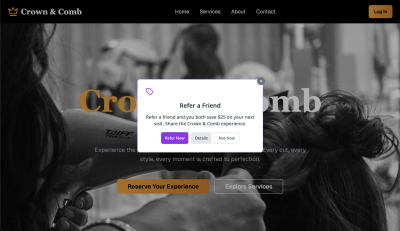
Crown & Comb: A bold, high-contrast, black-and-white hair salon website with bursts of color, designed intentionally to be complex. It featured service browsing, VIP programs, special packages, and a tricky online appointment-booking flow.
Using a unified screener, 30 online user interviews were conducted (10 per website), split evenly between cognitive participants and general population controls. Each session required participants to complete all tasks associated with a given website while being observed by a researcher. At the conclusion, every participant completed the 10-question Accessible Usability Scale (AUS) survey.
Data analysis was rigorous. Researchers reviewed session recordings and transcripts, counting every raised concern, question, difficulty, or missed task element as an "issue." All participant suggestions for design and structural improvements were cataloged similarly.
Across all websites, the cumulative data reinforced the initial hypothesis:
Total Issues Identified: Cognitive participants identified 197 issues, compared to 113 by the general population.
Total Suggestions Made: Cognitive participants delivered 93 suggestions, compared to 54 by general population controls.
Multiplier Effect: Across the board, cognitive testers consistently surfaced 1.8x more insights and recommendations.
Granular Website Breakdown
1. Strong Snacks (Simple Design)
Featuring the lowest overall complexity, this site yielded the highest median AUS scores and lowest issue counts.
Gen Pop: Averaged 6.4 issues, 2.6 suggestions, with an average AUS score of 90.5.
Cognitive: Averaged 9.8 issues, 4.8 suggestions, with an average AUS score of 76.8 (13.7 points lower).
As the site with the highest functional complexity and four distinct tasks, it generated the highest raw volume of user friction.
Gen Pop: Averaged 11 issues, 5.2 suggestions, with an average AUS score of 78.0.
Cognitive: Averaged 17 issues, 8.4 suggestions, with an average AUS score of 60.8 (17.2 points lower).
3. Crown & Comb (Intentional Complexity)
Designed to challenge users—particularly Task 3, which involved finding an elusive bridal package—this site revealed fascinating perceptual discrepancies.
Gen Pop: Averaged 5 issues, 3 suggestions, with a remarkably low average AUS score of 49.5.
Cognitive: Averaged 12 issues, 5.4 suggestions, yet recorded an average AUS score of 63.8 (14.3 points higher than the gen pop group).
Qualitative analysis illuminated profound differences in how friction is experienced. While general population users frequently framed frustration around lack of engagement or tedious mechanics (e.g., "This feels not particularly engaging"), cognitive participants articulated deep physiological and psychological tolls. One cognitive participant noted:
"For example, like, the mental energy aspect of it… ads, pop-ups, or maybe the website has too many options… It makes me, like, feel drained and less able to focus."
When usability issues overwhelm processing capacities, they cross the line from simple annoyances into outright accessibility barriers.
Official Statements and Industry Implications
The implications of these findings extend far beyond compliance-driven accessibility. They touch directly on core business metrics, customer loyalty, and long-term user retention.
As noted by a UX Manager at Bell Media regarding cognitive testing:
"2 sessions with cognitive users feel like 200 because of the volume of insights we get."
Translating Insights into Business ROI
Had product teams relied exclusively on general population testing, they would have missed critical vulnerabilities that directly impact bottom-line revenue:
E-Commerce Friction: On platforms like Turning Pages, ambiguous button behaviors ("Add to book bag") and opaque recommendation engines degraded user trust. In production environments, such friction multiplies across thousands of customer journeys, resulting in cart abandonment and direct revenue loss.
Brand Loyalty and Churn: General population users are often resilient enough to "muddle through" poorly designed interfaces. However, cognitive friction degrades user confidence. If a competitor offers a smoother experience, customer retention plummets.
Future Outlook: The Demographic Imperative
The urgency for adopting cognitive inclusion in UX research is compounded by macro-demographic shifts. According to U.S. Census projections, the population of Americans aged 65 and older is expected to surge from 17% to 25%, meaning 1 in 4 Americans will be an older adult by 2060.
Because cognitive processing speed, working memory, and focus naturally decline with age, the digital products of tomorrow must be built to accommodate these evolving needs today.
Cognitive Accessibility as an "On-Ramp"
For many product teams, jumping straight into accessibility testing with screen readers or alternative navigation tools can feel intimidating. Cognitive accessibility acts as an ideal entry point. By focusing intensely on reducing cognitive load, improving content clarity, and establishing predictable interface behaviors, UX teams build a robust methodological foundation.
Ultimately, cognitive inclusion in UX research is not merely an ethical obligation or a box-ticking exercise. It is a strategic necessity—a proven methodology to streamline research, clarify content, simplify user flows, and ship superior digital products for every single user.