


Executive Overview
In the hyper-competitive digital economy, thousands of aspiring copywriters and content creators enter the freelance marketplace every month. Armed with portfolio links, freshly designed websites, and unbridled enthusiasm, they draft what they believe to be the ultimate pitch. They fire off dozens of cold emails to prospective clients, marketing directors, and editors—and then, they wait.
And they wait.
More often than not, the silence that follows is deafening. Discouraged, many novices abandon their outreach campaigns entirely, concluding that cold emailing is a dead-end strategy.
According to veteran entrepreneurs and sales experts, however, the problem is rarely the initial pitch itself. Rather, it is a fatal omission in the execution phase: the failure to follow up. Industry data consistently demonstrates that the vast majority of sales, freelance contracts, and lucrative partnerships are never secured on the first touchpoint. Instead, they are forged through a disciplined, polite, and strategic cadence of subsequent communications.
This comprehensive report investigates the psychology of cold outreach, the mechanics of high-converting follow-up sequences, the thin line between persistence and spam, and the technological tools modern freelancers are using to automate their pipelines without sacrificing personal connection.
Detailed Chronology: The Lifecycle of a Cold Pitch
To understand why follow-ups are non-negotiable, one must first examine the standard trajectory of a cold email campaign. The process typically begins with meticulous prospect research. A diligent freelancer identifies a target company, pinpoints the decision-maker (such as a content manager or marketing VP), and crafts a tailored introduction.
Phase 1: The Initial Contact (Day 0)
The first email is dispatched. It is concise, heavily personalized in the opening sentence, and structured around the value the writer can bring to the table—not just a list of the writer’s credentials. Crucially, it concludes with a low-friction "easy out" to ensure the prospect feels zero pressure.
In an ideal world, the recipient reads this masterpiece immediately, recognizes an urgent gap in their content marketing strategy, and replies within ten minutes with a project brief.
Phase 2: The Reality of the In-Box (Days 1–3)
In reality, the prospect is currently drowning in a sea of unread emails, Slack notifications, and urgent meetings. Your email, no matter how brilliant, arrives while they are putting out a fire or rushing to hit a quarterly deadline. They skim the first sentence, think, "This looks interesting, I’ll look at it later," and promptly bury it beneath fifty incoming messages.
Without a follow-up, your email ceases to exist for them.

Phase 3: The First Nudge (Days 2–5)
This is where the professional freelancer differentiates themselves from the amateur. After waiting a respectful window of two to five days—long enough to avoid appearing desperate or aggressive, but short enough to remain fresh in their memory—the freelancer sends a brief, value-additive follow-up.
Phase 4: The Long-Term Cadence (Weeks 2–12+)
If the second touchpoint yields no response, the campaign shifts into a long-range nurturing phase. Rather than bombarding the prospect daily, the freelancer institutes a seasonal or quarterly cadence. They check in during natural business inflection points: the end-of-year rush, the fresh-start energy of mid-January, the spring content calendar overhaul, or the fall product launch season.
This chronological evolution shifts the relationship from an intrusive cold pitch to a familiar, trusted professional presence.
Supporting Context & Metrics: The Science of Persistence
Why do freelancers resist following up? Often, it stems from an internal psychological barrier: the fear of being annoying. Writers worry that sending a second or third email makes them look desperate, pushy, or unprofessional.
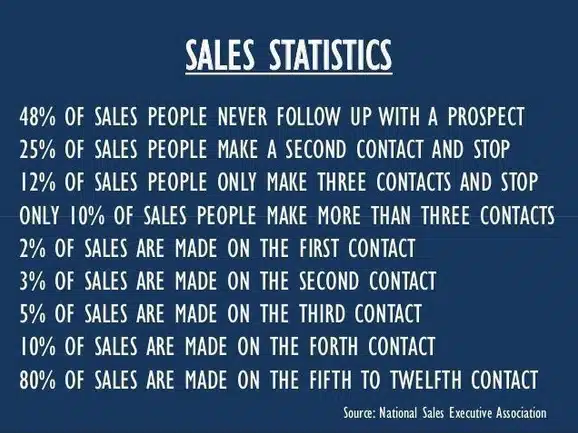
Data-driven sales research completely dismantles this misconception. Industry metrics compiled across B2B sales and freelance acquisition show a stark disconnect between how often salespeople quit and how often buyers actually buy:
- 2% of sales are made on the 1st contact.
- 3% of sales are made on the 2nd contact.
- 5% of sales are made on the 3rd contact.
- 10% of sales are made on the 4th contact.
- 80% of sales are made between the 5th and 12th contact.
When viewed through this statistical lens, sending a single cold email and walking away is equivalent to digging 99 percent of the way to a water source and abandoning the shovel. You have done the hard work of research, copywriting, and technical setup, only to quit before the threshold of conversion.
The Misalignment of Timing
The core reason follow-ups work is rooted in the simple mechanics of supply and demand. When your cold email lands in a marketing manager’s inbox, the statistical probability that they are actively looking to hire a freelance writer at that exact second is remarkably low.
However, business needs fluctuate rapidly. Three weeks from now, one of their staff writers might quit. Six months from now, they might secure a new round of funding and double their content output. Nine months from now, they might launch a new product line that requires an entirely new SEO strategy.
If you are not following up, you are relying entirely on sheer, unadulterated luck—hoping that your single email happened to coincide with their exact moment of need. Regular, thoughtful follow-ups ensure that when that moment does arrive months down the road, your name is the first one they see when they search their inbox. In many cases, you are actually doing the client a favor: saving them the arduous task of writing a job post, vetting candidates, and interviewing strangers by simply being available and top-of-mind.
Official Perspectives: Navigating Personalization vs. Spam
As remote work and digital entrepreneurship have expanded, the volume of automated cold outreach has exploded. Unfortunately, much of this volume is low-quality, generic, and generated by poorly calibrated artificial intelligence models.
Industry leaders and veteran agency owners emphasize that there is a profound difference between strategic persistence and automated harassment.
The Plague of Generic AI Outreach
"I get so many crappy emails," notes digital business pioneer Sean Ogle. "They’re not personalized. Perhaps they were written by AI, and then you get follow-ups every day that are also not personalized, and it drives me crazy. Those people give a bad rap to the people who do it properly."
When prospects receive daily, copy-pasted blocks of text from strangers who clearly know nothing about their business, they develop a defensive reflex. They hit "Spam," block the sender, and harbor a deep resentment toward cold outreach as a whole.
The Art of the Micro-Personalized Touch
To cut through this noise, effective freelancers adhere to a strict code of respect and relevance. Personalization does not require spending hours researching a single target’s entire professional history. According to veteran copywriters, customizing just the opening sentence—referencing a recent article the prospect wrote, a podcast they appeared on, or a specific company milestone—is entirely sufficient to signal genuine human intent.
Furthermore, professionalism dictates boundaries. If a prospect explicitly requests that you stop emailing them, their address must be purged from your database immediately. Persistence crosses the line into spam the moment it ignores explicit consent. When executed correctly, however, a follow-up should feel like a polite tap on the shoulder from a colleague offering assistance, rather than a high-pressure sales pitch.
Future Outlook: Tech-Enabled Pipelines and CRM Strategies
Managing a robust follow-up schedule for dozens—or hundreds—of prospective clients can quickly become overwhelming if managed manually in a paper notebook or a disorganized desktop folder. Fortunately, the technological landscape for freelance operations has evolved dramatically, offering tools that transform basic email accounts into sophisticated sales machines.
1. Gmail CRM Integration (e.g., Streak)
For freelancers who operate primarily out of Google Workspace, tools like Streak integrate directly into the Gmail interface, effectively turning an ordinary inbox into a lightweight Customer Relationship Management (CRM) system. These platforms allow users to:
- Track precisely when an email is opened.
- Log detailed notes regarding past interactions.
- Establish automated reminders for the next scheduled follow-up cadence.
2. AI-Assisted Pipeline Management
While poorly implemented AI can ruin a cold pitch, modern language models like Claude and ChatGPT can serve as hyper-efficient administrative assistants when utilized correctly. By feeding an AI model a secure log of outreach dates, prospect names, and communication history, freelancers can maintain a comprehensive overview of their pipeline. Creators can query the AI for weekly or monthly progress reports—tracking metrics such as conversion rates from cold email to discovery call, and from call to signed contract—without getting bogged down in spreadsheet maintenance.
3. The Modern Freelance Playbook
Ultimately, the future of freelance writing success belongs to those who view outreach not as a one-time transactional event, but as a long-term relationship-building engine. By combining meticulous initial research, micro-personalization, structured multi-touch follow-up cadences, and modern CRM tracking tools, writers can systematically turn cold prospects into warm, paying clients.
The hard work of building a portfolio and crafting a pitch is only the beginning. The real monetization happens in the spaces between the emails—in the disciplined, professional persistence that proves to your future clients that you are reliable, attentive, and ready to work.