

Executive Overview
In the modern digital publishing landscape, the value of a high-converting, authoritative article is often directly tied to the primary research behind it. For professional freelance writers, journalists, and content strategists, this research frequently manifests as interviews with Subject Matter Experts (SMEs). A standard 20-minute conversation with an industry insider can easily yield upwards of 3,000 words of spoken dialogue, rich with insights, industry jargon, and precise anecdotal evidence.
However, transforming raw, spoken dialogue into structured, publishable prose has historically presented a severe operational bottleneck. Traditionally, writers faced a stark dilemma: either split their cognitive focus between actively engaging the expert and frantically typing shorthand notes—resulting in compromised interview quality—or spend upwards of 60 to 90 minutes per call manually scrubbing back and forth through raw audio recordings.
Enter automated transcription software. Among the crowded field of artificial intelligence-driven productivity tools, Otter.ai has positioned itself as an industry standard since its widespread adoption by content creators around 2020. This investigative product review and productivity audit explores whether the platform’s $100-per-year Pro tier delivers a legitimate return on investment (ROI) for freelance writers. By evaluating its real-world transcription accuracy, time-saving metrics, workflow integration, and inherent limitations, this report provides a definitive blueprint for writers looking to optimize their operational overhead.
Detailed Chronology: How the Modern Content Workflow Was Transformed
To understand the current reliance on AI transcription tools, one must examine the evolution of the interview-to-draft pipeline over the past decade.
Phase 1: The Era of Manual Shorthand (Pre-2015)
Prior to accessible cloud-based audio processing, freelance writers operated under heavy physical and cognitive loads. Armed with digital voice recorders, mini-cassettes, or early smartphone recording apps, writers conducted interviews while simultaneously scribbling notes on legal pads.
- The Cost: Post-interview processing required listening to the tape in real-time, pausing, rewinding, and transcribing sentences manually. A 30-minute interview routinely demanded two to three hours of transcribing before the actual outlining and drafting phases could even begin.
Phase 2: Outsourcing to Human Transcriptionists (2015–2019)
As content demands scaled and budgets for specialized B2B publications increased, many writers turned to human transcription services or freelance platforms like Rev and Upwork.
- The Cost: While human accuracy approached near-perfection (98%+), the turnaround time introduced a major structural delay. Writers had to wait anywhere from 24 hours to five days to receive their completed files. For journalists operating under aggressive weekly deadlines, this lag severely compressed the window for drafting, editing, and client review.
Phase 3: The AI-Driven Real-Time Revolution (2020–Present)
The maturation of speech-to-text machine learning models fundamentally altered this timeline. Tools like Otter.ai shifted the paradigm from asynchronous human outsourcing to instant, automated processing.
- The Operational Shift: Writers could now conclude a Zoom or phone interview and possess a fully searchable, time-stamped transcript within seconds of hanging up. This instantaneous feedback loop eliminated multi-day waiting periods and allowed content creators to pivot immediately into synthesis and writing.
Supporting Context & Metrics: The ROI Math of AI Transcription
For independent contractors and freelancers operating on tight margins, every minute spent on administrative overhead reduces their effective hourly rate. To determine whether Otter.ai’s Pro plan ($8.33/month billed annually) is a justifiable business expense, we must examine the hard metrics of time savings and financial return.
The Financial Breakdown per Article
Consider a standard freelance writing assignment: an in-depth, 1,000-word B2B or fintech feature article commissioned at a flat rate of $1,200, requiring one SME interview.
-
Traditional Workflow (Manual Review):
- Research & Prep: 1 hour
- SME Interview: 20 minutes
- Manual Review/Transcription Cleanup: 60+ minutes
- Outlining, Drafting, & Polishing: 3 hours
- Total Time Invested: ~5 hours and 20 minutes
- Effective Hourly Rate: ~$225/hour
-
AI-Optimized Workflow (Using Otter.ai):
- Research & Prep: 1 hour
- SME Interview: 20 minutes
- Automated Transcription & Quick Verification: 10 minutes
- Outlining, Drafting, & Polishing: 3 hours
- Total Time Invested: ~4 hours and 30 minutes
- Effective Hourly Rate: ~$266/hour
By reclaiming roughly 50 to 60 minutes per article, the writer increases their hourly yield. Across a steady cadence of three to four interview-driven pieces per month, the time saved accumulates to between 3 and 4 hours—meaning the tool pays for itself within the first assignment of the billing cycle.
Key Performance Capabilities of the Platform
- Instantaneous Processing: Transcripts populate in real-time as the conversation unfolds, making it possible to review what was said moments prior without breaking the flow of dialogue.
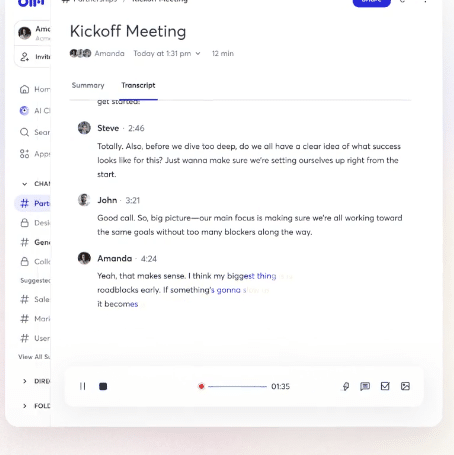
- AI Chat Search Functionality: Rather than manually scanning blocks of text, users can query the transcript chatbot (e.g., "What did the expert say about credit card fraud prevention?"), which instantly retrieves relevant quotes, summaries, and timestamp markers.
- Audio-to-Text Cross-Referencing: Clicking any line of text within the transcript immediately triggers the native audio player to jump to that precise millisecond, streamlining the verification of questionable quotes.
Critical Analysis: Limitations, Gotchas, and Platform Realities
While the quantitative benefits are clear, professional transparency requires a balanced look at the platform’s shortcomings. Otter.ai is not a magic bullet, and failing to account for its technical constraints can lead to costly errors in published journalism.
1. The Headphone and Speaker Mode Constraint
One of the most frequent operational hurdles users encounter involves audio routing. If a writer conducts interviews while wearing wired or wireless headphones, Otter’s capture mechanism typically records only the local microphone (the writer’s voice), missing the remote participant entirely.
- The Workaround: The software relies on capturing system audio through computer speakers or utilizing integrated virtual meeting bots (such as the OtterPilot for Zoom, Google Meet, and Microsoft Teams). Writers working out of open-plan offices, noisy cafes, or shared co-working spaces must secure private environments to ensure clear speaker separation without ambient noise contamination.
2. Accuracy Realities: The 80–85% Threshold
While marketing materials often tout up to 95% accuracy, real-world conditions in specialized niches (such as fintech, healthcare, or legal journalism) typically push accuracy closer to 80–85%.
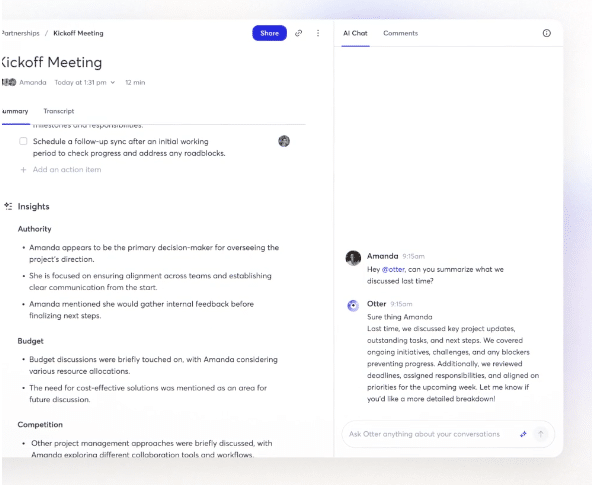
- The Impact: Proprietary industry terminology, acronyms, and foreign or uncommon proper nouns are frequently mangled by speech recognition engines. Speaker diarization (distinguishing between multiple voices) can also falter during rapid-fire back-and-forth dialogue or group webinars, labeling participants generically as "Speaker 1" and "Speaker 2."
- The Journalistic Imperative: Writers cannot rely on unverified AI output for direct quotes. Every extracted statement must be cross-checked against the audio playback link to preserve journalistic integrity and avoid misattributions.
Comparative Landscape: How Otter Stacks Up Against Alternatives
Freelance writers are spoiled for choice when it comes to transcription utilities. Understanding where Otter fits relative to its primary competitors helps clarify its unique market position.
| Tool | Primary Strengths | Notable Weaknesses | Best Suited For |
|---|---|---|---|
| Otter.ai | Robust AI search, calendar integrations, generous free tier, fast processing. | Speaker identification can be erratic; requires proper speaker mode setup. | General freelance writers, journalists, and B2B content creators doing regular interviews. |
| Fireflies.ai | Excellent CRM integrations, strong meeting summarization features. | Steeper learning curve for simple solo writing workflows. | Sales professionals, agency owners, and client-heavy consultants. |
| Fathom | Highly rated native Zoom integration, intuitive highlight reel creation. | Less focused on traditional editorial publishing workflows. | Remote teams, coaches, and corporate meeting management. |
| Rev | Unmatched human transcription accuracy (98%+). | High cost per audio minute; slow turnaround times (hours to days). | Legal, academic, and investigative long-form journalism requiring verbatim accuracy. |
Future Outlook: The Trajectory of AI in Content Creation
As natural language processing and voice recognition models continue to advance at an exponential rate, the landscape of digital content creation will experience further consolidation and automation.
What Lies Ahead for Freelance Writers
- Context-Aware Dialects: Future iterations of transcription engines will increasingly ingest industry-specific glossaries prior to calls, drastically reducing the error rate for technical jargon in fields like biotechnology, cryptocurrency, and macroeconomics.
- Automated Synthesization: The gap between raw transcript and initial article outline is rapidly closing. While human editorial judgment, narrative voice, and ethical oversight remain entirely irreplaceable, the mechanical labor of structuring interviews into thematic buckets will be handled natively by integrated LLMs.
- Evolving Pricing Pressures: As foundational AI models become commoditized, software providers will face downward pressure on subscription fees. However, tools that successfully integrate deep calendar synchronization, secure cloud archiving, and frictionless workflow sharing—such as Otter.ai—will continue to command market share by saving premium hours for high-earning professionals.
Conclusion & Verdict
For the aspiring or established freelance writer, managing time is synonymous with managing income. The administrative burden of manual transcription represents a direct drag on earning potential.
Despite minor imperfections in speaker diarization and an 80–85% baseline accuracy rate in complex niches, Otter.ai remains one of the most cost-effective productivity investments available to content creators. At roughly $100 per year for the Pro tier—or via a capable, functional Free Basic tier that allows adequate stress-testing—the platform eliminates the multi-hour transcription bottleneck, empowers conversational immersion during interviews, and accelerates the journey from raw recording to published prose.
For any writer regularly conducting Subject Matter Expert interviews, auditing this tool is no longer optional; it is a foundational step toward scaling a profitable, sustainable freelance writing business.
