

Executive Overview
For the past several years, the technology sector has operated under a collective, unyielding assumption: that humanity is suffering from a desperate, unmet craving for more artificial intelligence. Corporate boardrooms, venture capital firms, and product development labs have pushed an aggressive narrative that consumers and enterprise workers alike are eager to swap out legacy workflows, traditional tools, and human-centric processes for a suite of "AI-first" innovations.
Yet, a glaring disconnect has emerged between what executive leadership envisions and what the market actually tolerates. Behind the glossy product launches and breathless quarterly earnings calls lies a sobering reality: most people do not want more AI—at least not in the intrusive, disruptive, and often unrefined manner dictated by modern tech giants.
Mounting data regarding low feature adoption, plummeting retention rates, and the hidden psychological toll of forced technological integration reveals a profound miscalculation. AI is continually marketed as an all-encompassing value proposition, but for the average end-user, it frequently functions as an expensive, unpredictable, and frustrating bolt-on. Rather than eliminating friction, modern AI implementations often amplify organizational dysfunction, create endless cycles of error-checking, and intensify workloads.
This article explores the growing backlash against mandatory artificial intelligence, examines the stark divergence between corporate ambition and human reality, and argues for a paradigm shift from "AI-first" disruption to "AI-second" augmentation.
Detailed Chronology: The Evolution of the AI Integration Backlash
To understand how the technology sector arrived at this critical juncture of consumer skepticism and enterprise fatigue, it is necessary to examine the trajectory of the AI boom over recent years.
Phase 1: The Gold Rush of Unbounded Optimism (2022–2023)
Following the widespread public release of generative text and image models, the global tech ecosystem underwent a seismic shift. Companies across every conceivable sector—from financial services to retail, education to enterprise software—scrambled to stake a claim in the artificial intelligence gold rush. The prevailing philosophy among leadership teams was simple: move fast, integrate everything, and brand it with AI.
During this initial phase, feature parity meant having an integrated chatbot or a generative content generator, regardless of whether the user base expressed a genuine need for it. "Powered by AI" was treated as a self-contained value proposition capable of driving stock prices and capturing investor enthusiasm.
Phase 2: The Friction of Forced Adoption (2024–2025)
As the novelty of generative tools began to wear off, enterprises and consumers alike began interacting with these features on a day-to-day basis. This period marked the surfacing of operational friction. Employees found themselves bouncing across an increasingly fragmented ecosystem of standalone AI windows, browser extensions, and isolated chat interfaces.
Instead of saving time, workers reported spending excessive hours reviewing AI-generated outputs for hallucinations, editing out low-quality "AI slop," and trying to reconcile conflicting automated directives with legacy internal processes. Adoption curves flattened, and while corporations continued to report heavy investments, retention and daily active usage metrics among end-users told a vastly different story.
Phase 3: The Productivity Paradox and Consumer Fatigue (2026 and Beyond)
By 2026, empirical studies began to dismantle the myth of universal productivity gains. Comprehensive workplace productivity data published across major business journals revealed an uncomfortable truth: AI was not reducing workloads; it was intensifying them.

Workers were logging longer hours—including weekends—not because they were achieving more, but because they were spending unprecedented amounts of mental energy managing, supervising, and cleaning up after automated systems. Simultaneously, the consumer market demonstrated clear boundaries: resistance to AI-narrated books, automated romantic partners, and uninvited agentic algorithms began to solidify into vocal public skepticism.
Supporting Context & Metrics: The Human and Operational Cost
The corporate insistence on pushing AI into every facet of daily life rests on a foundational misunderstanding of software value. Product designers often defend unreliable AI features by arguing that humans are unreliable too. However, consumer psychology research demonstrates that people do not evaluate software by comparing it to the flaws of other humans; they compare features to features. If a traditional, deterministic feature works reliably every single time, while an AI-powered alternative delivers inconsistent or hallucinatory results, users will invariably choose predictability.
The Metrics of Workplace Intensification
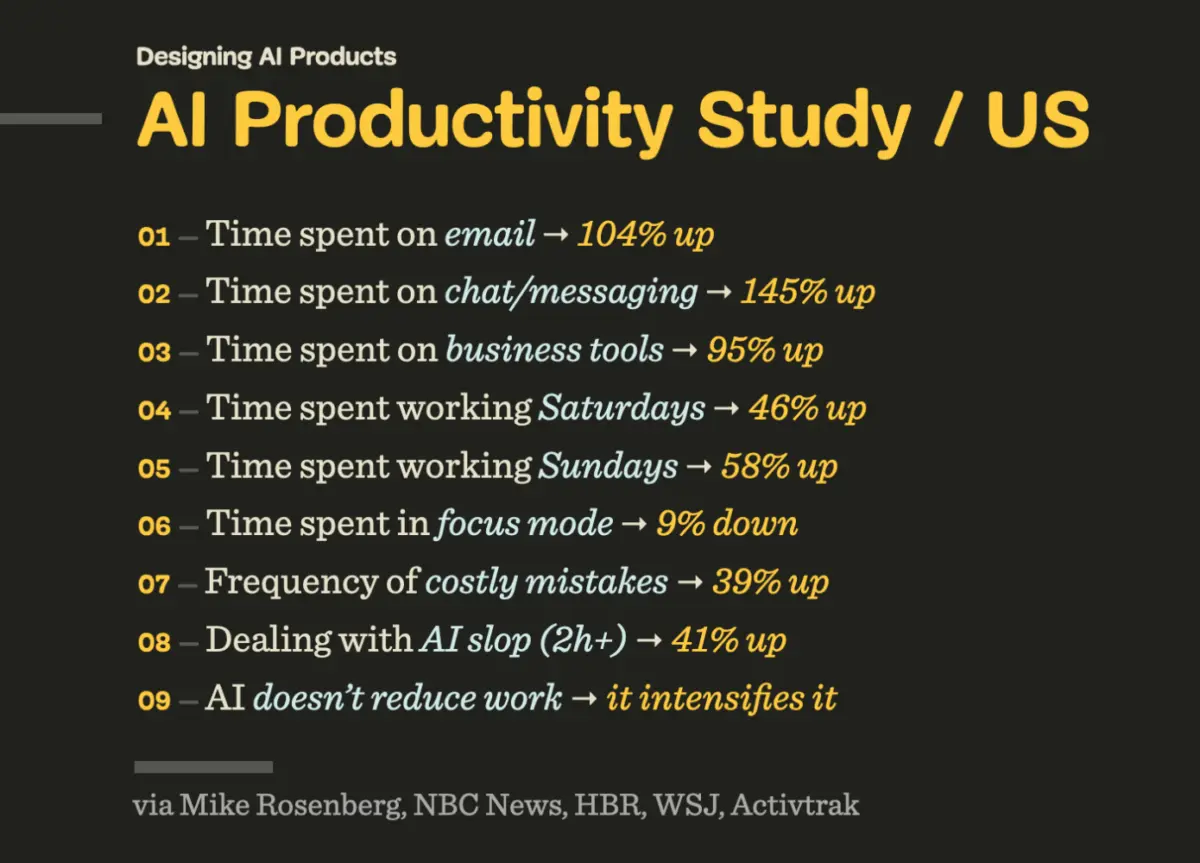
Recent workplace studies paint a vivid picture of how AI integration has impacted daily professional life. Far from streamlining operations, the introduction of disconnected AI tools has correlated with steep increases in communication and oversight burdens:
- Email and Messaging Volume: Time spent managing emails has surged by over 100%, while chat and messaging tool engagement has jumped by upwards of 140% as teams coordinate around automated outputs.
- Extended Working Hours: Weekend labor has seen a marked rise, with Saturday and Sunday work hours increasing significantly among professionals tasked with managing accelerated, AI-driven pipelines.
- Cognitive Load and "AI Slop": Studies indicate a 39% increase in costly operational mistakes stemming from unverified automation, alongside a 41% increase in time wasted filtering through low-quality AI-generated noise ("slop").
- Focus Depletion: Deep-focus mode metrics have dropped consistently, underscoring how constant context-switching between fragmented tools drains employee attention spans.
AI as a Mirror of Organizational Dysfunction
A recurring fallacy in modern corporate strategy is the belief that AI can act as a silver bullet for deep-seated operational flaws. Organizations frequently assume that deploying advanced language models or automated agents will magically rectify years of accumulated technical debt, poor data quality, broken internal cultures, and ambiguous strategic priorities.
In practice, AI functions less like a corrective filter and more like an amplifier of existing shortcomings. If an organization suffers from poor data hygiene or inconsistent decision-making frameworks, artificial intelligence will rapidly scale those inconsistencies and hand them directly to the end-user. Rather than solving internal disarray, it forces human employees to act as frontline troubleshooters for systemic organizational chaos.

Official Statements and Industry Insights
The disconnect between technology push and human pull has prompted prominent voices in design, ethics, and corporate leadership to call for a recalibration of industry priorities.
The core of this philosophical divide is perhaps best articulated by Bo Young Lee, whose reflections on the appropriate boundaries of automation have resonated widely across professional networks:
"I don’t want to read books written by AI. I don’t want to gaze upon paintings by AI. I don’t want AI to teach my children. I don’t want to have an AI therapist. I don’t want AI making my medical decisions. I want AI to do all the physical and mental labor that taxes me so I can read books written by humans and go to art galleries to engage with art made by humans. I want AI that makes my life easier rather than forces me to change myself."
This sentiment underscores a vital distinction: the general public is not categorically opposed to technological assistance; rather, they reject the erosion of human artistry, emotional connection, and agency.
Furthermore, product design authorities—such as Vitaly Friedman, creator of specialized UX training initiatives like Design Patterns For AI Interfaces—have consistently emphasized that AI must fit neatly within established mental models rather than forcing users to master entirely new, unnatural interaction paradigms. When AI is treated as a standalone box to speak to or type into indefinitely, it disrupts natural workflows. When it is designed as a subtle, ambient assistant embedded within familiar environments, it begins to deliver genuine, friction-free utility.

Future Outlook: The Rise of the "AI-Second" Paradigm
As the technology sector matures past its initial infatuation with unbridled disruption, the path forward requires a fundamental shift in philosophy. The future of sustainable digital product design does not lie in "AI-first" disruption, but in an "AI-second" approach.
1. From Workflow Replacement to Task Augmentation
Future-proof products will recognize that human beings derive profound professional and personal satisfaction from the act of creation, critical thinking, and nuanced decision-making. Automation should not seek to replace these fulfilling aspects of work; instead, it should aggressively target the mundane, repetitive, and mentally exhausting chores that drain human energy. By lifting the burden of administrative drudgery, AI can create the headspace required for deeper human engagement.
2. Ambient, Humble, and Predictable Design
The most successful technological tools are those that fade into the background. Rather than demanding constant attention, opening separate chat panels, or requiring complex prompt engineering, effective automation should be calm, ambient, and supportive. It should respect existing human workflows and adapt to the cognitive frameworks users have spent years refining, rather than forcing users to re-engineer how they think.
3. Valuing Human Connection Over Synthetic Novelty
Ultimately, the collective pushback against forced artificial intelligence is a reaffirmation of the value of human connection. Stories, emotions, shared laughter, and authentic human perspectives cannot be synthesized by algorithms.
The mandate for developers, product leaders, and designers moving forward is clear: stop building features for an idealized world that craves constant technological mediation. Instead, build tools that respect human time, honor predictability, and quietly handle the boring stuff—leaving people free to spend their time on the work, and the people, they genuinely love.
