

Executive Overview
Every digital property experiences its own golden hour precisely on launch day. The final branch is merged, the codebase clears quality assurance, and the site goes live exactly as envisioned by its creators. For a brief, shining moment, it is structurally, aesthetically, and functionally perfect.
It will never be this good again.
This is not because the software deteriorates or the servers fail; the infrastructure remains sound, and the uptime monitors stay green. Instead, the world outside moves on. Markets shift, competitors launch rival products, messaging strategies evolve, and the meticulously crafted digital presence slowly slips out of alignment with the enterprise it represents. Twelve months later, that once-cutting-edge portal reads like a period piece—not strictly broken, but fundamentally behind.
For decades, digital teams have accepted this entropy as an immutable law of web development. Maintenance is viewed as a reactive chore, an uphill battle against digital decay fought with sporadic redesigns and panicked code pushes.
Enter the era of autonomous websites: digital properties continuously optimized, updated, and refined by specialized artificial intelligence agents long after the initial launch. Proponents argue this technology could shatter the cycle of digital stagnation, allowing a site to quietly improve itself while its creators focus on core business operations.
Yet, as platform builders and developers begin testing the limits of full autonomy, they have collided with a counterintuitive psychological and operational wall: almost nobody actually wants a website that changes entirely on its own.
This investigative report examines the paradigm shift toward autonomous web platforms, drawing on insights from industry pioneers like Pierre Burgy, co-founder of the autonomous website platform Fimo. We explore the granular tension between total automation and human creative control, the psychological hurdles of relinquishing digital real estate to algorithms, and how the future of web design hinges not on removing humans, but on redefining where human judgment truly matters.
Detailed Chronology: From Static Launches to Self-Healing Codebase
The trajectory of the web has always been defined by a tension between creation and maintenance. To understand the current wave of autonomous web architecture, one must trace how the industry arrived at the breaking point of digital decay.
Era 1: The Static Craftsmanship (Late 1990s – 2010s)
In the early decades of commercial web development, building a site was treated like constructing a physical building. Architects drafted wireframes, engineers laid the foundation with HTML and CSS, and content creators filled the rooms. Once completed, the "building" was handed over to the client. Maintenance required calling in contractors for minor renovations, while major overhauls happened every three to five years. The concept of continuous, real-time evolution was logistically impossible and financially prohibitive for most organizations.
Era 2: The Continuous Integration Trap (2010s – 2020s)
The rise of agile development, design systems, and modern content management systems (CMS) promised relief. Teams could push updates continuously. However, this introduced a new bottleneck: human bandwidth. While tools became faster, the human operational load skyrocketed. Developers spent hours chasing unoptimized images, broken meta tags, and accessibility regressions introduced by rushed code releases. The website became a mirror of internal team bandwidth; if a team was stretched thin, the website stalled and decayed.
Era 3: The Autonomous Horizon (2024 – Present)
With the maturation of Large Language Models (LLMs) and agentic workflows, a new category of platforms emerged. Pioneers asked a radical question: What if the website could maintain itself?
Platforms like Fimo were built on the assumption that full autonomy was the ultimate destination. Teams would point an agent at a repository, and the AI would write, edit, optimize, and publish changes indefinitely.
However, early real-world testing revealed an immediate paradox. When given the keys to the digital kingdom, users hesitated. They did not immediately embrace hands-off autonomy. The friction point was not technological capability—it was psychological safety, organizational politics, and the absence of clear boundaries between machine efficiency and human intent.
Supporting Context & Metrics: The Anatomy of Digital Decay
To comprehend why autonomous agents are shaking up the web ecosystem, one must quantify the invisible tax of website maintenance.
Industry data consistently shows that a staggering percentage of digital operational drag has nothing to do with product innovation and everything to do with housekeeping. Consider the breakdown of routine website upkeep:
- Eighty Percent Chores: Roughly 80% of ongoing website maintenance involves rule-bound, repetitive, and deterministic tasks. This includes verifying accessibility compliance (WCAG standards), propagating design-system token updates, compressing newly uploaded assets, and repairing broken hyperlinks caused by restructuring.
- The Human Cost of Context Switching: Developers and designers frequently lose hours of deep work context switching to fix trivial issues, such as missing alt text or misaligned typography tokens.
- The Competitor Drift Gap: Studies on enterprise digital maturity reveal that average B2B websites undergo a noticeable messaging misalignment with their core product offerings within just 9 to 14 months of a major launch if manual content operations lag.
When agents are introduced to handle this baseline layer, the impact is immediate. Imagine waking up to find that an overnight agent caught a missing design-system token on the pricing page and fixed it, compressed a batch of rushed, uncompressed image assets, and flagged a subtle accessibility regression introduced by a newly deployed component.
Yet, despite these measurable efficiencies, the industry faced a conceptual crisis: How much control are teams actually willing to surrender?
Official Statements and Industry Insights: Redrawing the Line of Control
The friction inherent in autonomous web architecture forced platform architects to rethink the relationship between humans and machines. Pierre Burgy and his engineering team at Fimo discovered that "just make it autonomous" is fundamentally the wrong goal.
A website is rarely owned by a single individual; it is a shared canvas where multiple stakeholders intersect, each with a different tolerance for automated changes.
"Almost nobody actually wants a website that changes entirely on its own," Burgy notes. "Not because they distrust the agents, but because a website has no single owner. Different parts belong to different people, and each one wants a different amount of autonomy."
The Three-Tier Reality of Web Operations
To make autonomy palatable, platform designers had to categorize website operations into three distinct buckets:
-
The No-Brainer Chores (The 80%):
This is the realm of rules over taste. Accessibility compliance, broken meta tags, unoptimized images, and rote design token propagation fall squarely here. Nobody was hired for their artistic genius in spotting a missing alt attribute. Handing this off to agents yields immediate relief without threatening human job security. -
The Untouchable Core (The Sanctuary of Taste):
At the opposite end lies work that no sane team would delegate at any price. An agent can check contrast ratios and heading hierarchies, but it cannot decide what a brand should feel like, nor can it evaluate whether a piece of copy possesses genuine creative resonance. This is the domain of human judgment—the exact reason creative professionals are hired. -
The Subjective Middle Ground:
Between chores and untouchables lies a vast gray area where the dividing line shifts depending on the stakeholder.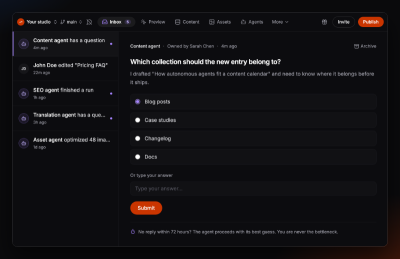
Consider a concrete example: changing the site’s default theme to dark mode.
- For a developer, this is a one-line configuration change backed by clear technical rationale—the kind of task they are happy to delegate to an agent.
- For a brand designer, the default theme is a foundational statement of identity and visual posture. They demand direct, manual ownership over that decision.
The realization is profound: "Right" is not an objective property of a task; it is a function of where an individual’s professional value sits. Consequently, universal settings fail. True autonomy requires per-task and per-person customizability.
Composing Agents, Not Toggles
Because the boundary line is intensely personal, simple binary toggles ("approve" or "delegate") are inadequate. Platforms must allow teams to build and compose the agents themselves.
Instead of choosing from a rigid menu of behaviors, creators define the operational boundaries of individual agents. An organization might deploy an accessibility agent with full autonomous publishing rights, while keeping a content agent strictly on a human-approval leash for any brand-facing copy changes.
Crucially, this boundary is dynamic. Trust is earned through verifiable logs, transparent before-and-after visual diffs, and historical tracking. As an agent proves its reliability, the boundary shifts toward less human intervention.
Future Outlook: The Death of the Frozen Site
As we look toward the horizon of web engineering, the paradigm of the static, launch-and-pray website looks increasingly obsolete.
The traditional fear—that an autonomous agent might alter a digital property without explicit human oversight—pales in comparison to the far greater, silent risk: the frozen site. A website that remains untouched for months does not stay pristine; it slowly becomes obsolete in a way that escapes notice until the enterprise it represents has moved entirely past it.
The emergence of autonomous web platforms signals a maturation in how we think about artificial intelligence in creative industries. AI is not here to replace the designer or usurp the developer’s creative prerogative.
Instead, its true purpose is mechanical liberation.
“The point of autonomy was never to remove you from your website. It was to remove the decay.”
By delegating the endless tide of digital chores to tireless algorithmic agents, creative professionals can reclaim their most valuable asset: their judgment. They can focus the entirety of their intellect on the handful of high-stakes decisions that define a brand’s soul, leaving the underlying architecture to maintain itself in an infinite, self-healing loop.
The future web will not be built once and left to weather the elements. It will be a living, breathing digital organism—anchored by human vision, and sustained by autonomous intelligence.
