

Executive Overview
For years, a standard mantra dominated frontend development: “There’s a library for that.”
Need to format a date? Install a package. Group an array by a specific property? Pull in a utility function. Handle HTTP requests, build accessible modal dialogs, or manage complex internationalization? Fire up the terminal and add another dependency to your package.json.
Most developers install dependencies with good intentions. A package solves an immediate engineering hurdle, tests pass, code ships to production, and the dependency is relegated to the background, rarely examined again. However, the web platform itself has not stood still. Modern browsers are evolving at an unprecedented pace, rapidly absorbing capabilities that once required external codebases.
Today, in a typical mid-sized JavaScript application, developers can often find between 60KB and 90KB (minified and gzipped) of dependencies—and considerably more in uncompressed weight—that the native platform can now handle entirely on its own. Tasks like internationalization, deep cloning, number formatting, HTTP fetching, and basic user interface primitives are increasingly built straight into the browser.
The primary barrier preventing engineering teams from reclaiming this lost bandwidth isn’t laziness; it is systemic blindness. Teams frequently audit their dependency trees for security vulnerabilities via tools like npm audit, but they rarely ask the foundational architectural question: “Is this library still doing something the browser cannot?”
By leveraging the web ecosystem’s Baseline standard, engineering teams now have a predictable, data-driven framework to audit their codebases, prune redundant third-party modules, and systematically return heavy workloads back to the browser runtime.
Detailed Chronology: The Evolution of Web Platform Capabilities
To understand why so many third-party libraries have become redundant, we must examine how the gap between user-land JavaScript and native browser capabilities has systematically closed over recent years.

Historically, JavaScript lagged behind backend languages and native environments in standard utility features. If a developer needed to format a relative time stamp (e.g., "3 hours ago"), manage complex currency conversions, or build an accessible modal dialog that trapped focus correctly, the platform offered little to no native support. This vacuum was filled by open-source maintainers who built robust, cross-browser libraries to solve these universal pain points.
However, the launch and maturation of standardization initiatives like the WebDX Community Group and the Baseline project changed the velocity of web feature deployment. Baseline provides a clear, objective measurement of when a web feature is safe to use across all major browser engines (Chrome, Edge, Firefox, and Safari). It categorizes features into three distinct phases:
- In Development: The feature is being implemented in one or more engines.
- Newly Available: The feature has recently landed across all major browser engines, marking the beginning of a standardized 30-month clock.
- Widely Available: The feature has been supported across all major engines for at least 30 months, making it universally safe to rely upon without conditional polyfills.
This structural cadence has transformed browser development. Features that once required heavy external abstractions are now graduating rapidly from experimental status into Widely Available native APIs.
For instance, the introduction of the native <dialog> element solved decades of brittle, hand-rolled accessibility implementations for modals. Similarly, the continuous expansion of the Intl namespace has steadily eliminated the need for specialized formatting utilities. As these native capabilities crossed the Baseline threshold, the technical debt of maintaining legacy helper libraries became starkly apparent.
Supporting Context & Metrics: Auditing the Dependency Bloat
When evaluating modern web applications, the impact of unneeded dependencies goes far beyond raw file size. Every kilobyte of JavaScript added to a bundle incurs a cost across parsing, compilation, execution, and network transmission—disproportionately affecting users on mobile devices or emerging network conditions.
To systematically identify and eliminate redundant code, developers must analyze their dependencies not as isolated packages, but within operational clusters. Wins rarely happen in isolation; they compound when entire categories of libraries are replaced by native platform alternatives.
Cluster 1: Internationalization (The Immediate Win)
Internationalization (i18n) represents the single largest quick-win cluster in modern codebases. Libraries handling relative times (timeago.js), number formatting (numeral), pluralization (pluralize), and list joining historically added upwards of 14 KB gzipped to a typical bundle.

The native Intl namespace now covers these domains natively and robustly:
- Relative Time:
Intl.RelativeTimeFormatturns timestamps into localized strings like"yesterday"or"in 3 hours"with minimal configuration. - Numbers and Currency:
Intl.NumberFormathandles thousands separators, compact notations (e.g.,"1.2M"), and complex currency styling. - List Formatting:
Intl.ListFormatnatively manages complex sentence joining, including the Oxford comma, removing the need for custom string-concatenation helpers.
Cluster 2: HTTP Clients
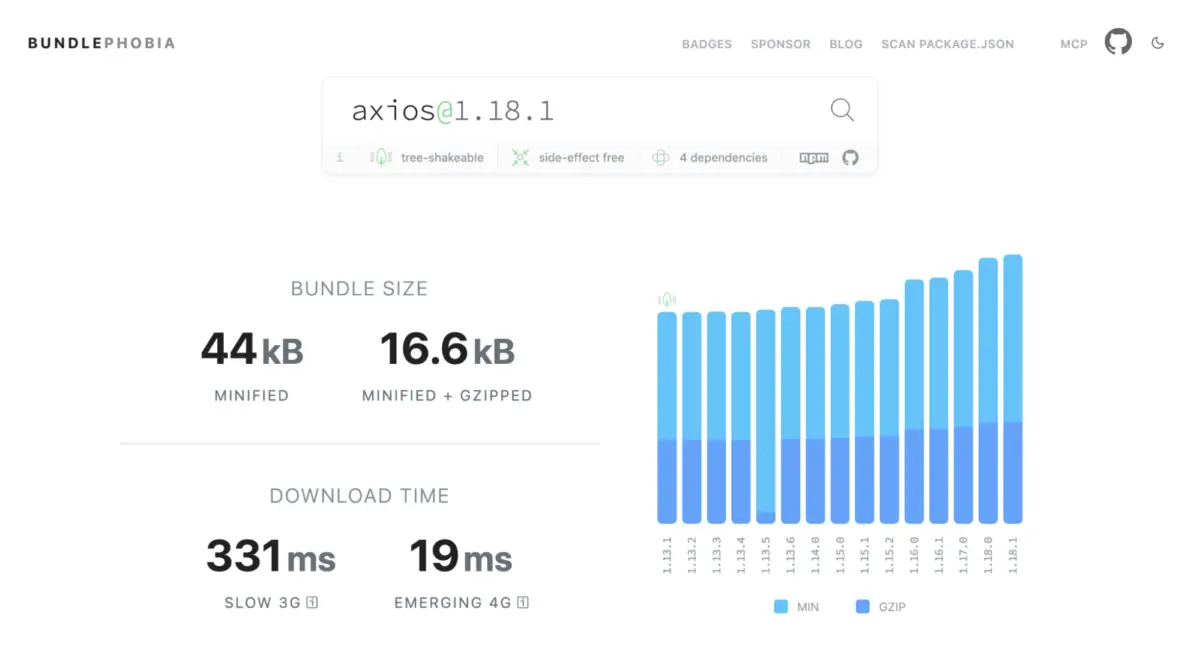
Developers frequently default to heavy libraries like axios (~17 KB gz) or superagent (~19 KB gz) for API requests. While these libraries offer rich abstractions, native fetch combined with AbortController and AbortSignal.timeout() handles standard GET and POST operations natively across all modern environments. While fetch requires explicit response parsing (such as calling .json()), dropping unneeded abstraction layers saves substantial bundle overhead for applications requiring straightforward data fetching.
Cluster 3: UI Primitives & Accessibility
Historically, building robust UI components required stacking multiple single-purpose dependencies: modal managers, focus-trap utilities (focus-trap), body scroll-lock plugins (body-scroll-lock), and tooltip positioning engines (tippy.js). Combined, these primitives easily consume over 24 KB gzipped.
Today, three native platform features largely replace this entire stack:
- The
<dialog>Element: Handles focus trapping, background inertness, top-layer rendering, andEscape-key dismissal natively. - The Popover API: Provides light-dismiss behavior and top-layer management for dropdowns and tooltips with zero JavaScript.
- CSS Anchor Positioning: Replaces complex JavaScript-driven positioning math (such as Popper) entirely via CSS rules.
Cluster 4: Lodash and Utility Sub-Packages
While developers rarely import the entire monolithic lodash package (~25 KB gz) anymore, standalone utilities like lodash.clonedeep and lodash.groupby remain prevalent.
Modern JavaScript handles these tasks natively:
- Grouping:
Object.groupByandMap.groupByorganize collections cleanly into objects or maps. - Deep Cloning:
structuredClone()provides a fast, native mechanism to deep-clone objects, supporting Dates, Maps, Sets, and circular references without parsing JSON workarounds. - Set Operations: Native
Setobjects now support built-in mathematical methods includingintersection,union,difference, andsymmetricDifference.
Official Statements and Architectural Decision Frameworks
Ripping libraries out blindly can introduce regressions or break edge cases for specific user segments. To maintain code health while aggressively shedding bundle weight, engineering leads recommend implementing a rigorous three-question decision framework before removing any dependency:

- Is the replacement Baseline-safe for my audience?
Developers must evaluate features against their actual user analytics rather than abstract standards. B2B dashboards dominated by enterprise users on evergreen browsers can adopt newly available features rapidly, whereas public-facing portals serving legacy mobile devices require conservative feature-checking or temporary polyfills. - What does the swap actually cost?
Removing a small library only to replace it with an unoptimized, heavyweight polyfill can paradoxically increase overall bundle size. - Does the platform feature cover my real-world use case?
Native alternatives are often intentionally minimalist. Developers must audit whether advanced library features—such as HTTP request interceptors or automatic retry logic—are actively utilized before executing a platform swap.
Commenting on the state of platform maturation, senior web platform advocates emphasize that the goal is not to eliminate dependencies wholesale, but to continuously re-evaluate assumptions. As platforms evolve, the maintenance burden of carrying custom wrappers for standard browser features becomes an avoidable drag on application performance.
Future Outlook: What Lies Ahead on the Horizon
The continuous narrowing of the gap between user-land libraries and native browser features signals an exciting trajectory for web engineering. As upcoming proposals move through the standardization pipeline, developers can anticipate retiring even more auxiliary packages.
Features currently advancing through standardization include native duration formatting extensions, advanced layout primitives, and widespread adoption of features currently hovering in the "Newly Available" tier. Notably, APIs like Temporal—the long-awaited modern replacement for JavaScript’s legacy Date object—illustrate the careful calculus teams must perform. While Temporal offers an immutably superior design, its current lack of universal Baseline status requires heavy polyfills that outweigh lightweight libraries like dayjs. However, as engines like Safari achieve stable, production-ready releases for these advanced APIs, the calculus will inevitably shift.
Ultimately, keeping bundles lean requires establishing a repeatable operational habit. Forward-thinking engineering organizations now schedule quarterly dependency audits alongside routine security reviews. By systematically cross-referencing package.json inventories against evolving Baseline metrics, teams can continuously reclaim bloated bandwidth, simplify their codebases, and hand complex operational workloads back to where they belong: the modern web browser.
