

Executive Overview
The web application architecture landscape is undergoing a silent paradigm shift. For over two decades, the prevailing paradigm of web development has relied on a thin-client, server-centric model: user interactions trigger network requests, payloads are processed on remote backends, and databases located thousands of miles away orchestrate the application state. By 2026, however, this traditional request-response model is increasingly colliding with user expectations for frictionless performance, real-time multi-device synchronization, and absolute reliability under adverse network conditions.
Enter local-first software—an architecture that treats the client device not merely as a rendering surface, but as an autonomous node in a distributed system equipped with its own embedded database.
While the concept gained theoretical grounding through landmark research papers published in 2019, the intervening years have witnessed the maturation of foundational tooling, such as WebAssembly (WASM)-compiled SQLite, the Origin Private File System (OPFS), and reliable background synchronization engines. Yet, moving local-first architectures from academic manifestos to production-grade, highly-available systems is far from trivial. For engineering teams evaluating this architecture today, local-first is neither a universal silver bullet nor an unnecessary novelty; it is a specialized toolset designed to solve hard distributed systems problems at the edge.
Detailed Chronology: From Academic Manifesto to Production Reality
To understand where local-first web development stands, it is necessary to examine how the industry arrived at this juncture.
- The 2019 Conceptualization: The term "local-first software" was formalized by research group Ink & Switch in a seminal 2019 white paper. The paper established seven foundational ideals: speed, multi-device sync, offline functionality, real-time collaboration, longevity, privacy, and true user data ownership. At the time, the engineering community largely dismissed these ideals as visionary wish-lists, constrained by nascent browser storage APIs, a lack of standardized CRDT (Conflict-Free Replicated Data Type) libraries, and an ingrained reliance on centralized server topologies.
- The Intervening Years (2020–2024): Developers experimented with early offline-first patterns, leaning heavily on Service Workers, Progressive Web App (PWA) caching strategies, and IndexedDB. However, these implementations stopped short of true local-first architectures because the server remained the absolute source of truth. Client storage was treated as a fragile performance cache rather than a primary relational database.
- The Technological Inflection (2025–2026): The paradigm finally locked into place with the widespread adoption of browser-native WASM runtimes. The introduction of robust OPFS synchronization primitives allowed SQLite to run directly inside the browser with performance metrics rivalling native desktop environments. Concurrently, production-ready sync frameworks—ranging from CRDT libraries like Yjs and Automerge to database replication layers like PowerSync and ElectricSQL—bridged the gap between client-side databases and server infrastructure (such as PostgreSQL).
Today, engineers are no longer asking if they can run a relational database in a browser, but rather when and how to construct distributed sync loops without introducing catastrophic state divergence.
Supporting Context & Metrics: When to Build Local-First (And When to Avoid It)
Adopting a local-first architecture introduces inherent structural complexity. Experienced systems architects emphasize that misapplying this pattern to the wrong domain leads to severe engineering overhead.
Where Local-First Shines
Local-first principles deliver maximum value in applications characterized by heavy user-generated data, interactive collaboration, and unpredictable network topologies. Prime candidates include:
- Note-taking and rich-document editing suites.
- Real-time collaborative design and project management tools.
- Field-service applications deployed in remote environments with zero or intermittent connectivity.
- Software products where absolute data privacy and user ownership are core market differentiators.
When Local-First is a Structural Anti-Pattern
Conversely, engineering teams must actively avoid local-first paradigms in specific scenarios:
- Server-Generated Data Feeds: Analytics dashboards, automated social media feeds, and high-frequency search results where the client acts purely as a consumer of server-side data streams.
- Strong Transactional Consistency (ACID Requirements): Financial ledger systems, payment processing gateways, and high-stakes inventory management where race conditions (e.g., two users purchasing the final item in stock) demand a single, centralized authoritative arbiter.
- Massive Datasets: Systems whose underlying data footprint structurally exceeds the storage quotas or memory limits of typical client devices.
| Storage Mechanism | Best Suited For | Critical Limitations & Watch-Outs |
|---|---|---|
| IndexedDB | Broad browser compatibility, moderate local caching. | Verbose, primitive API; no native SQL query support; poor developer ergonomics. |
| OPFS + SQLite WASM | Complex relational data, full SQL queries, high-performance client applications. | Safari browser quirks/version-specific bugs; adds ~400KB gzipped to bundle size. |
| PostgreSQL in WASM (e.g., PGlite) | Full relational parity between client and server runtimes. | Larger memory footprint and bundle sizes; still maturing for low-end mobile devices. |
Official Engineering Perspectives: Managing State, Sync, and Conflicts
Engineering leaders who have shipped production-grade local-first applications highlight three distinct pillars that dictate system stability: replicas over requests, semantic conflict resolution, and authorization boundaries.
1. Replicas, Not Requests
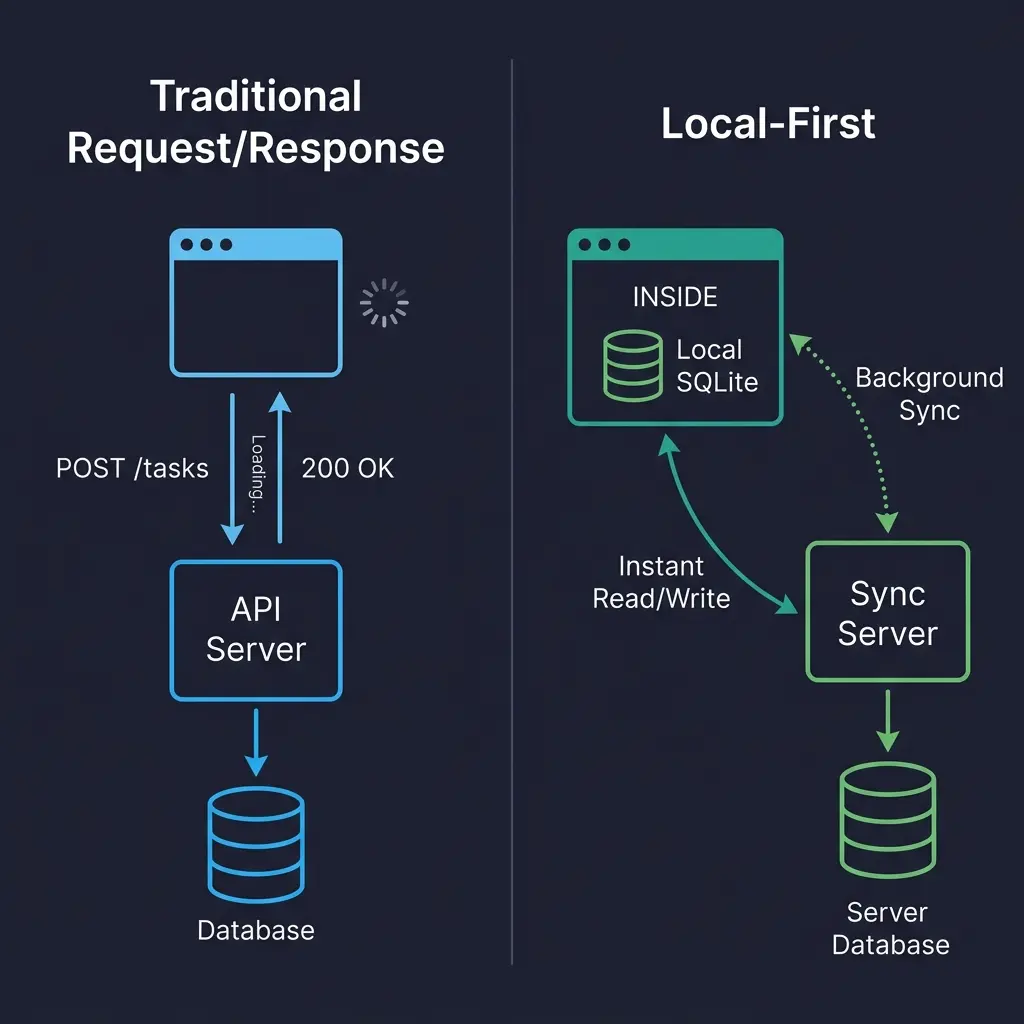
In a traditional web application, the client issues an HTTP request, awaits a server response, and renders a loading spinner. In a local-first system, the mental model mirrors Git: every client holds a fully functional replica of the relevant database subset. Writes occur locally against an embedded SQLite instance via WASM, guaranteeing instant user feedback. Background synchronization mechanisms quietly push local mutations and pull remote updates without blocking the main execution thread.
2. The Nuance of Conflict Resolution
When multiple clients modify identical records while offline, synchronization engines must reconcile the divergence. While CRDTs mathematically guarantee convergence for collaborative text editing (via libraries like Yjs), structured relational data often relies on field-level Last-Write-Wins (LWW) strategies backed by precise ISO timestamps and deterministic client ID tie-breakers.
However, structural merging does not prevent semantic conflicts—such as two users booking the same meeting room slot independently. Production systems must implement server-side validation layers during the sync write-back phase. Rather than outright rejecting invalid mutations (which triggers unrecoverable client-server divergence), robust architectures accept the mutation, flag the semantic violation, and surface non-blocking contextual resolution prompts to the end user.

3. The Security and Auth Dilemma
A common misconception among developers transitioning to local-first is that client-side security is sufficient. Because an attacker can inspect local SQLite files via browser developer tools, the client can never be treated as a trust boundary. Authorization must be strictly enforced at the sync ingestion layer—utilizing fine-grained sync rules or server-side row-level security (RLS) to ensure that clients only replicate data they are explicitly authorized to access.
Future Outlook: The Horizon of Distributed Web Architecture
As the software development community looks toward the latter half of the decade, the trajectory of local-first engineering points toward even deeper integration between client and server runtimes.
The convergence of local-first paradigms with Edge AI represents the next major frontier. With privacy regulations tightening globally, the ability to execute on-device machine learning models against local SQLite replicas—while syncing only encrypted metadata to cloud infrastructure—will become a major competitive advantage. Furthermore, as WASM ecosystems mature and database runtimes like PGlite continue to optimize their memory footprints, the artificial boundary separating client-side and server-side data layers will steadily dissolve.
Nevertheless, the industry faces an ongoing challenge regarding standardization and fragmentation. Unlike traditional HTTP or WebSocket protocols, the sync layer currently lacks a universal standard. Engineering teams must carefully architect their systems with abstraction layers to avoid vendor lock-in to specific proprietary sync engines.
Ultimately, local-first development is a powerful architectural evolution for the modern web—provided it is deployed with rigorous intent. As veteran engineers frequently remind development teams at industry roundtables: the best architecture is not the trendiest one, but the one your team can comfortably debug and maintain when a distributed edge failure occurs at 2:00 AM.
