


Executive Overview
In the summer of 2024, a pivotal working group of expert accessibility researchers assembled with a singular, urgent mandate: to establish the gold standard for conducting usability testing with individuals living with cognitive disabilities. Spearheaded by industry leaders—including representatives from accessibility platform Fable—this initiative sought to demystify a historically overlooked segment of digital consumers.
Cognitive disability serves as an umbrella term encompassing a variety of conditions that alter how the human brain processes, stores, and retrieves information, predominantly impacting memory, focus, and executive learning functions. According to the U.S. Centers for Disease Control and Prevention (CDC), cognitive disabilities represent the most prevalent class of disability in the United States, affecting roughly 13.9% of the population. Furthermore, landmark studies from Yale University indicate that this segment is expanding rapidly.
Despite this high prevalence, mainstream user experience (UX) testing has historically marginalized neurodivergent individuals and those facing cognitive barriers. To correct this imbalance, a groundbreaking empirical study was launched in collaboration with the University of California, Irvine. By pitting general population (gen pop) participants against cognitive accessibility testers across three distinct AI-generated web prototypes, researchers uncovered a transformative realization: participants with cognitive disabilities identified 1.8 times more usability issues and contributed 1.8 times more actionable design suggestions than their general population counterparts.
This comprehensive investigative report explores the chronological development of this study, its quantitative metrics, the qualitative impact of cognitive overload, and why integrating cognitive inclusion is no longer a peripheral compliance checkbox, but the ultimate catalyst for superior digital design.
Detailed Chronology: From Pilot Framework to Empirical Validation
The journey toward understanding how to effectively conduct user research with cognitive testers required a methodical, iterative approach. It began with the formation of the expert working group at Fable, where the author serves as VP of Innovation.
Phase 1: Establishing the Framework and Screener
To effectively engage this audience, the research collective established four core operational goals:
- Identify best practices for recruiting and interviewing cognitive testers safely and ethically.
- Formulate a specialized screening mechanism capable of accurately identifying individuals self-identifying with memory, attention, and learning hurdles.
- Establish quantitative surveying tools to measure qualitative digital experiences.
- Document and open-source these learnings for the broader UX community.
The team deployed a customized screener and conducted an exhaustive literature review of previous studies involving cognitive participants.
Phase 2: The Pilot Study
Following the design of the screener, researchers tested these newly minted methodologies on an initial cohort of 25 cognitive testers. This pilot phase served as an iterative testing ground. The team refined their interview guides, optimized survey protocols, and ultimately formulated a repeatable framework for running qualitative user interviews alongside quantitative digital product evaluations.
Phase 3: The UC Irvine Joint Study
Buoyed by the rich insights harvested during the pilot phase, researchers hypothesized that cognitive testers would unearth exponentially more functional and architectural flaws in websites than typical general population participants. To validate this hypothesis, a formal partnership was struck with researchers at the University of California, Irvine—including Syed Fatiul Huq, alongside Fable researchers Pranav Pidathala, Ali Brown, and Michael Fagan.
To ensure a rigorous test environment, three distinct web prototypes were generated using an AI prototyping tool, each featuring unique user goals, aesthetic architectures, and interaction paradigms:
- Strong Snacks: A bright, brutalist, image-heavy single-page style platform dedicated to three-ingredient, high-protein recipes, complete with categorization filters and a newsletter subscription workflow.
- Turning Pages: A moody, dark, classic digital bookstore featuring extensive genre filtering, an interactive book-swiping preference builder, complex custom book lists, and a full shopping cart and checkout pipeline.
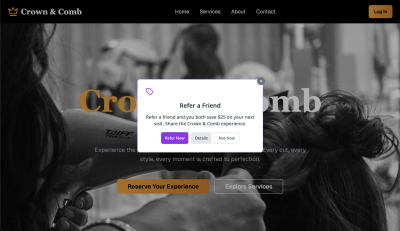
- Crown & Comb: A bold, high-contrast, black-and-white salon booking platform featuring intricate service packages, a VIP membership model, and an intentionally complex appointment scheduling workflow designed to test user patience and navigation stamina.
Supporting Context & Metrics: The Empirical Findings
The study executed 30 structured online user interviews—10 per website—with an exact 50/50 split between cognitive accessibility participants and general population participants. Every user session was recorded, transcribed, and audited using a strict coding methodology: every participant question, hesitation, missed task objective, and suggested remediation was logged as an individual "issue."
At the conclusion of their testing tasks, all participants completed the Accessible Usability Scale (AUS)—a validated, Creative Commons-licensed 10-question survey scoring digital product usability from 0 to 100.

Aggregate Performance Across All Sites
When the data across all three web properties was aggregated, the initial hypothesis was decisively confirmed:
- Total Issues Identified: Cognitive participants surfaced 197 usability issues, compared to just 113 issues raised by the general population group.
- Total Suggestions Provided: Cognitive participants offered 93 concrete recommendations for improvement, dwarfing the 54 suggestions put forward by general population testers.
- Issue-to-Suggestion Ratio: Across the board, cognitive participants proved 1.8 times more productive at diagnosing product friction points.
Granular Breakdown by Web Property
1. Strong Snacks (Simple & Brutalist)
Given its minimalist design, Strong Snacks yielded the lowest overall issue counts and highest median AUS scores. However, the disparity between cohorts remained stark.
- Gen Pop: 32 total issues (Average: 6.4), 13 suggestions (Average: 2.6), Average AUS: 90.5.
- Cognitive: 49 total issues (Average: 9.8), 24 suggestions (Average: 4.8), Average AUS: 76.8.
- Takeaway: Cognitive participants found 3.4 more issues on average and rated their overall experience nearly 14 points lower than the general public.
2. Turning Pages (Complex Bookstore & E-commerce)
Featuring multifaceted interactions and four distinct tasks, this site generated the highest volume of friction.
- Gen Pop: 55 total issues (Average: 11), 26 suggestions (Average: 5.2), Average AUS: 78.0.
- Cognitive: 86 total issues (Average: 17), 42 suggestions (Average: 8.4), Average AUS: 60.8.
- Takeaway: Cognitive participants uncovered 6 additional issues on average and scored the experience 17.2 points lower, struggling deeply with inconsistent button affordances and ambiguous content origins.
3. Crown & Comb (Intentional Complexity & Booking)
Designed deliberately to challenge users—particularly regarding task 3 (locating a hidden bridal package)—this site provoked fascinating psychological divergences.
- Gen Pop: 26 total issues (Average: 5), 15 suggestions (Average: 3), Average AUS: 49.5.
- Cognitive: 62 total issues (Average: 12), 27 suggestions (Average: 5.4), Average AUS: 63.8.
- Takeaway: While cognitive participants found 7 more issues on average, their overall AUS scores were surprisingly 14.3 points higher than the gen pop group. Researchers deduced that gen pop users experienced sharper drops in satisfaction when encountering broken interaction patterns, whereas cognitive users maintained a steadier, albeit heavily taxed, engagement level.
Qualitative Insights: The Human Toll of Cognitive Friction
Beyond quantitative metrics, the qualitative data paints a vivid picture of how digital architecture directly impacts the cognitive load, emotional well-being, and physical endurance of users.
When issues were categorized, cognitive participants flagged significantly higher volumes of problems tied to content clarity, button and link affordances, icon/visual element recognition, and media animations. Conversely, both groups performed nearly identically regarding traditional site navigation (45 vs 46 issues).

A revealing qualitative comparison emerged between the lowest-scoring participants on the Crown & Comb platform:
General Population Participant Quote:
"As soon as you have a name of a treatment and a little explanation and like the duration and the price, as soon as you click onto that, it should be that you can interact with that service straight away. And I feel like if you’re seeing a service repeated on a page multiple times and you’re still not able to select it, it’s really, really frustrating. This feels not particularly engaging."Cognitive Accessibility Participant Quote:
"For example, like, the mental energy aspect of it, like, sometimes there’s, like, okay, cookies, and then ads, pop-ups, or maybe the website or service has too many options to look through… I have to go through a lot of stuff. It makes me, like, feel drained and less able to focus."
While the general population participant expressed annoyance at broken UI patterns, the cognitive participant articulated a visceral, systemic depletion of mental energy. This distinction underscores a vital threshold in UX design: usability barriers graduate into true accessibility barriers the moment excessive cognitive load induces mental exhaustion, disorientation, and task abandonment.
Future Outlook: Why Cognitive Inclusion is the Next Frontier for Business Growth
As digital product development matures, the imperative to build for cognitive accessibility extends far beyond compliance or altruism—it is a critical economic driver.
The Aging Population Demographic Shift
According to U.S. Census Bureau projections, the demographic makeup of America is shifting dramatically. Adults aged 65 and older are projected to climb from 17% to 25% of the population, meaning 1 in 4 Americans will be an older adult by 2060. This developmental stage naturally introduces varying degrees of cognitive decline, memory adjustment, and focus management. Companies that fail to design for cognitive ease today will find themselves structurally unequipped for the largest consumer demographic of tomorrow.
The Business Case: Loyalty, Retention, and Revenue
General population users often "muddle through" poorly designed digital interfaces, completing tasks despite friction. However, in hyper-competitive digital marketplaces, friction breeds abandonment. When a seamless competitor emerges, frustrated users migrate instantly. By listening to cognitive accessibility testers, product teams uncover foundational design debt—unpredictable button interactions, hidden calls-to-action, and overwhelming visual noise—that erodes trust and drains conversion funnels.
As a UX manager at Bell Media famously noted:
"2 sessions with cognitive users feel like 200 because of the volume of insights we get."
Starting Your Cognitive Inclusion Journey
UX teams seeking to modernize their research methodologies should treat cognitive accessibility as the ideal on-ramp into broader inclusive design. While testing with screen reader and alternative navigation users remains vital, engineering teams often face steep learning curves. Focusing initially on cognitive load, content predictability, and visual clarity establishes a robust foundation that simplifies subsequent advanced accessibility work.
Cognitive inclusion in UX research is no longer optional. It is the definitive methodology for maximizing research efficiency, writing clearer copy, streamlining conversion pathways, and shipping products that genuinely serve every human mind.