

Executive Overview
In the rapidly expanding frontier of quantum information science, microscopic imperfections within otherwise pristine crystal lattices have emerged as foundational building blocks. Known as spin defects—such as those found in diamond and silicon carbide—these tiny atomic anomalies possess the remarkable ability to function as stable qubits. Their quantum states can be meticulously controlled, manipulated, and read, making them extraordinarily promising for the development of next-generation quantum sensors, secure communication networks, and advanced quantum computers.
However, fully harnessing the capabilities of spin defects has long been throttled by a fundamental theoretical bottleneck: scientists have struggled to accurately predict and model how these defects dynamically change their energy states over time when illuminated by light.
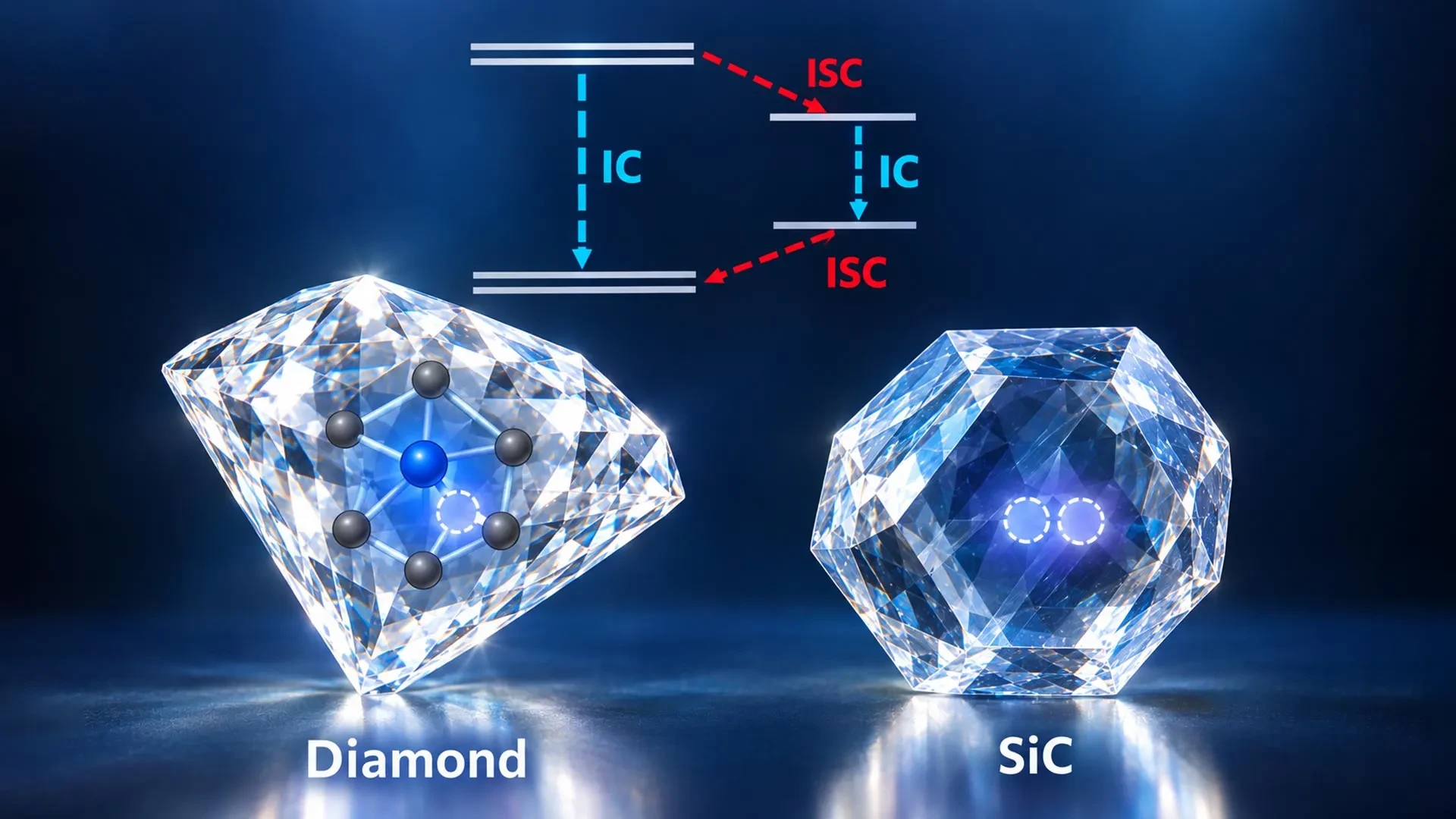
Addressing this critical gap, a team of researchers at the University of Chicago Pritzker School of Molecular Engineering (UChicago PME) has successfully developed a pioneering computational method. This innovative framework provides a holistic, end-to-end picture of the complex physiological and quantum mechanical processes that occur when spin defects interact with light. Published in the prestigious journal Physical Review Letters, the breakthrough centers on the ability to simulate the entire optical cycle of a defect, including a notoriously difficult-to-model phenomenon known as internal conversion—the process by which a photo-excited system sheds its energy via atomic vibrations rather than light emission.
Beyond refining our understanding of quantum computing hardware, this computational tour de force has profound implications for renewable energy conversion and storage technologies. Because internal conversion dictates how energy is transferred or lost across a vast array of condensed matter systems, the UChicago methodology delivers a missing piece of a decades-long puzzle in materials science. Integrated into the open-source GPU-accelerated simulation software WEST, the framework is now accessible to the global scientific community, signaling a paradigm shift in how researchers design, test, and deploy quantum and energy materials.
Detailed Chronology: The Road to a Breakthrough
The realization of this computational milestone was neither accidental nor instantaneous; it represents the culmination of years of persistent theoretical inquiry, mathematical refinement, and high-performance computing development led by senior author Giulia Galli and her research group.
Years of Foundation-Building
For over a decade, the research group centered around Giulia Galli—the Liew Family Professor of Electronic Structure and Simulations in UChicago PME and the Department of Chemistry—has worked to untangle the intricate optical cycles of spin defects. Working within the Midwest Integrated Center for Computational Materials (MICCoM), a consortium backed by the U.S. Department of Energy’s Office of Basic Energy Sciences since 2015, the team dedicated years to writing, optimizing, and scaling advanced simulation algorithms.
The primary hurdle historically blocking progress was the sheer mathematical complexity of internal conversion. When a laser pulse excites a spin defect, the system must eventually return to its baseline, lower-energy ground state. It can achieve this via three primary pathways:
- Radiative decay, where the system releases a photon of light.
- Inter-system crossing, where it transitions between states possessing different electron spins.
- Non-radiative decay (internal conversion), where the electron’s excitation energy is dumped directly into the vibrational modes—the physical jiggling and thermal motions—of the surrounding atomic lattice.
While quantum mechanics equations could easily handle radiative and spin-transition pathways, calculating the energy lost through atomic lattice vibrations presented massive computational obstacles. Describing realistic solid-state environments—which often require models containing hundreds or thousands of explicit atoms—meant factoring in the deeply complex, multi-body interactions between localized electrons and a sea of vibrating neighboring nuclei.
The Convergence of Theory and Algorithm
The turning point came when Galli, postdoctoral researcher Stefano Villani, and Yu Jin (then a graduate student in Galli’s group, now a postdoctoral scholar at the Flatiron Institute in New York) successfully integrated several disparate computational methodologies developed across their tenure.
Instead of treating the surrounding atomic configurations individually—an approach that quickly drains computational resources—the researchers leveraged sophisticated mathematical constructs known as many-body wavefunctions to represent the excited states of the defects. Through rigorous, exact mathematical derivations, the team mapped out precisely how strongly each distinct electronic excited state couples with the collective movements of nearby atoms.
This breakthrough mathematical bridge allowed the researchers to connect individual electronic states directly to the complete spectrum of vibrational configurations across hundreds of surrounding atoms. The algorithms bypass brute-force estimations, delivering unprecedented analytical precision without sacrificing scale.
Integration into WEST
To ensure the fruit of their theoretical labor could be practically deployed, the team embedded their newly derived framework directly into WEST (Without Empty States), an open-source simulation package heavily optimized for graphics processing units (GPUs). WEST has been a focal point of Galli’s laboratory through MICCoM, engineered precisely to handle the heavy lifting of modern quantum materials simulations. With the code updated and publicly released, the theoretical models transitioned into actionable, high-performance computational tools capable of tackling real-world materials chemistry.
Supporting Context & Metrics
To rigorously test the newly forged computational machinery, the UChicago PME team applied their framework to two classic, highly scrutinized crystalline systems: nitrogen-vacancy (NV) centers in diamond and divacancy defects in silicon carbide. The results yielded both expected confirmations and shocking revisions to established scientific doctrine.
The Diamond Benchmark
Initially, the researchers focused on the nitrogen-vacancy center in diamond, a heavily studied crystal defect celebrated for its utility in quantum sensing and magnetometry. When run through the WEST framework, the computational predictions aligned with remarkable accuracy alongside recent advanced spectroscopy measurements.
Specifically, the model revealed that for triplet states in the diamond NV center, internal conversion played a relatively minor role in overall energy dissipation. Conversely, for singlet states, internal conversion emerged as the absolute primary mechanism responsible for shedding energy. Both conclusions matched long-held theoretical expectations within the physics community, serving as a powerful validation of the framework’s baseline accuracy.
The Silicon Carbide Revelation
Buoyed by their success with diamond, the team turned their attention to a more complex and elusive system: the divacancy defect in silicon carbide (SiC), a wide-bandgap semiconductor gaining intense traction in power electronics and quantum photonics.
Here, the calculations delivered a genuine surprise. Previous theoretical models had assumed that internal conversion played a negligible or secondary role in the lifespan of the divacancy’s excited triplet state. However, the UChicago framework proved that internal conversion exerts a far more profound, dominant influence on the excited state’s lifetime than earlier equations accounted for.
This previously underestimated energy-loss pathway neatly resolved a persistent, frustrating discrepancy that had long baffled researchers: a stubborn mismatch between theoretical predictions and real-world experimental observations. By quantifying the true magnitude of internal conversion in silicon carbide, the team provided the missing explanatory link required to reconcile theory with empirical reality.
Official Statements
The implications of this work extend far beyond the immediate academic community, touching upon fundamental questions in quantum mechanics, solid-state physics, and renewable energy engineering.
Reflecting on the broad utility of the breakthrough, senior author Giulia Galli emphasized its interdisciplinary resonance:
"This internal conversion process is not only relevant to spin defects—it’s also related to processes of interest to energy technologies. That’s one of the reasons this work is so exciting. We provided the missing piece of the puzzle needed to completely describe the optical cycle of spin defects."
Detailing the agonizing complexity that kept this problem unsolved for decades, lead author Stefano Villani noted:
"Although the equations are known, it’s hard to describe the process accurately because of computational difficulties. You need to account for complex interactions between the electrons and surrounding atoms, and that’s challenging in realistic solids represented by models with hundreds or thousands of atoms."
Highlighting the novelty of the mathematical derivation itself, co-author Yu Jin remarked:
"In the past, a clear mathematical derivation and efficient algorithms were not available. The new derivation came together after years of work on the optical cycle of spin defects. Our work can now be used to make more accurate predictions about many materials of interest for quantum technologies."
Future Outlook & Next Steps
With the theoretical framework now fully operational and distributed via the WEST software suite, the quantum engineering community stands on the cusp of a new predictive era. Researchers worldwide can now simulate the complex optical dynamics of spin defects with a fidelity previously thought impossible.
Nevertheless, the computational journey is far from complete. Galli and her team acknowledge that accurately simulating many-body quantum interactions in solid-state lattices remains an intensely resource-heavy endeavor, demanding substantial high-performance computing infrastructure. To democratize access and streamline workflows further, the UChicago PME lab is already actively investigating ways to merge their physics-based models with artificial intelligence.
"We are working on ways to integrate machine learning into excited states calculations to further improve the efficiency of our method," Villani explained, outlining the team’s immediate developmental roadmap.
Simultaneously, the researchers are expanding the scope of their framework beyond diamond and silicon carbide. Current projects are setting their sights on mapping spin defects in ultra-pure silicon—a material holding massive promise for scalable semiconductor-based quantum computing—as well as specialized chemical compounds utilized in solar energy conversion and advanced battery storage.
By lifting the computational fog that has obscured internal conversion for generations, the UChicago PME team has done more than just solve a physics problem. They have provided the global scientific community with a sharpened lens, one that brings the quantum landscape into razor-sharp focus and paves the way for the robust technologies of tomorrow.