

Executive Overview
In the high-stakes world of digital marketing, relying on manual spreadsheets to monitor organic visibility is a relic of a bygone era. Modern Search Engine Optimization (SEO) demands real-time data granularity, precise geographical tracking down to the zip-code level, and the ability to measure performance across dynamic, AI-infused search engine results pages (SERPs). As the digital landscape evolves toward 2025, understanding how your web properties, competitors, and specific SERP features move across multiple search engines is no longer optional—it is a core business requirement.
Whether you are managing a boutique local storefront or directing enterprise SEO strategy for a Fortune 500 brand, the right SERP tracking software acts as the compass for your digital investments. This comprehensive review examines why these tools are indispensable, outlines the nine critical features you must demand from your software vendor, and evaluates the seven best SERP tracking tools on the market today. By dissecting both standalone tracking platforms and robust all-in-one SEO suites, this guide provides the analytical depth needed to make an informed, ROI-driven software investment.

Detailed Chronology: The Evolution of Rank Tracking
To fully appreciate the sophistication of modern SERP tracking tools, it is vital to trace how the industry has transformed over the past decade.
- The Early Era of Basic Scraping (Pre-2015): In the nascent days of SEO software, rank trackers were rudimentary desktop applications or basic cloud scrapers. They offered sporadic weekly updates, suffered from high rates of IP blocking by search engines, and lacked the capacity to process massive keyword volumes or complex local variations.
- The Shift to Cloud-Based Automation (2015–2020): As JavaScript-heavy web architectures and personalized search results took over, tracking tools migrated entirely to cloud infrastructures. Providers introduced automated daily updates, initial integrations with Google Analytics, and rudimentary mobile versus desktop segmentation.
- The Rise of Complex SERP Features (2020–2023): Google’s layout transformed drastically with the introduction of Knowledge Cards, People Also Ask (PAA) boxes, Video Carousels, and Featured Snippets. Trackers had to evolve beyond simple vertical lists to capture "Position #0" dynamics and feature volatility.
- The AI Overview and Real-Time Era (2024–2025): Today, search engines are dominated by generative AI integrations, such as Google’s AI Overviews. Modern SERP tracking tools have matured into sophisticated analytics hubs capable of on-demand data refreshing, deep attribution modeling, and integration with advanced marketing data warehouses.
Supporting Context & Metrics: Why Invest in SERP Software?
Investing in enterprise-grade SERP tracking software is fundamentally about risk mitigation and proving accountability. Without granular data, digital marketing budgets are vulnerable to budget cuts and misdirected strategies.

According to industry benchmarks, organizations that leverage daily, automated rank tracking alongside conversion attribution are able to identify traffic dips 40% faster than those relying on weekly or monthly manual checks. Furthermore, modern SERP trackers allow digital marketers to:
- Validate SEO expenditures by establishing a direct correlation between rank improvements and bottom-line revenue.
- Monitor Share of Voice (SoV) across thousands of keywords to gauge real market dominance against direct competitors.
- Isolate localized ranking anomalies to optimize hyper-local brick-and-mortar campaigns.
- Detect sudden algorithm updates or penalties instantaneously, reducing recovery times.
The 9 Essential Features to Look for in SERP Tracking Software
When evaluating solutions for your organization, ensure the platform delivers on these nine non-negotiable criteria:

1. Accurate, On-Demand Ranking Updates
SERP positions fluctuate rapidly throughout the day. Waiting days for scheduled updates leaves your team blind during algorithm updates. Look for tools that offer automated 24-hour refreshes alongside on-demand, single-click data updates. Platforms like AccuRanker set the standard here by letting users instantly pull fresh ranking data on command.
2. Comprehensive SERP Feature Monitoring
Securing a traditional top-three ranking is only half the battle. You need visibility into AI Overviews, Featured Snippets, local map packs, and video carousels. Top-tier tools track over 50 distinct SERP features, illuminating precisely which keywords trigger these opportunities and how to steal them from competitors.

3. Multi-Engine Support
While Google dominates global search market share, specialized campaigns often require monitoring alternative engines such as Bing, Baidu, Yandex, and YouTube—particularly for international or regional e-commerce campaigns.
4. Granular Geographic and Device Segmentation
A truly effective SERP tracker must offer macro-level dashboards alongside micro-level capabilities. You should be able to segment data by country, state, city, or even zip code, while seamlessly toggling between desktop and mobile rankings.

5. Attribution to Traffic and Revenue
Rankings alone do not pay the bills. The best tools integrate natively with Google Analytics, Adobe Analytics, or business intelligence tools to combine keyword positions, search volume, and Share of Voice with downstream metrics like bounce rates, page load times, and conversion revenue.
6. Robust Historical Data Analysis
Point-in-time metrics offer a narrow view. Comprehensive rank trackers store deep historical archives, allowing SEO professionals to analyze multi-year ranking trends, evaluate seasonal fluctuations, and measure long-term campaign velocity.

7. Advanced Competitor Benchmarking
Because search results are zero-sum games, tracking your competitors’ gains and losses is vital. Look for software that categorizes keywords into logical performance buckets (e.g., positions 1–3, 4–10, 11–50) to instantly spot emerging competitive threats.
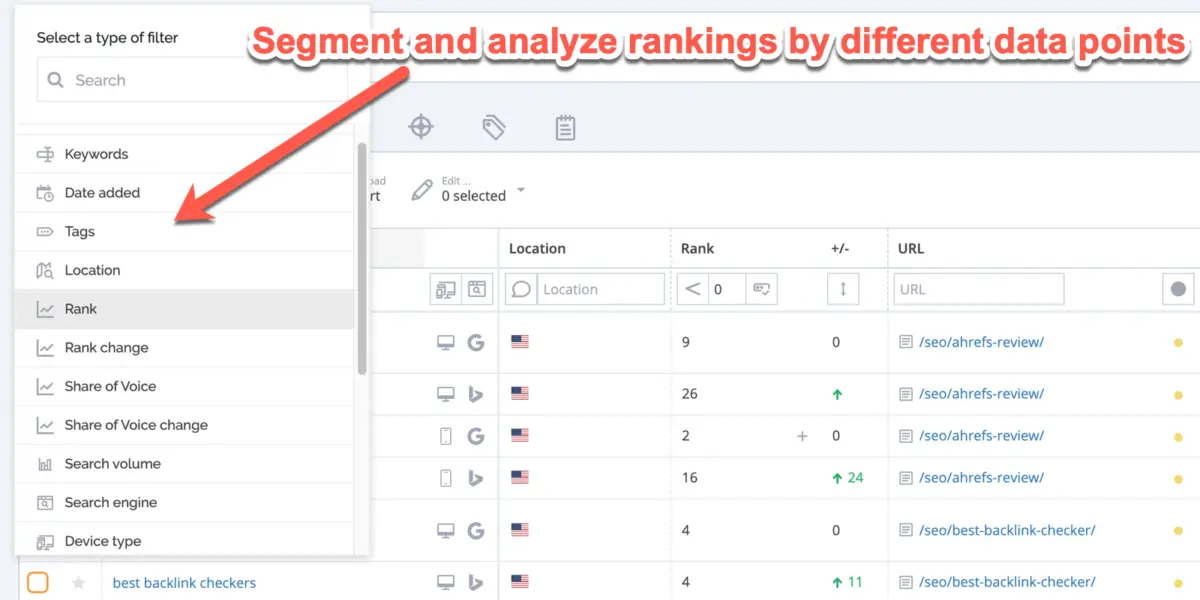
8. Custom Tagging and Data Segmentation
Not all keywords hold equal business value. Advanced tagging systems allow you to group keywords by buyer persona, sales funnel stage, product category, or content asset type, facilitating targeted performance reviews.

9. White-Label Reporting and Integrations
For agencies and enterprise teams, client-facing and stakeholder reporting must be streamlined. Native white-label PDF reports and robust API connectors for tools like Google Looker Studio and Databox ensure your data is always presented clearly and professionally.
Official Statements & Expert Insights
Industry leaders continually emphasize the necessity of integrating advanced tracking with visualization dashboards.

"The thing that really got me using them heavily in the last month or two is their Google Data Studio connector. Combining the tag feature, as well as the Share of Voice metric… has been a big help in making these reports immediately digestible."
— Ian Howells, Co-Founder, Traffic Think Tank
Similarly, enterprise SEO veterans note the impact of streamlined dashboards:

"It’s by far the best keyword ranking tracker in the market and has a ton of great reporting functions. If you want visibility on large volumes of keywords housed within a nice dashboard—this is for you."
— Matthew Howells-Barby, Co-Founder, Traffic Think Tank
The 7 Best SERP Tracking Tools to Consider
The market is saturated with options, but the following seven platforms represent the absolute pinnacle of standalone trackers and all-in-one SEO suites.

1. AccuRanker (Best Dedicated SERP Tracker)
AccuRanker is widely regarded as the premier standalone SERP tracking platform. Trusted by over 32,000 companies—including enterprise giants like HubSpot, IKEA, and Kinsta—it delivers lightning-fast, highly accurate data.
- Best Features: On-demand ranking refreshes, deep Share of Voice analytics, comprehensive SERP feature tracking across 50+ elements, and seamless Google Analytics integration.
- Who it’s for: SEO agencies, consultants, and enterprise brands that demand real-time data accuracy and advanced API capabilities.
- Pricing: Starts at $116/month for up to 1,000 tracked keywords.
2. Semrush Position Tracker and SERP Gap Analyzer (Best All-in-One Suite)
As an all-in-one digital marketing powerhouse utilized by over 10 million users (including Samsung and Booking.com), Semrush offers a Position Tracking tool that rivals any standalone product.

- Best Features: Hyper-accurate daily tracking from international to zip-code levels, extensive mobile/desktop comparisons, and the innovative SERP Gap Analyzer app which scans search results to uncover under-optimized content and low-hanging fruit.
- Who it’s for: Marketing professionals, e-commerce brands, and agencies looking for an expansive, all-encompassing SEO toolkit.
- Pricing: Subscription plans start at $139.95/month.
3. ProRankTracker (Best Scalable Value Tracker)
ProRankTracker serves over 60,000 customers with a robust, cost-effective standalone architecture designed for high-volume monitoring across multiple search engines and video platforms.
- Best Features: Extensive multi-language support, accurate localized tracking, and sophisticated client reporting suites.
- Who it’s for: SEM agencies, international companies, and video marketers needing multi-device insights.
- Pricing: Plans start at an accessible $39/month.
4. Advanced Web Ranking – AWR (Best for Enterprise Customization)
Advanced Web Ranking is a veteran standalone tracker utilized by enterprise brands and tech giants like Microsoft. It is celebrated for its customizable reporting infrastructure and robust data handling.

- Best Features: Flexible cloud deployment, deep competitor intelligence, and fully customizable white-label reporting.
- Who it’s for: In-house marketing teams and large enterprises requiring tailored reporting workflows.
- Pricing: Subscription plans start at $99/month.
5. SERPWatcher by Mangools (Best for Simplicity & Usability)
Developed by Mangools, SERPWatcher is an intuitive, visually striking rank tracker trusted by brands like Airbnb and Adidas. Its proprietary "Performance Index" metric instantly communicates organic traffic potential.
- Best Features: Simplified user interface, automated alert triggers for significant rank movements, and bundled access to complementary tools like SERPChecker.
- Who it’s for: Small business owners, startups, and freelancers who prefer streamlined, user-friendly SEO tools.
- Pricing: Starts at $29.90/month.
6. SE Ranking (Best Hybrid Platform)
SE Ranking is a comprehensive, feature-rich all-in-one SEO platform. Its Position Tracking tool simulates user behavior precisely within target locations to ensure 100% data fidelity.

- Best Features: Localized search simulation, comprehensive historical data storage, and professional-grade white-label reporting.
- Who it’s for: Digital agencies and SMBs seeking high accuracy within a multi-tool ecosystem.
- Pricing: Starts at $52/month for daily updates on 500 keywords.
7. Nightwatch (Best for Global Scale & Flexibility)
Trusted by enterprise titans like Shopify and Coinbase, Nightwatch provides access to search engine rankings across more than 107,000 locations worldwide, making it exceptionally powerful for global brand management.
- Best Features: Advanced segmentation, custom data filtering, and unparalleled global location coverage.
- Who it’s for: Organizations of all scales, from agile freelancers to massive international enterprises.
- Pricing: Starts at $32/month for up to 250 keywords, backed by a 14-day free trial.
Future Outlook
Looking ahead past 2025, the trajectory of SERP tracking points squarely toward deeper AI integration, predictive ranking analytics, and automated content optimization loops. As search engine layouts continue to fragment under the weight of generative search features, static rank tracking will become entirely obsolete.

Marketers must shift away from merely watching vanity ranking numbers and instead embrace platforms that offer holistic visibility—connecting keyword positions directly to user intent, engagement metrics, and revenue generation. Whether you opt for a specialized standalone tracker like AccuRanker or an expansive ecosystem like Semrush, equipping your team with real-time, granular SERP data will remain the ultimate catalyst for sustainable organic growth.